What it does
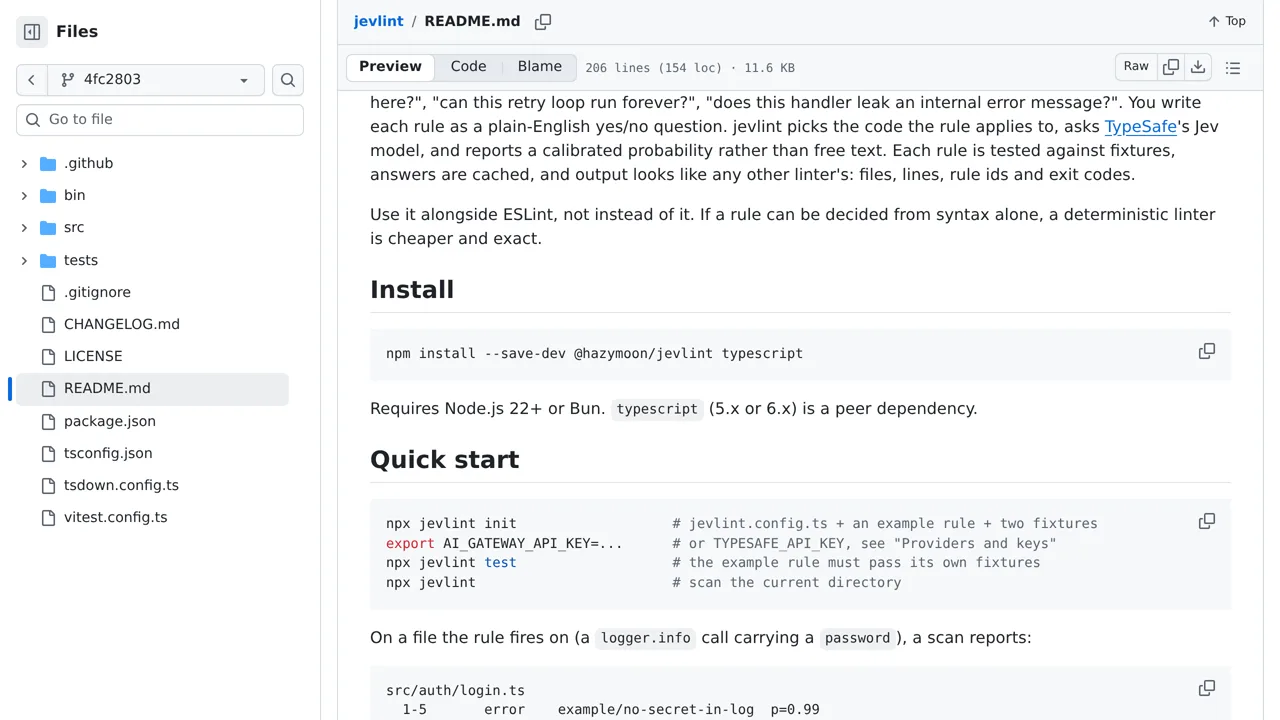
Rules are tested against fixtures, answers are cached, and output looks like any other linter's — files, lines, rule ids, and exit codes — so it runs alongside ESLint rather than instead of it.
Agent tooling
Semantic lint rules written as plain-English yes-or-no questions, with Jev returning a calibrated probability instead of free text.
Only you can see your notes.
Screenshot unavailable. Open the experiment ↗
Rules are tested against fixtures, answers are cached, and output looks like any other linter's — files, lines, rule ids, and exit codes — so it runs alongside ESLint rather than instead of it.
Start by writing down review questions about your code in simple words. For example, ask whether a file saves user passwords in text logs or repeats a task endlessly. Collect pairs of small code samples that show clear mistakes and safe examples.
Your developer can set up the tool and connect it using an access key from TypeSafe, the external service that evaluates each question. Remember that your code files travel across the internet to this service, and a passing answer is not a guarantee that code is secure.