JevMade

Sign in
← Back to experiments

Apps & data pipelines

OntoSmith

OntoSmith builds a knowledge graph in Neo4j under an ontology you approve first: a cheap model proposes facts, and Jev checks each one against the passage it came from before anything is written to the graph.

Bookmark: OntoSmith Keep this in your collection.
Leave a noteWhat would you try with this? : OntoSmith

Only you can see your notes.

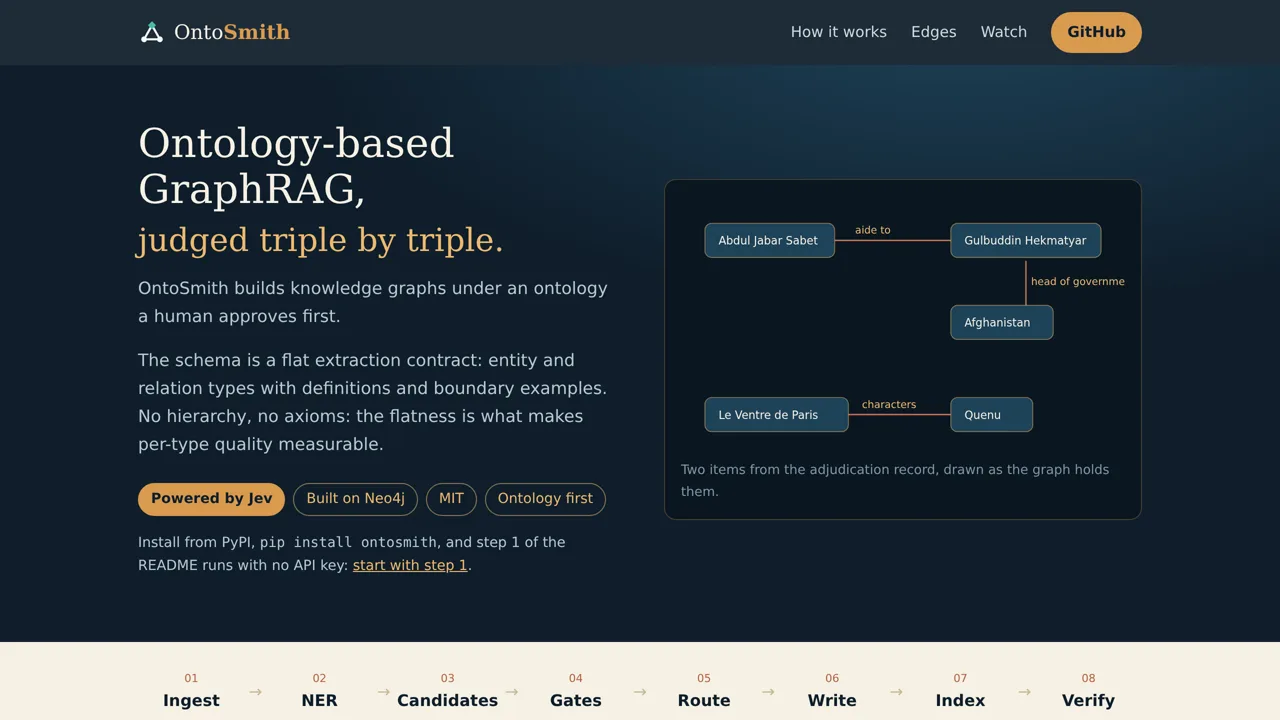
Source screenshot of OntoSmith
SOURCE SCREENSHOTFull screenshot ↗

What it does

Dongbum Lee splits the work into seats. Claude Haiku 5.5 proposes triples in the reference setup, Jev marks each one verified or sends it to a review band, and an optional Claude Sonnet 5.5 escalation seat, off by default, takes hard calls. His own figures, repeated in a Connected Data London post, include 3.8 cents per document over 500 documents and a graph precision of 0.911 after re-auditing with a judge from another model family.

How you can use it

You can have a developer borrow this design to turn long texts into a searchable web of facts. You first approve a simple list of allowed entity types and relationships. A cheaper AI proposes facts from each passage, and an outside AI judge verifies each fact against the original text before saving it.

To test the tool, your developer needs a running Neo4j database and an access key that connects to the AI models. The author found this graph method improved recall on long contracts, but not on short article abstracts. An AI judge can still make mistakes, so unverified claims get placed into a separate review pile.
Maker-reported (not independently measured by JevMade)

Author-reported, via the Connected Data post: 3.8 cents per document across 500 documents in the flagship build; about 7 cents per document projected for judging alone in the default configuration. · Corrected graph precision 0.911 [0.892–0.928], revised down after a re-audit by a judge from a different model family. · Graphs added +0.080 recall@20 (0.631 → 0.712) on a pinned 116-question set over long contracts, and zero on short abstracts. · Eight-stage pipeline (ingest, NER, candidates, gates, route, write, index, verify) into Neo4j, with lexical, graph and vector search. · Ontology packs for open-domain text, legal contracts, biomedical literature and imported FIBO contracts: flat, versioned and hash-pinned over a domain-neutral core. For a new document type it drafts one for approval. · Lesson from the build: a decision model on default parameters is "someone else's operating point", so thresholds were fitted stage by stage.

Primitives
Not stated
Platform
Python (PyPI) + Neo4j
Added
Project created
GitHub stars
58 (snapshot, not live)

Keep this for later

Sign in to bookmark experiments, guides and videos, and keep notes only you can see.

Continue to sign in

We’ll bring you back to this listing.