Read & learn
Written guides.
Understand Jev, one idea at a time. Walkthroughs, recipes, and writeups — our notes first, the original next.
A public registry · independent & community-run
Learn, build, and play with Jev — from deep technical guides to creative experiments.
Read & learn
Understand Jev, one idea at a time. Walkthroughs, recipes, and writeups — our notes first, the original next.
Watch & learn
See an idea take shape. Tutorials, demos, and deep dives, organized by topic and credited to their creators.
Make & explore
See what builders made with Jev. Games, tools, repositories, articles, and more — traced to their sources.
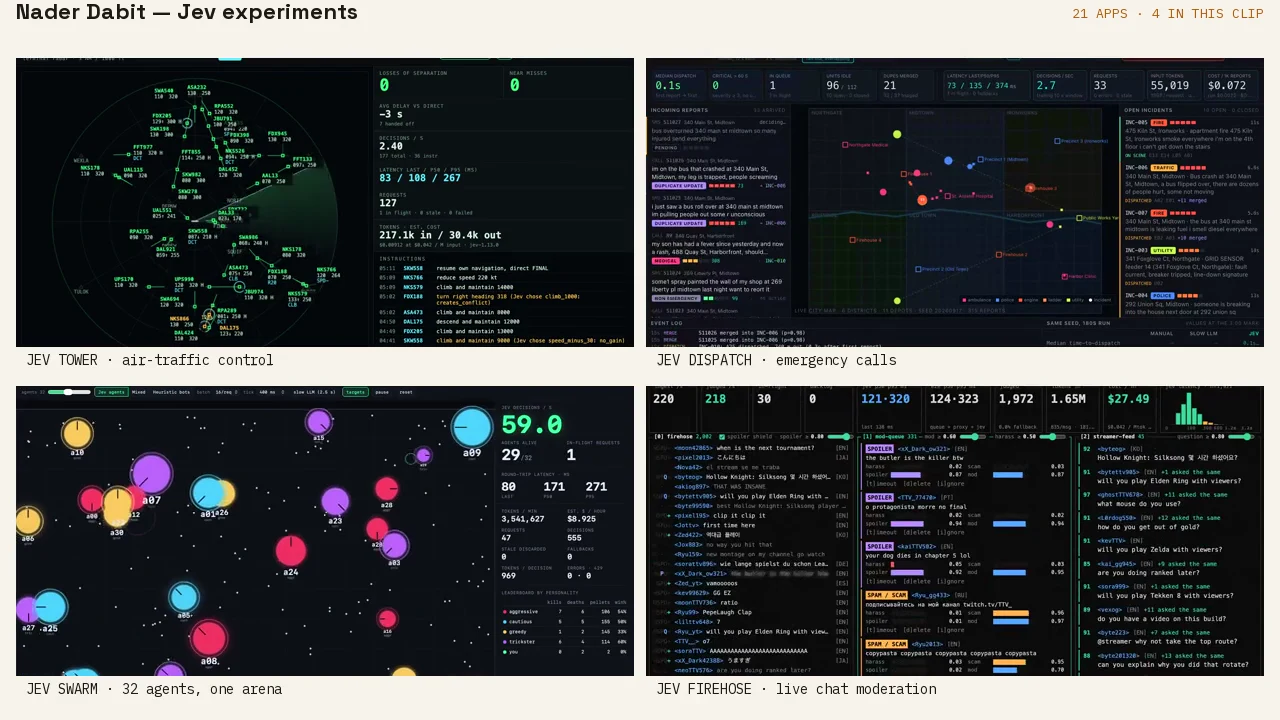
Every category, from games and tools to repositories and writeups, traced to a primary source.
Same ideas.
Different paths.
This is the full registry, not just the featured picks. Figures like speed, cost, and stars are maker-reported or captured snapshots, not JevMade measurements.
1613 experiments · showing 1201–1260
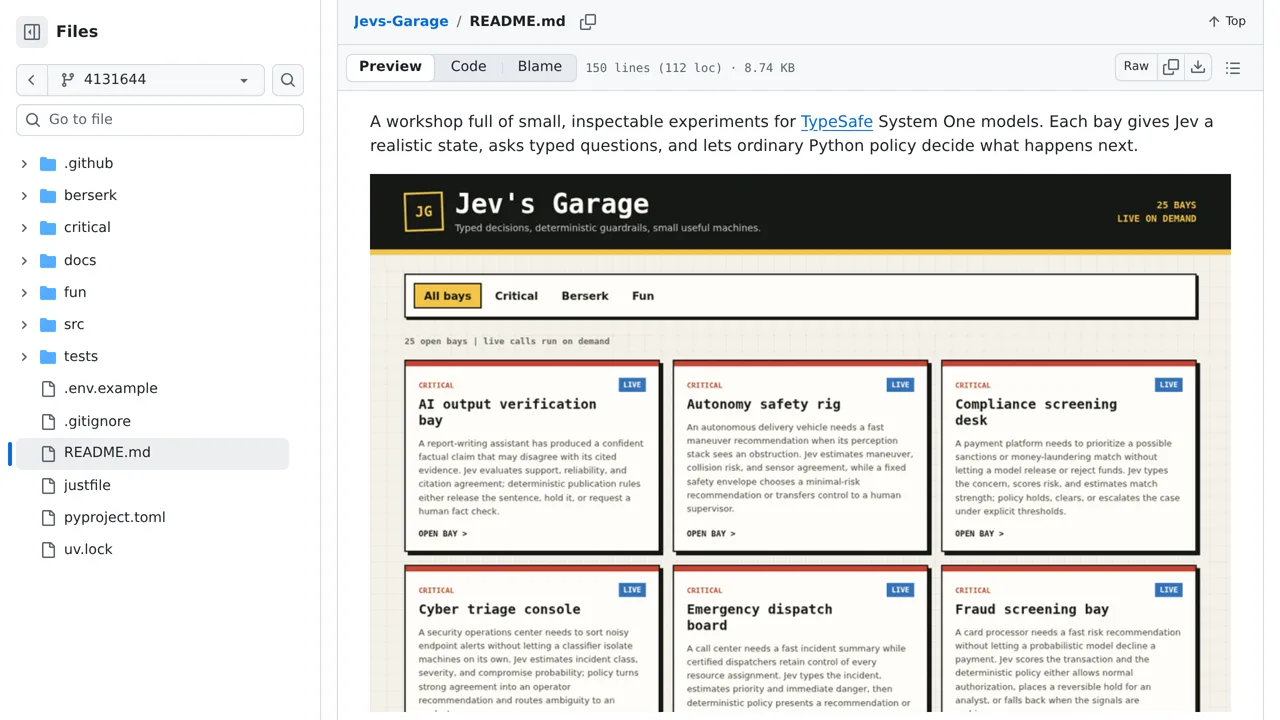
A garage of small inspectable demos where Jev supplies the judgment — fraud screening, cyber triage, medical routing, emergency dispatch — and plain Python policy decides what to do.
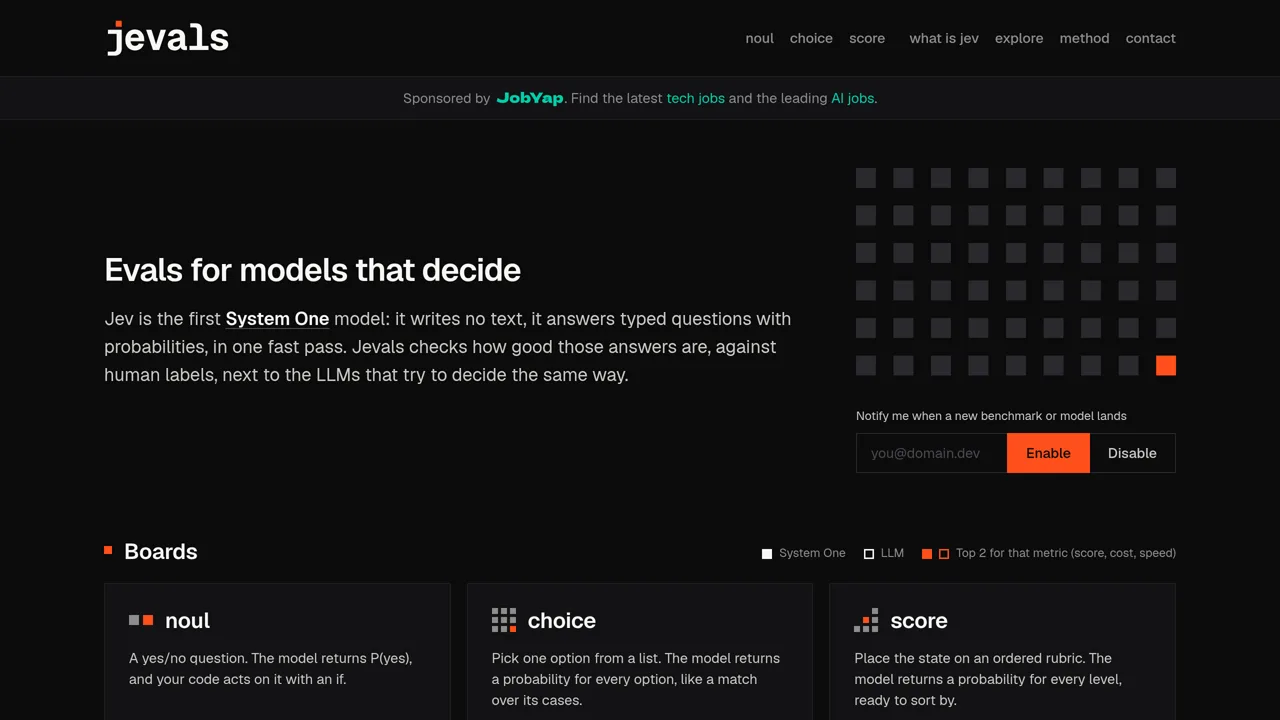
The open data behind an independent benchmark that puts Jev and six LLMs through the same typed questions on PubMedQA, Banking77 and HelpSteer2.
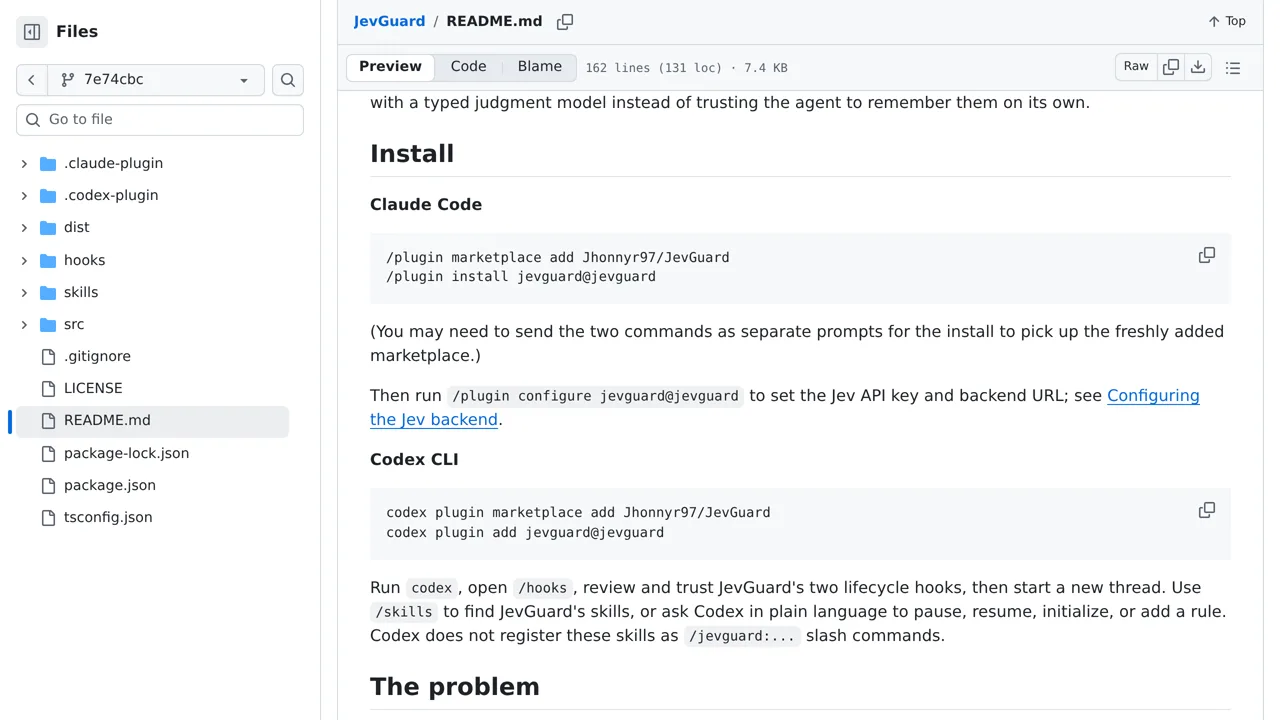
A Claude Code and Codex plugin that checks each tool call and final answer against the project's own rules with a System One model.
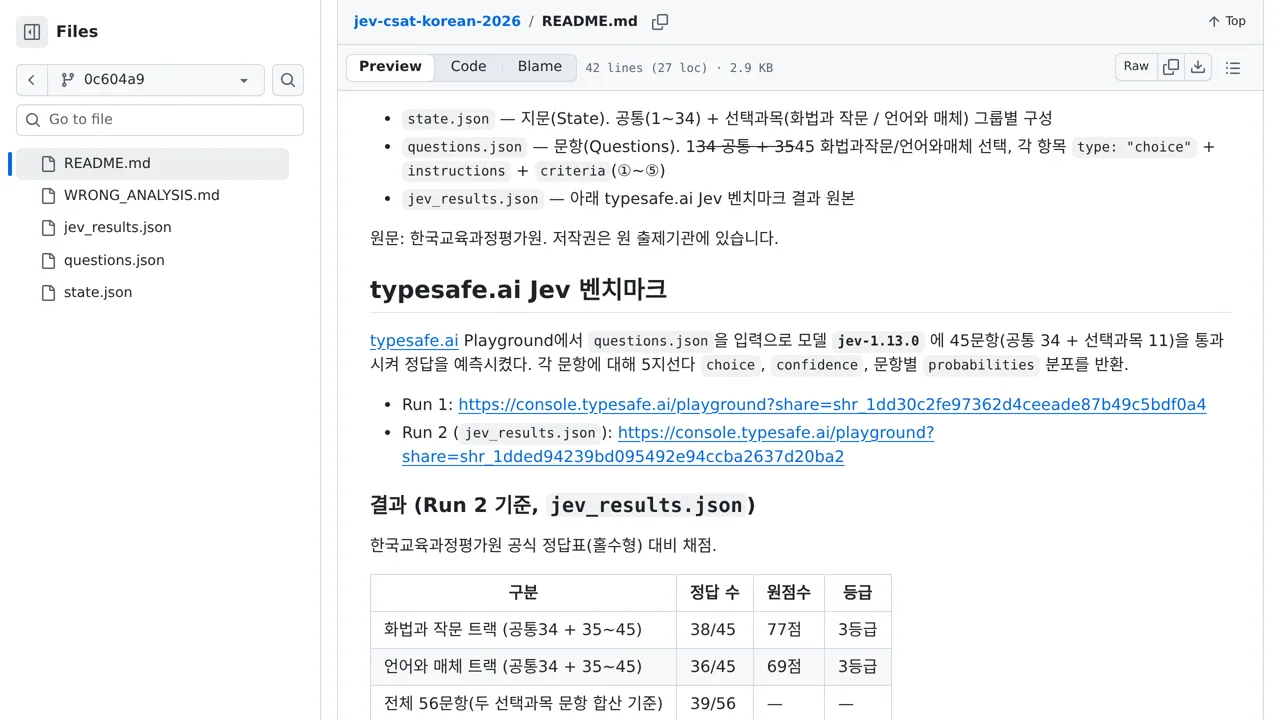
The 2026 Korean CSAT Korean-language paper turned into a JSON state and typed choice questions, with Jev's answers, probabilities and error analysis kept alongside.
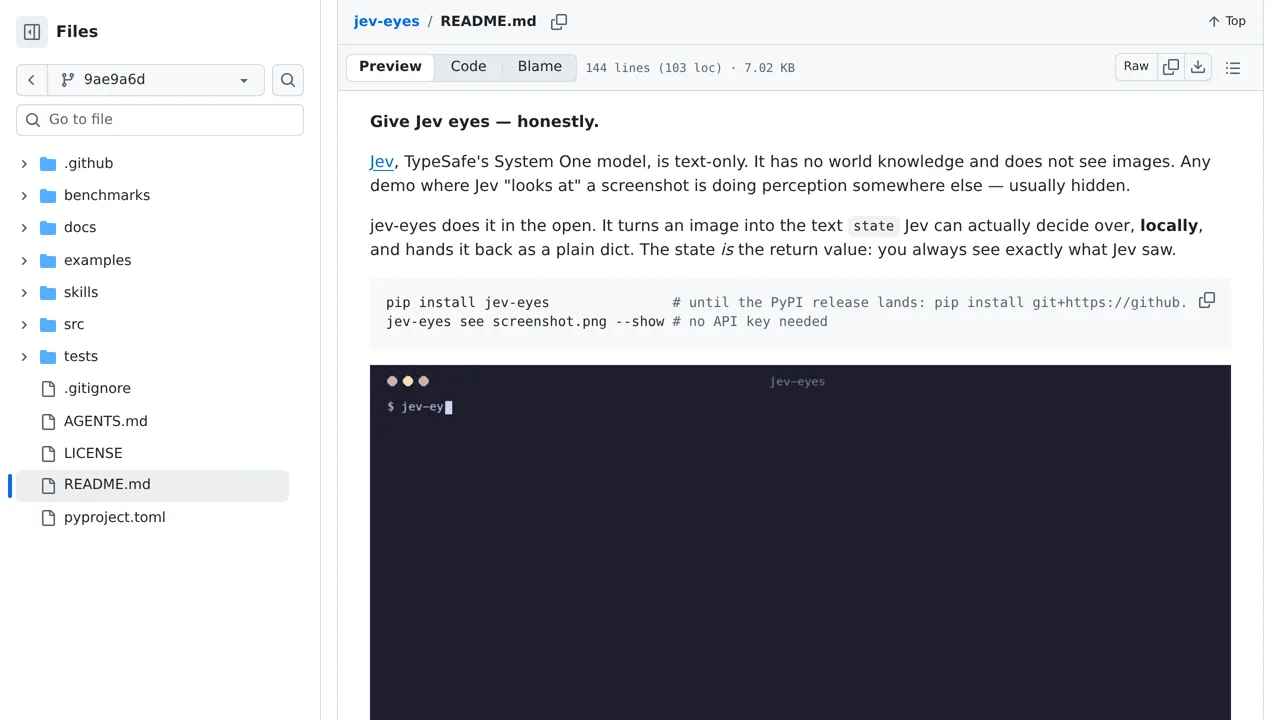
Turns an image into the text state Jev can judge — local OCR in reading order plus a character-grid layout map — and returns exactly what the model will see.
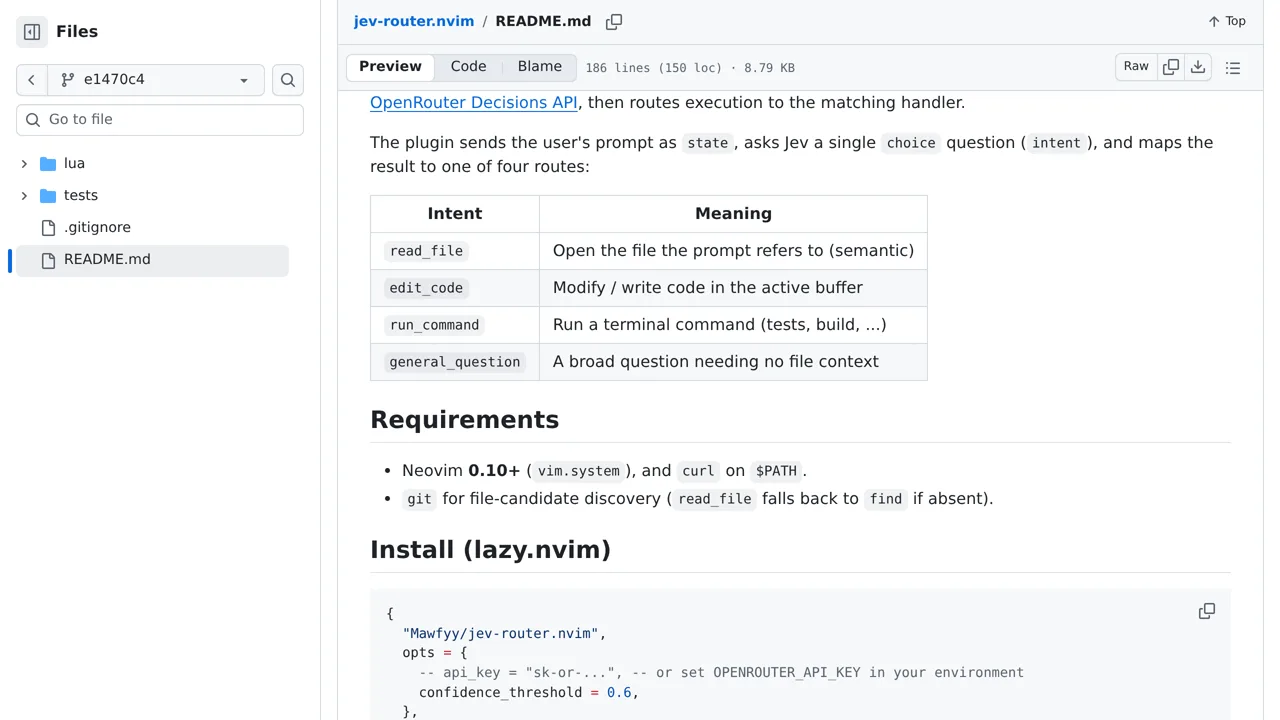
A Neovim intent router that sends your prompt to Jev as one Choice and dispatches to a read, edit, shell or chat handler.
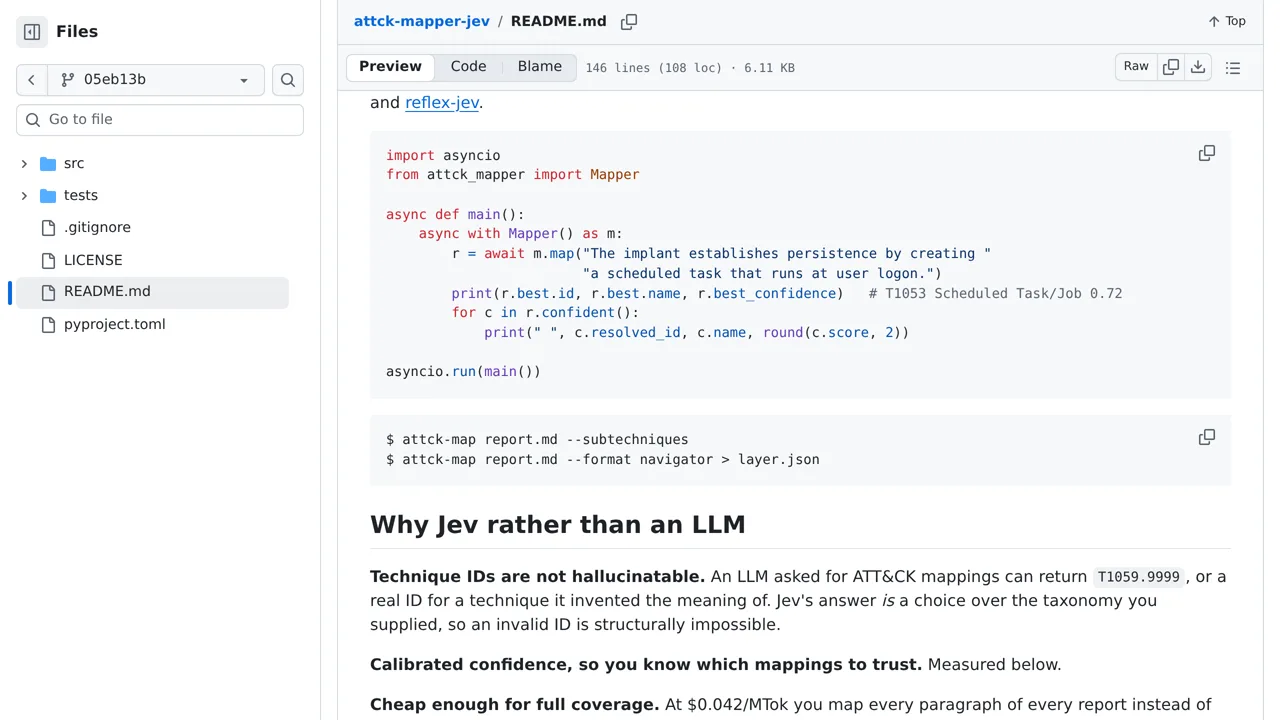
Maps threat-report prose onto MITRE ATT&CK techniques and emits a Navigator layer you can load straight into the ATT&CK interface.
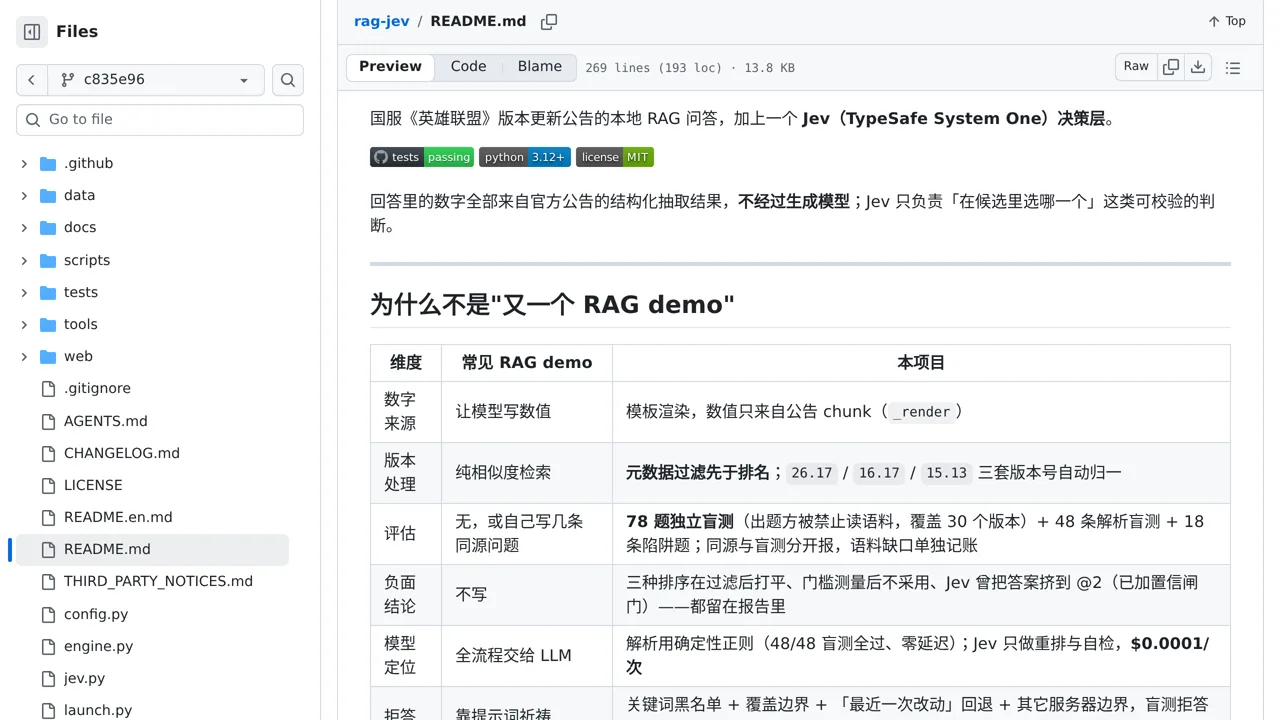
A local RAG workbench over Chinese League of Legends patch notes: every number comes from parsing the announcement, and Jev only reranks candidates and checks its own answer.
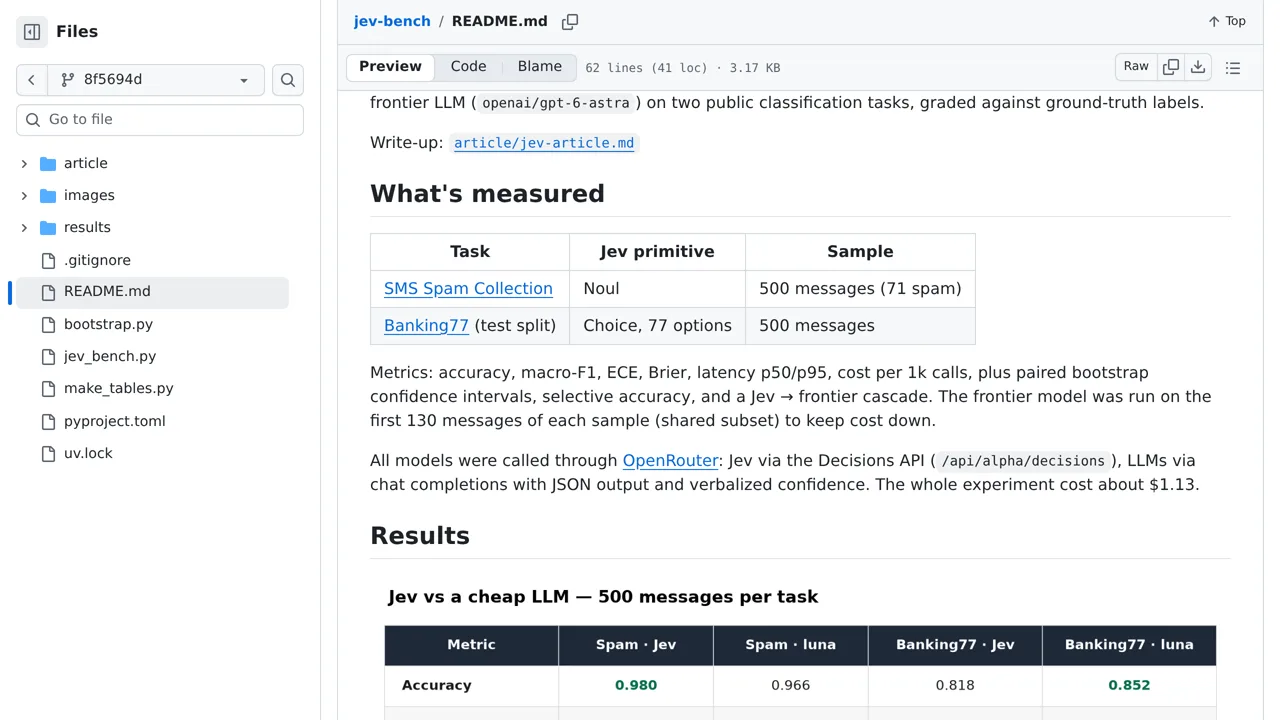
An independent benchmark of Jev 1.13 against a cheap and a frontier LLM on SMS spam and Banking77, measuring accuracy, ECE, Brier, latency and cost.
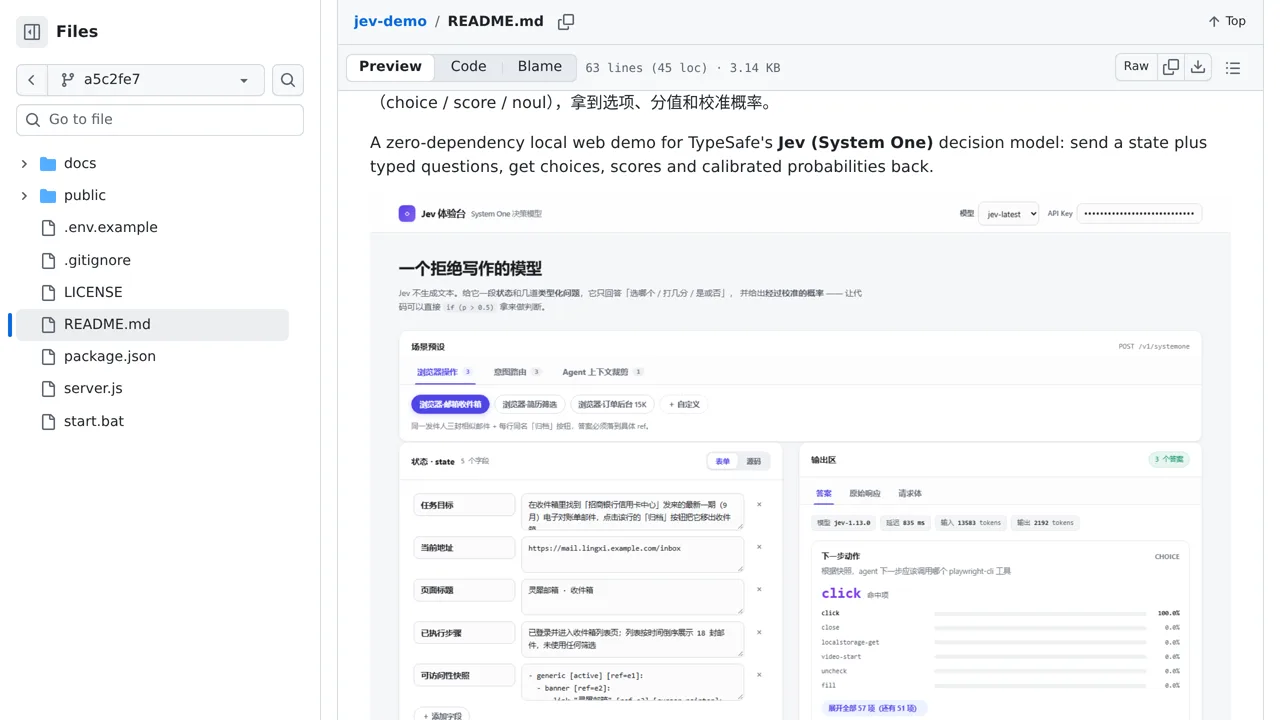
A zero-dependency local playground for Jev with a structured question editor and three presets: browser operation, intent routing and agent context trimming.
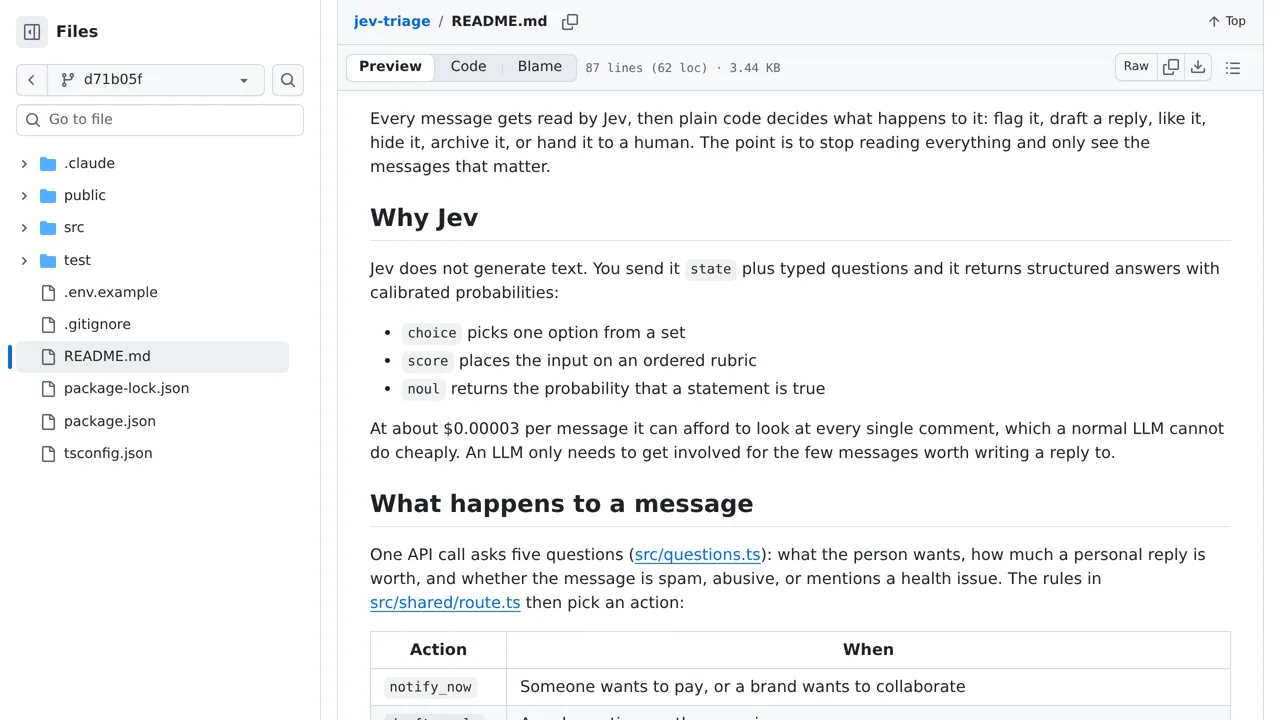
A creator-inbox desk that asks Jev five questions per comment and lets code choose the action; a confidence slider re-routes the whole queue without another call.
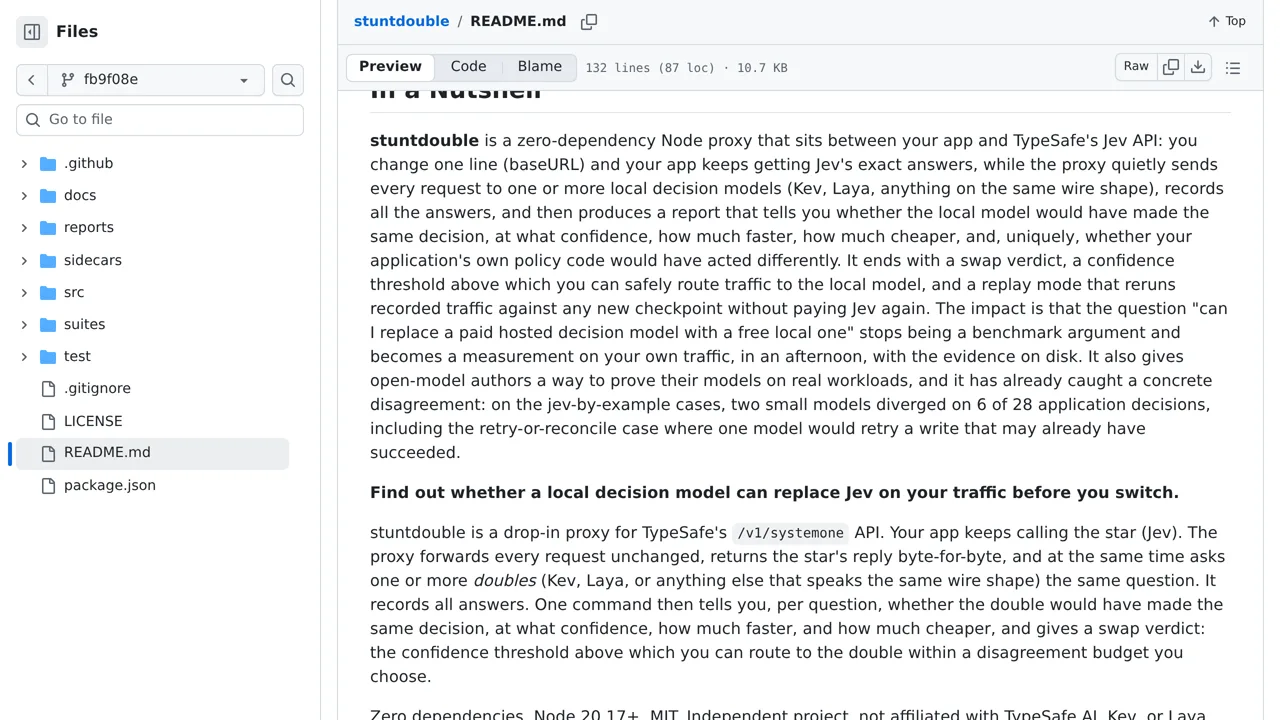
A drop-in proxy that answers your app with Jev byte for byte while asking the same question of local doubles, then reports where they would have decided differently.
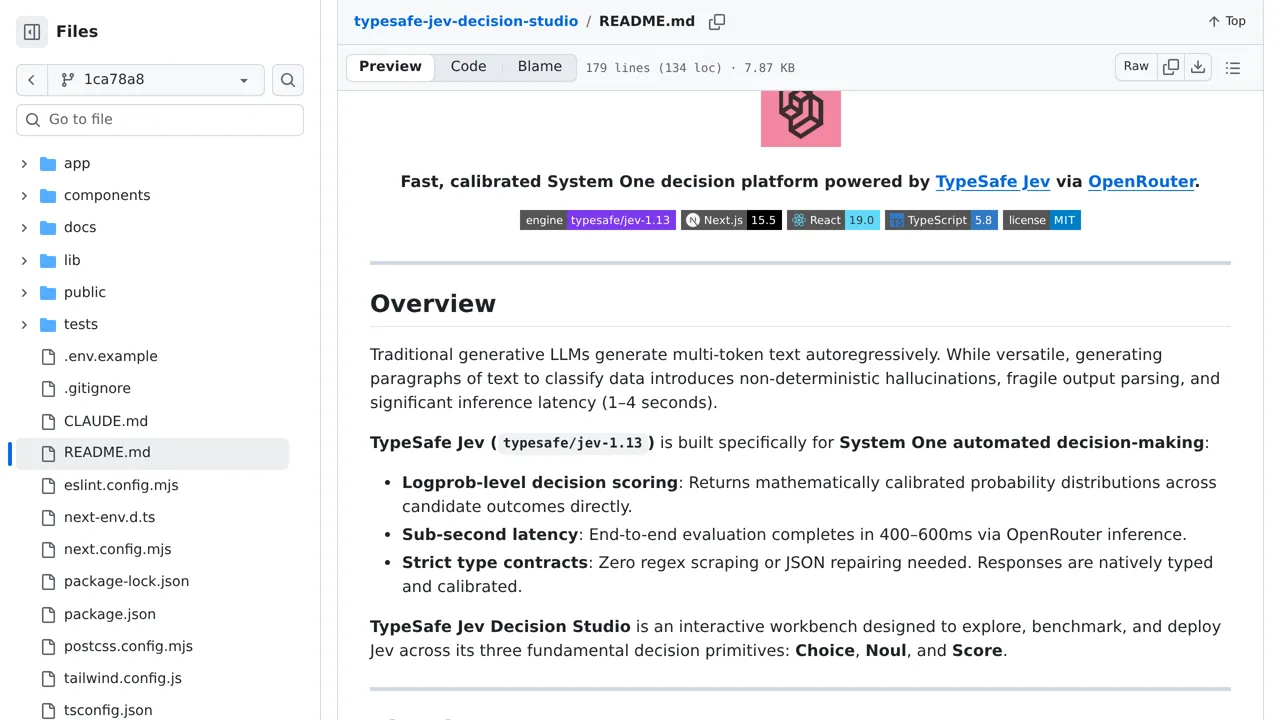
A Next.js workbench for Jev's three primitives through OpenRouter: a 95-category Choice, Noul evaluation with transfer curves, and Score rubric rating.
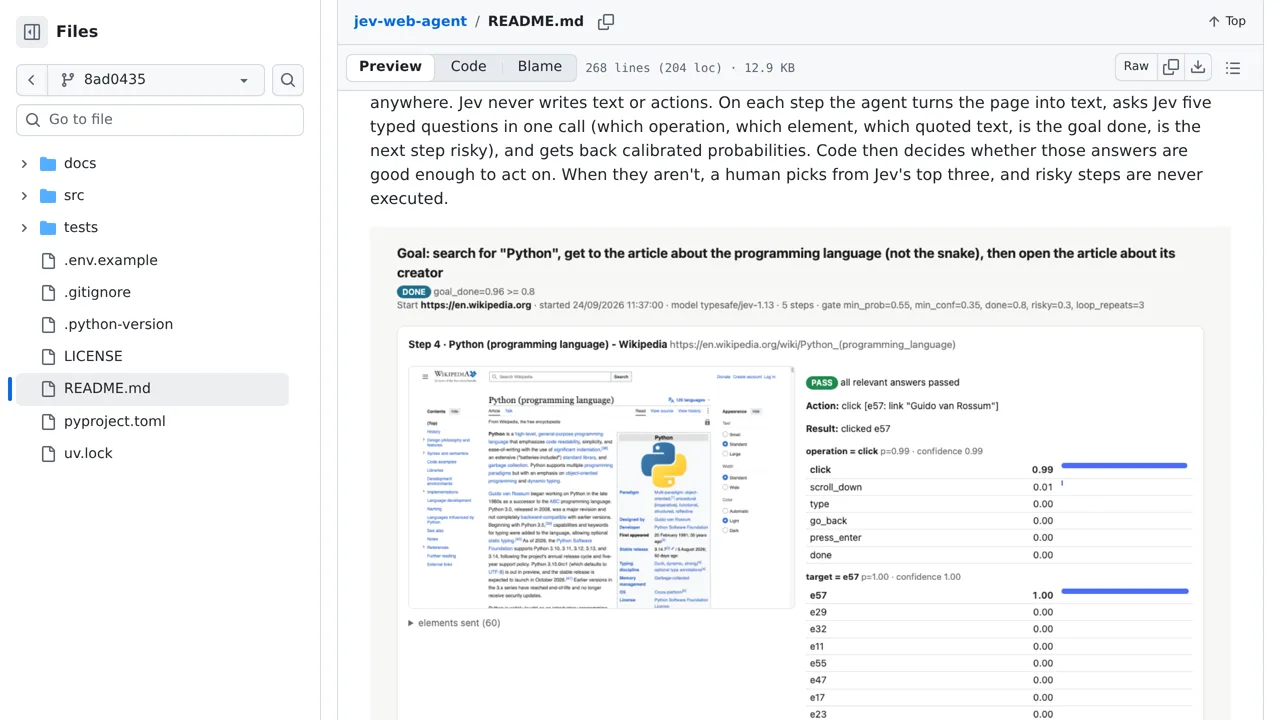
A web agent with no LLM in it: each step asks Jev five typed questions in one call, and code gates the answers before anything is executed.
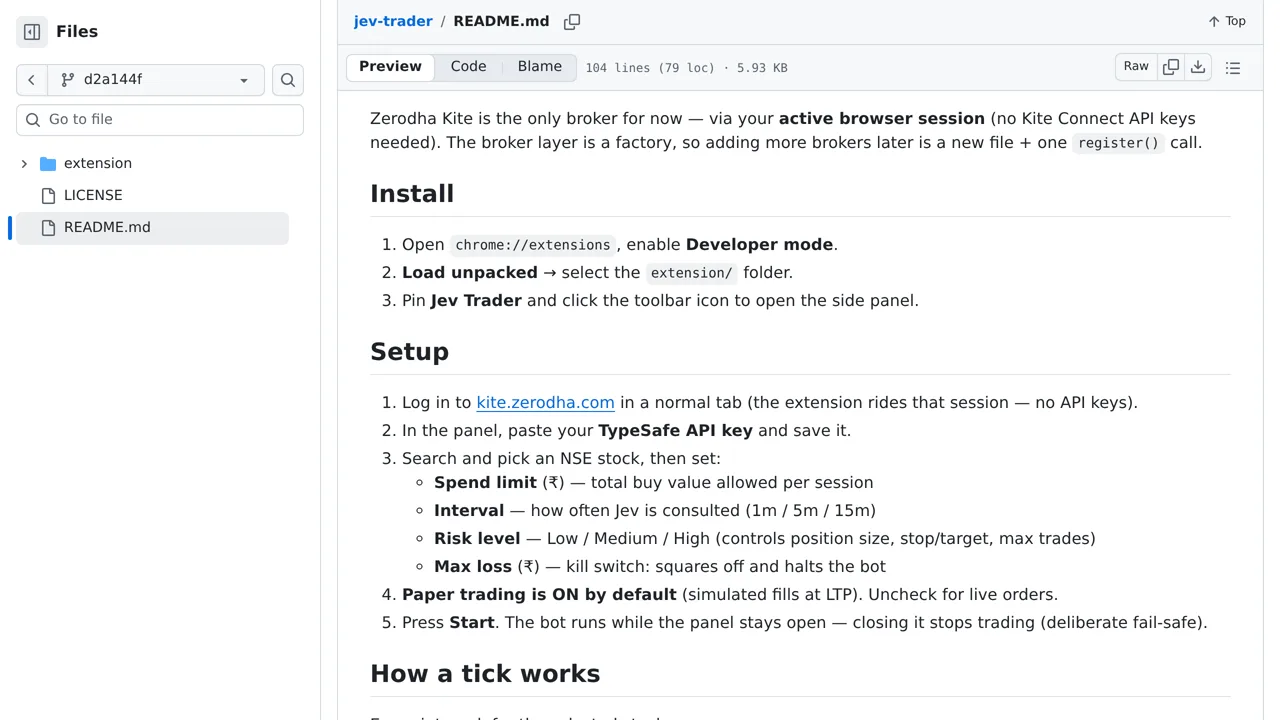
A Chrome side panel that auto-trades an NSE stock through Zerodha Kite: Jev answers a direction question each tick and a risk gate sizes and places the order.
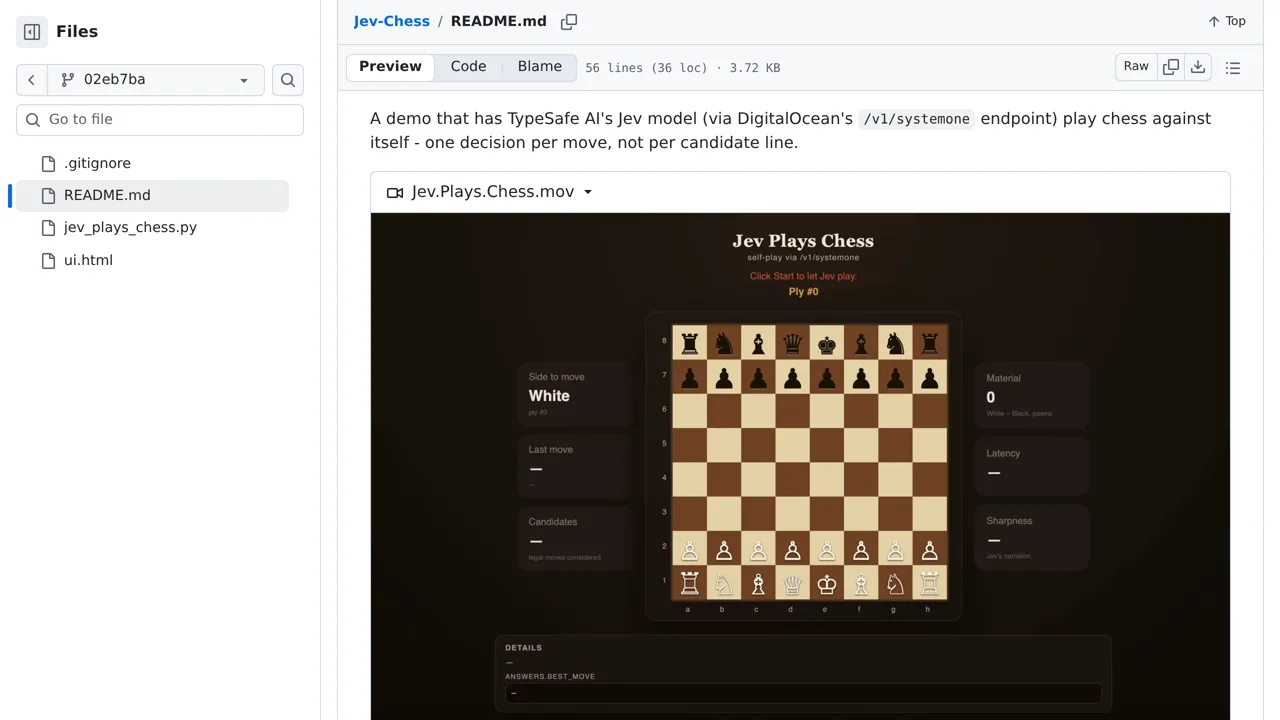
Has Jev play chess against itself one decision per move, with a browser board showing the position and Jev's last answer.
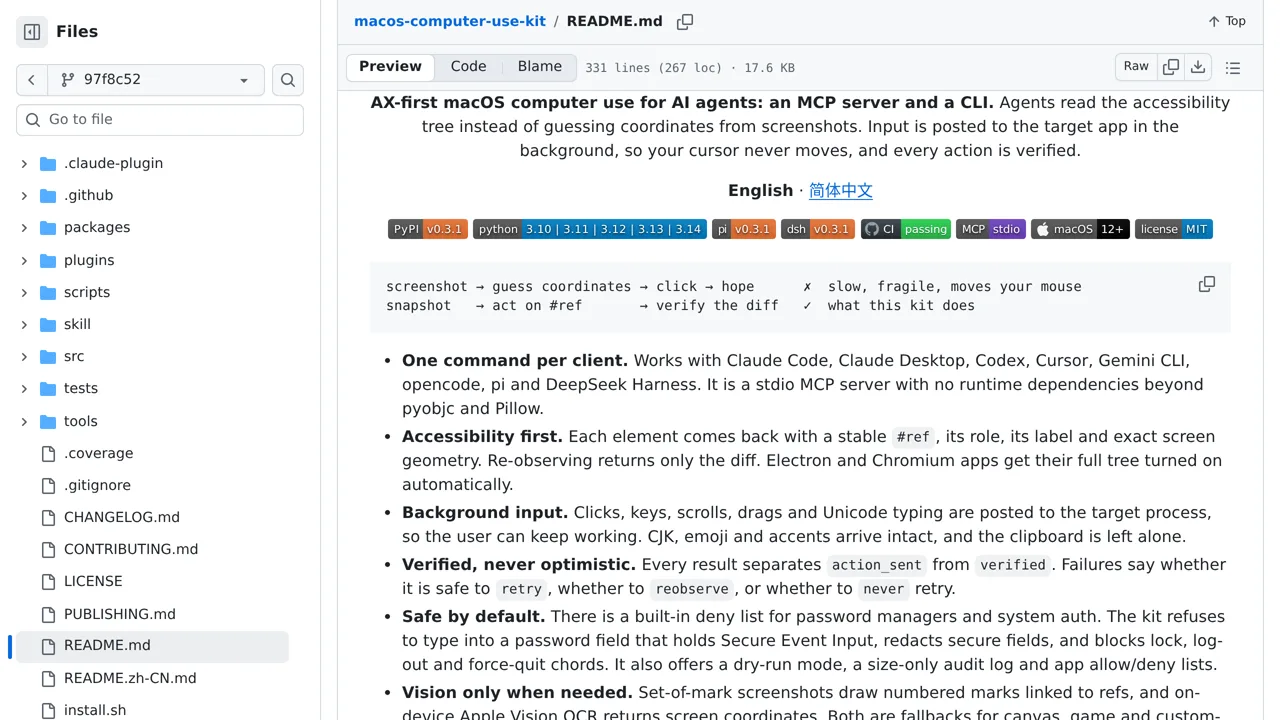
An accessibility-first computer-use kit for macOS agents where optional Jev guards judge the target and the input just before an irreversible action.
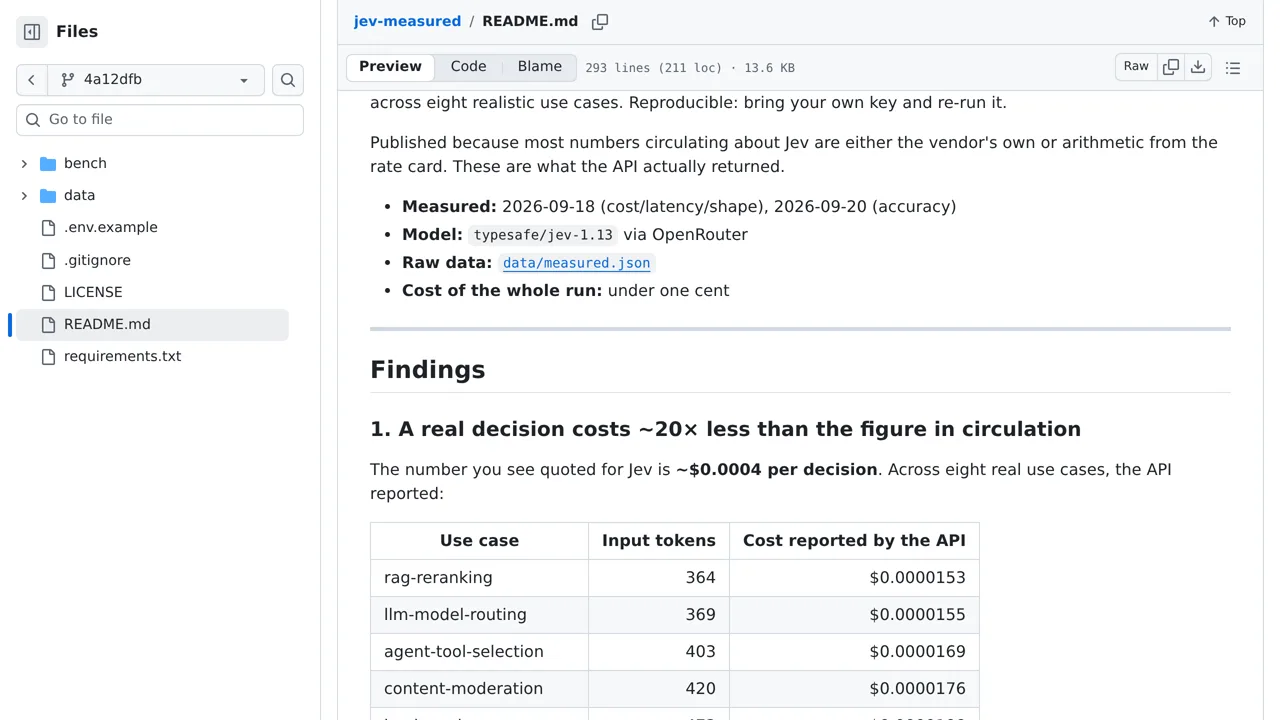
Measures what the live Jev API actually returns across eight realistic use cases, reporting cost, latency and response shape rather than rate-card arithmetic.
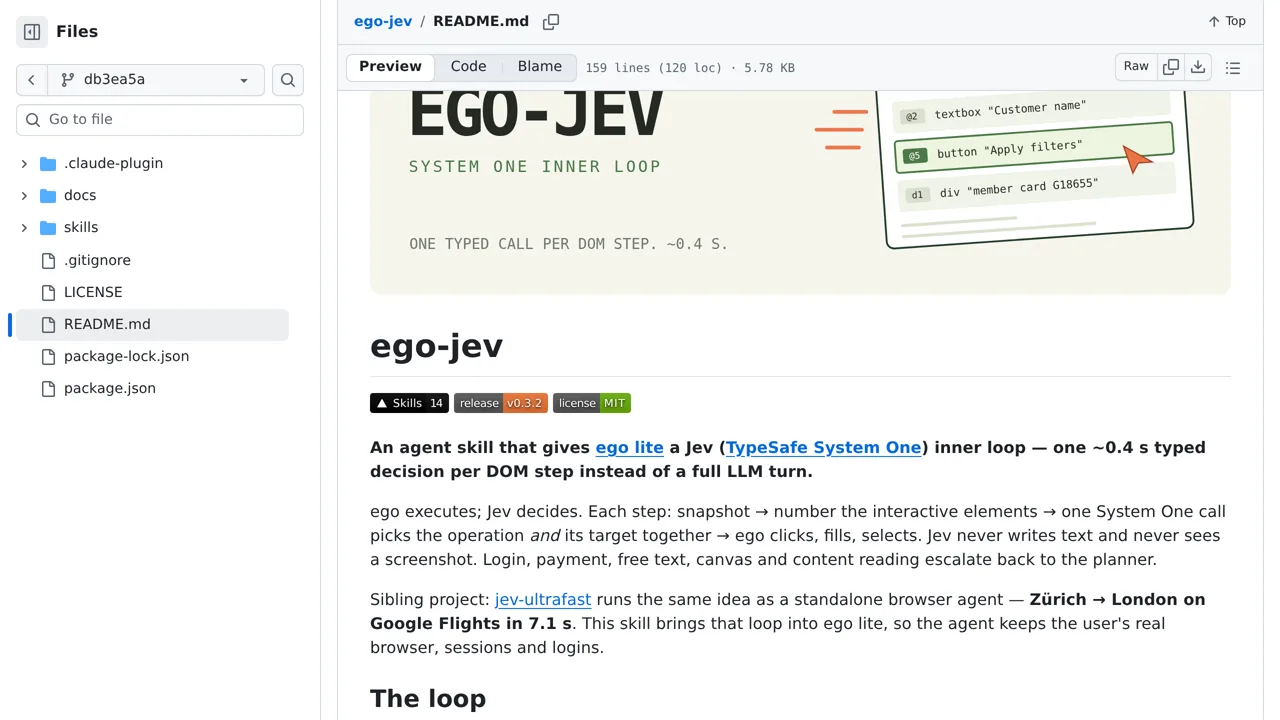
Gives the ego lite browser a Jev inner loop: each DOM step is numbered and one call picks both the operation and its target.
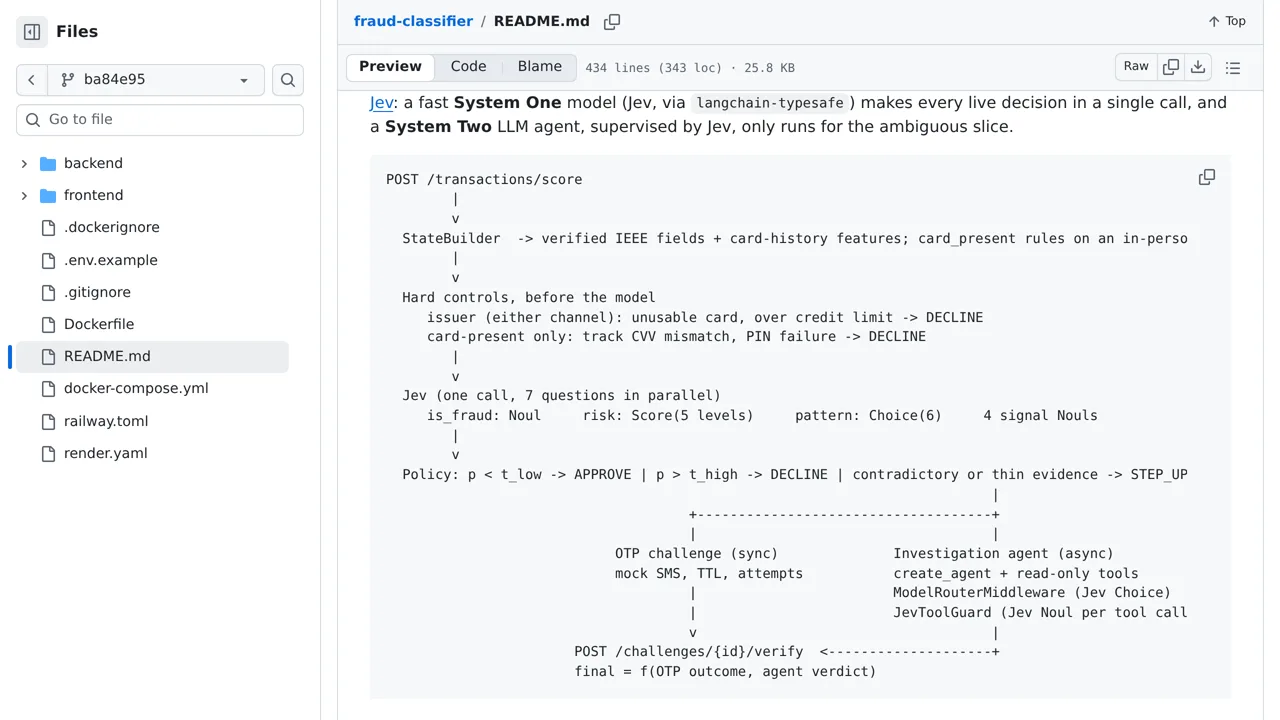
A real-time card-transaction fraud classifier where a System One model makes every live decision and an LLM agent runs only for the ambiguous slice.
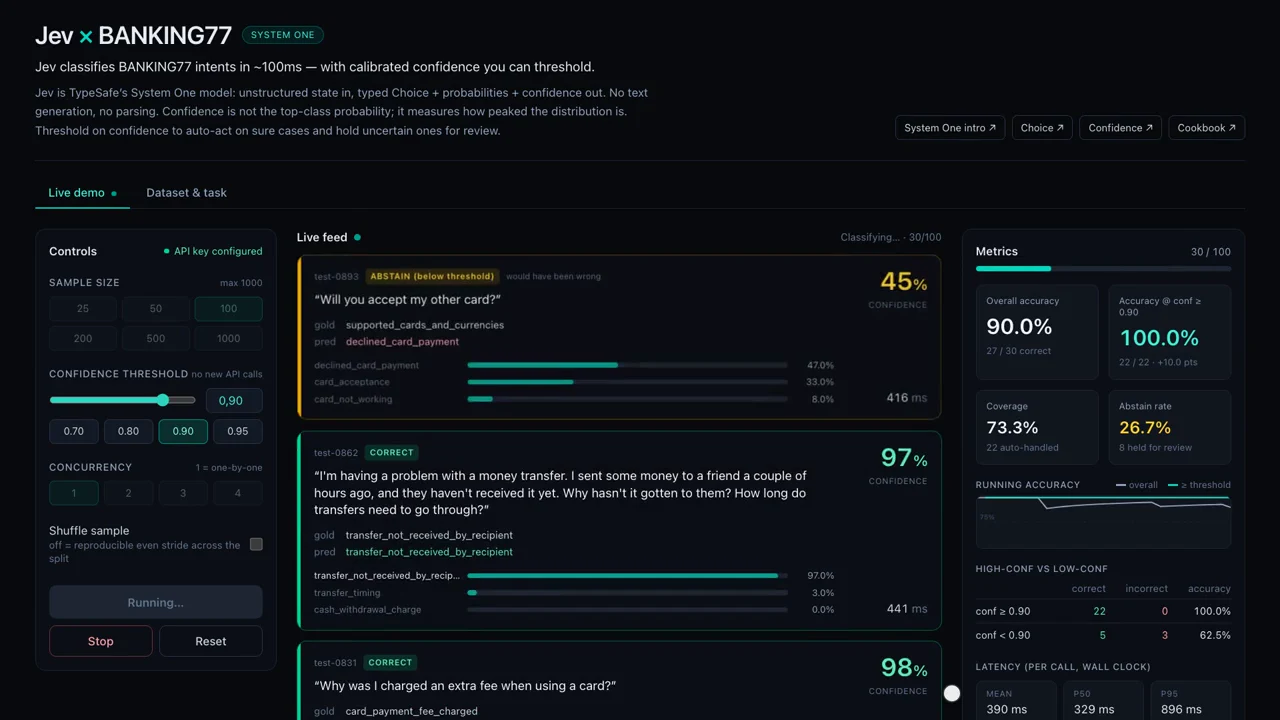
A single-page app that classifies BANKING77 support queries with Jev and streams the results one ticket at a time.
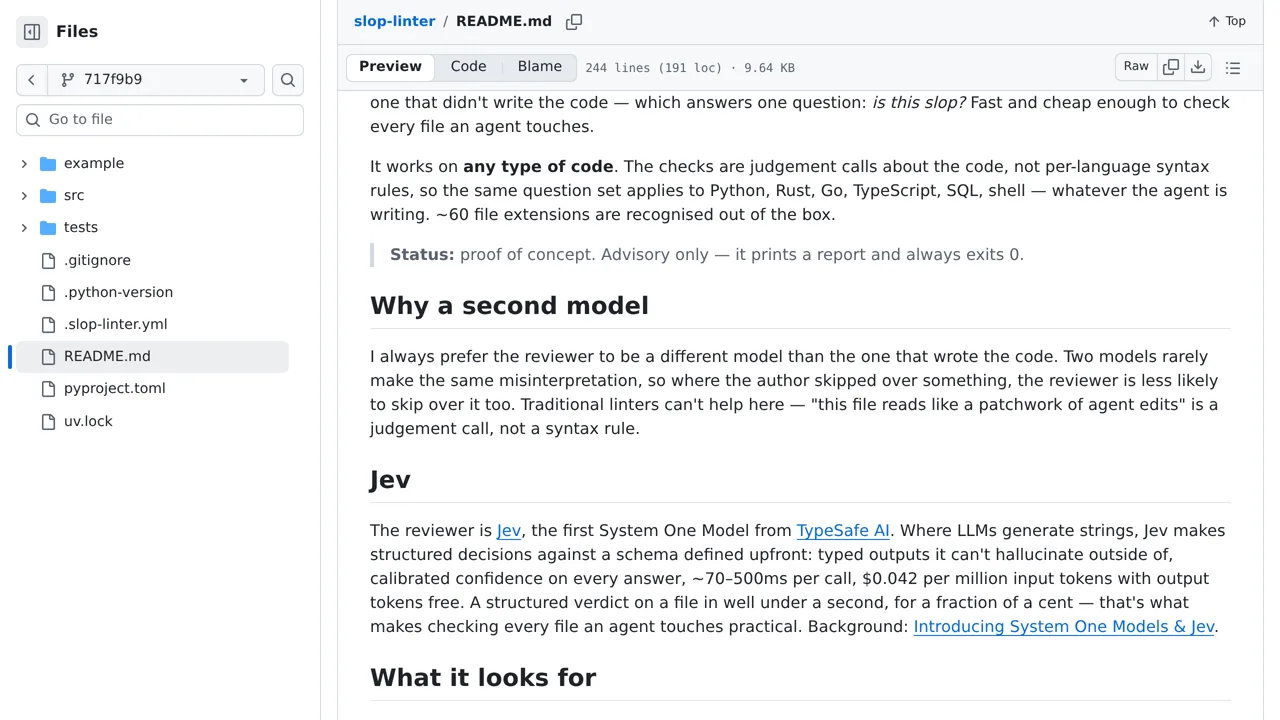
A linter that sends each file an agent touched to Jev and asks one question: is this slop?
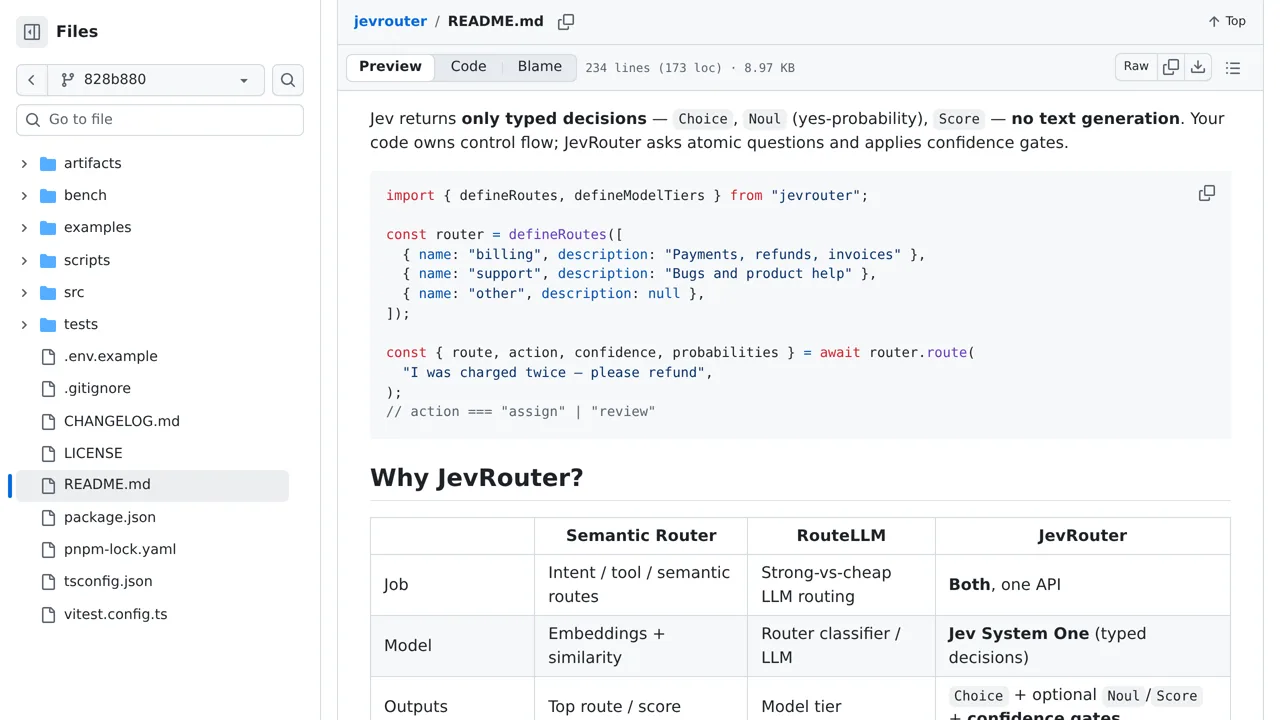
A drop-in routing layer that turns named routes into one Jev Choice, with a gate question for whether the request is even in domain.
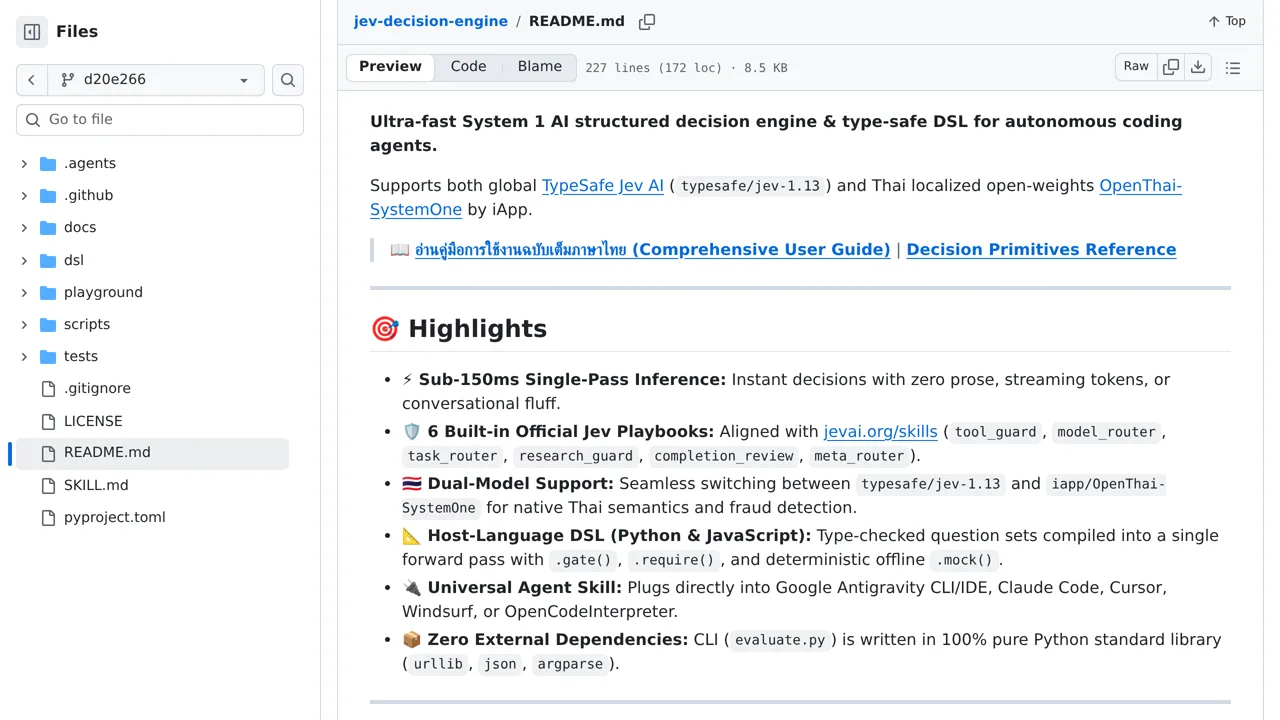
An agent skill and stdlib CLI that turn Python or JavaScript question builders into one System One payload, with six named decision playbooks.
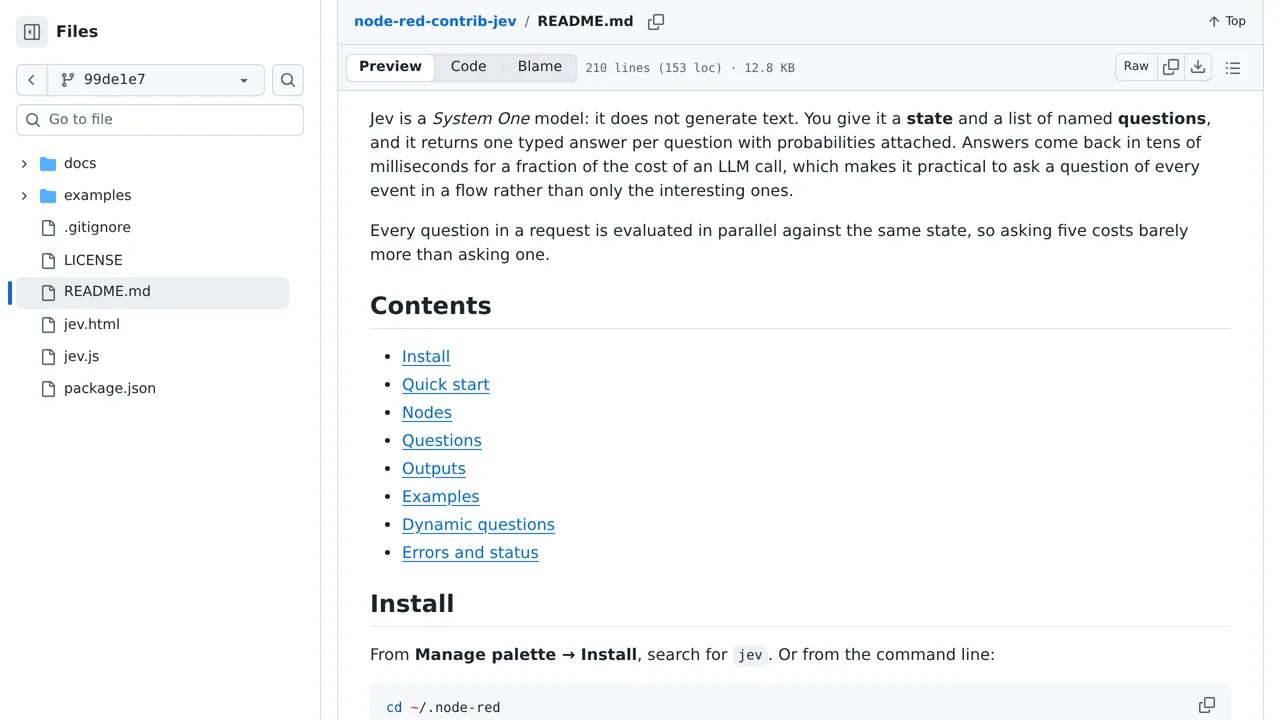
A Node-RED node set that evaluates a flow's state against a list of named questions and returns one typed answer per question.
Play Jev at Gomoku, Go or chess: code builds a pool of legal candidate moves and Jev answers one Choice over them, with every call shown under the board.

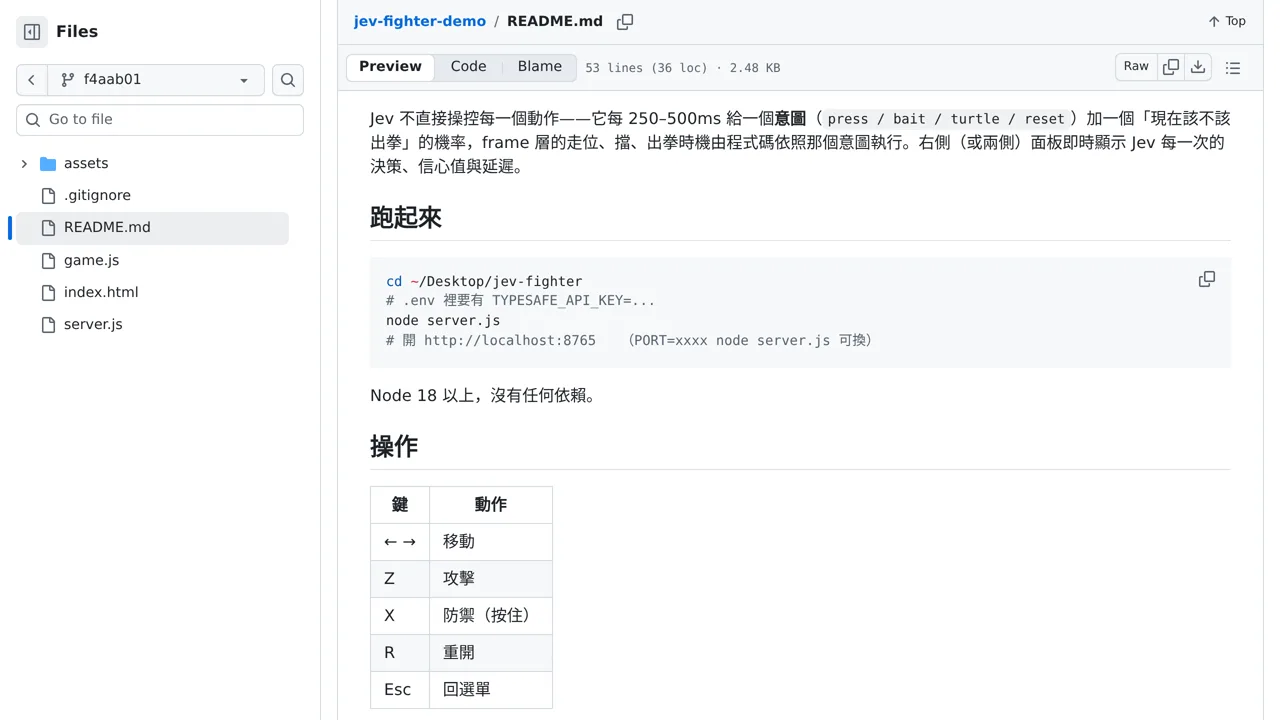
A 2D fighting demo where Jev calls the intent every few hundred milliseconds and frame-level code turns that intent into footwork, blocks and punches.
An agentic GraphRAG engine where every graph operation is a typed decision from a swappable System One model, and the LLM runs only once to write the answer.

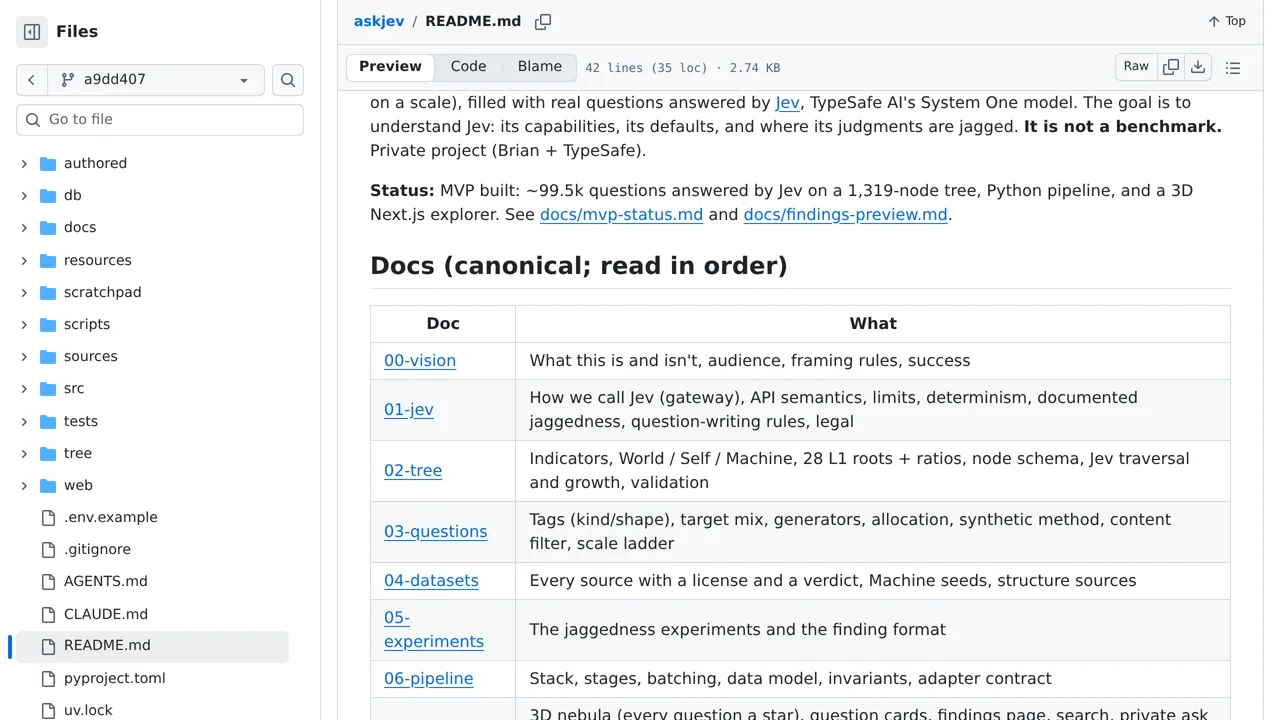
A tree with a place for every closed question a person or program could ask, filled with real questions answered by Jev, plus a 3D explorer where each question is a star.
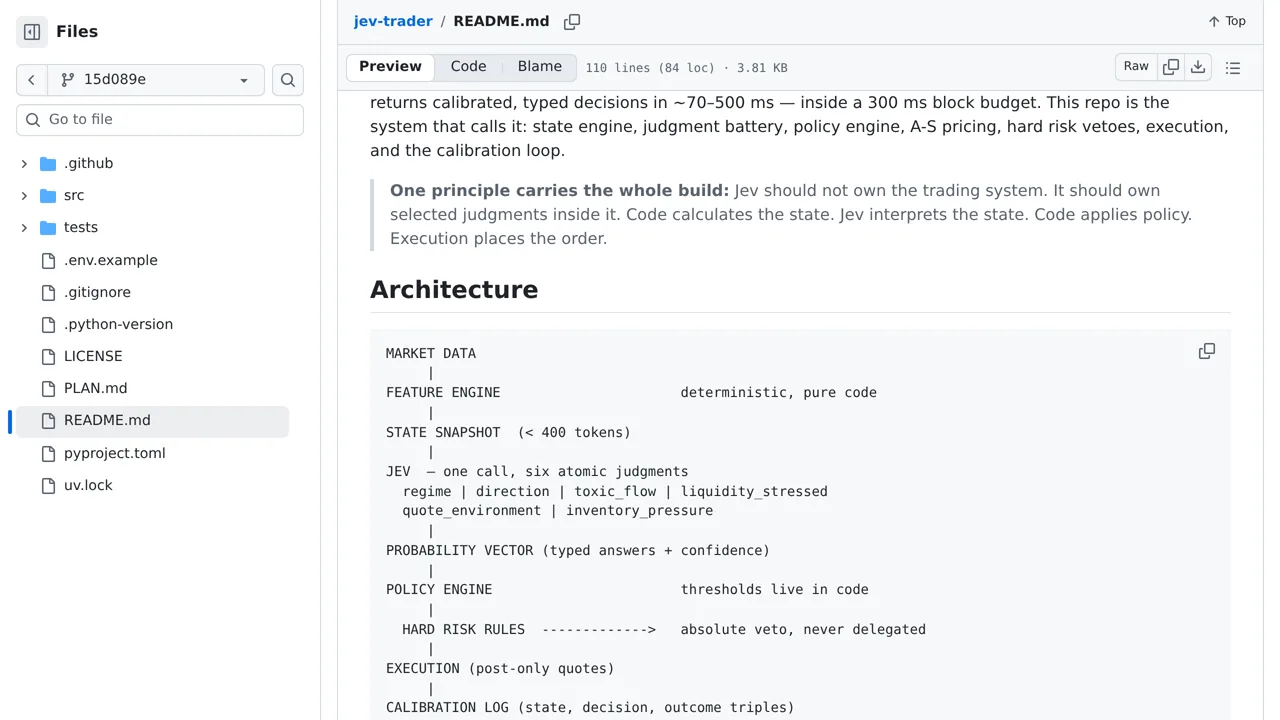
A 24/7 market-making system where Jev answers six atomic judgments per tick and a code-side policy composes the action and holds the risk vetoes.
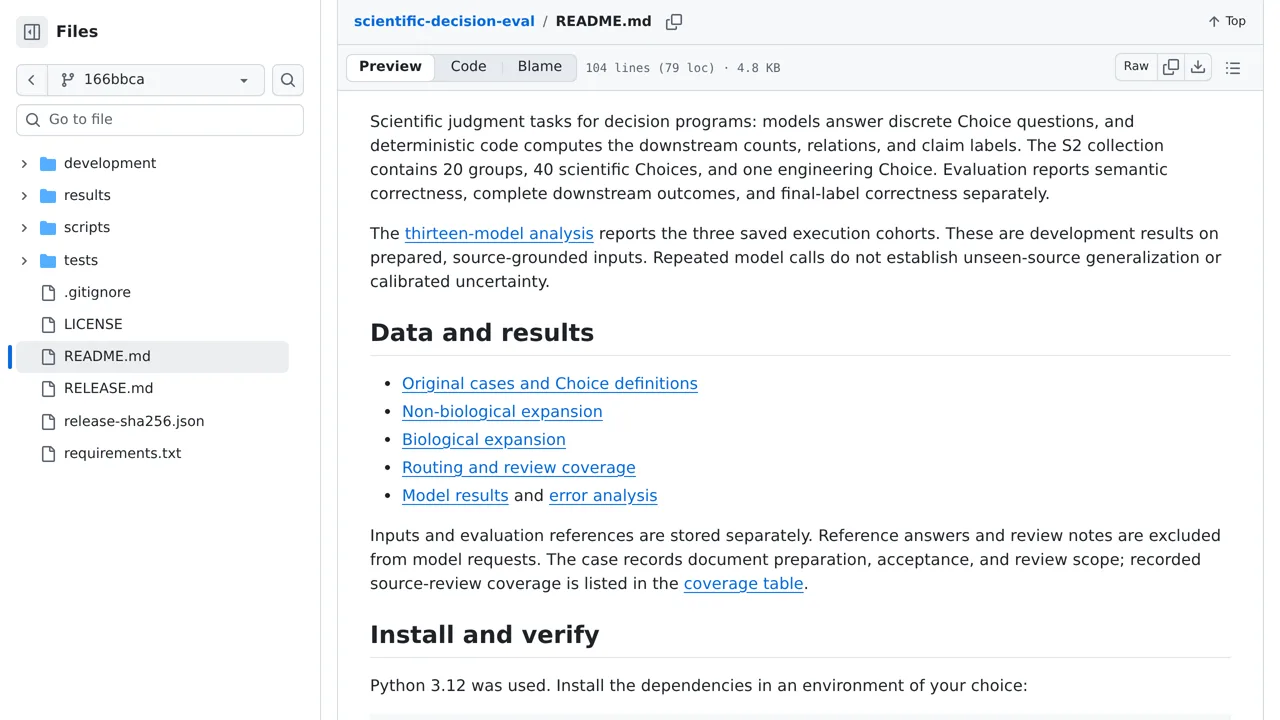
Tests Jev on scientific judgement questions, then follows the consequences: what those choices do to the results that depend on them.
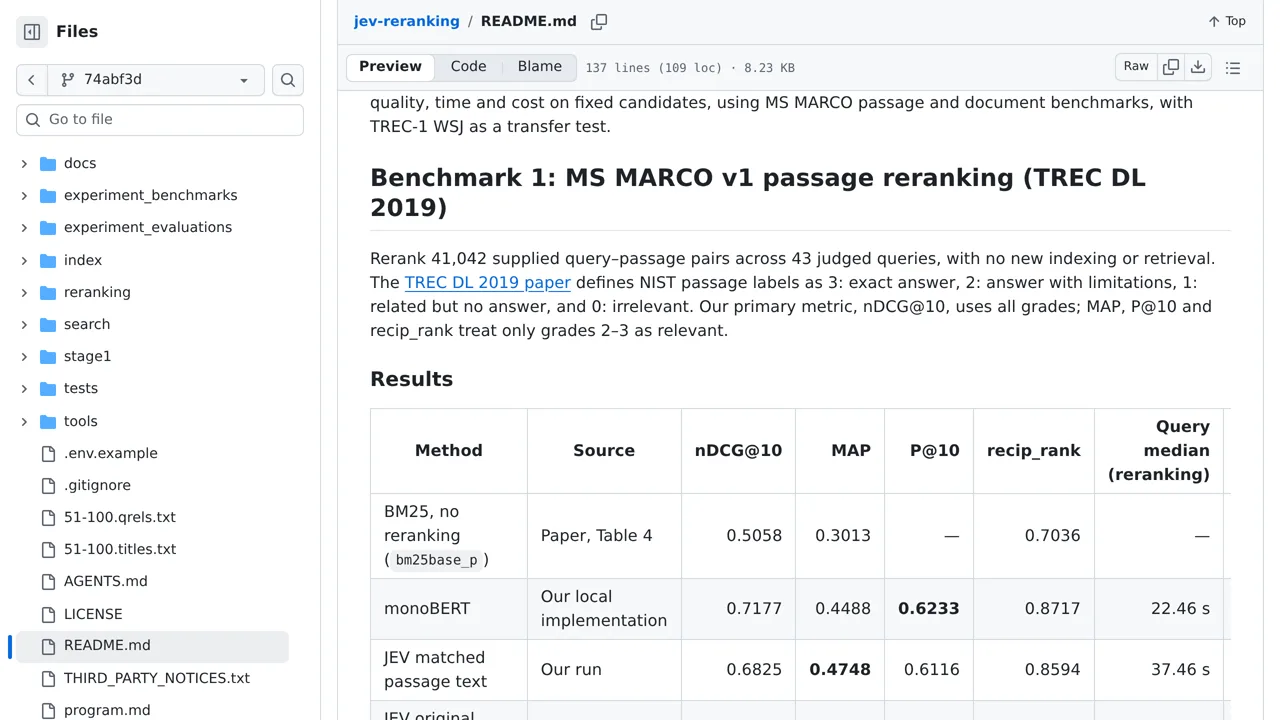
Reranks fixed MS MARCO candidate sets by asking Jev one relevance question per query and document pair, then scores the runs with trec_eval.
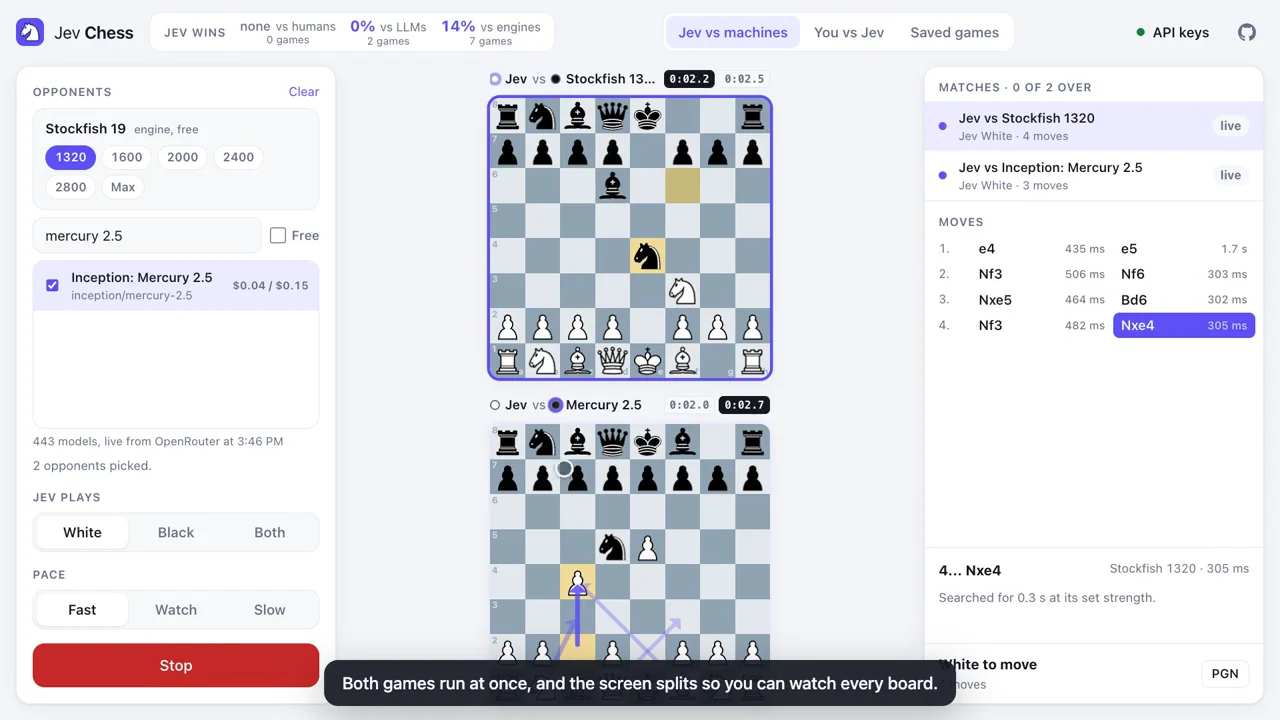
Jev plays chess against Stockfish, against any OpenRouter model, or against you, with the moves it weighed drawn as arrows and their probabilities beside them.
An unofficial operator-level showcase: a local lab with a smart-home demo, worked examples for each primitive and pattern, and a TypeScript CLI harness for agent loops.

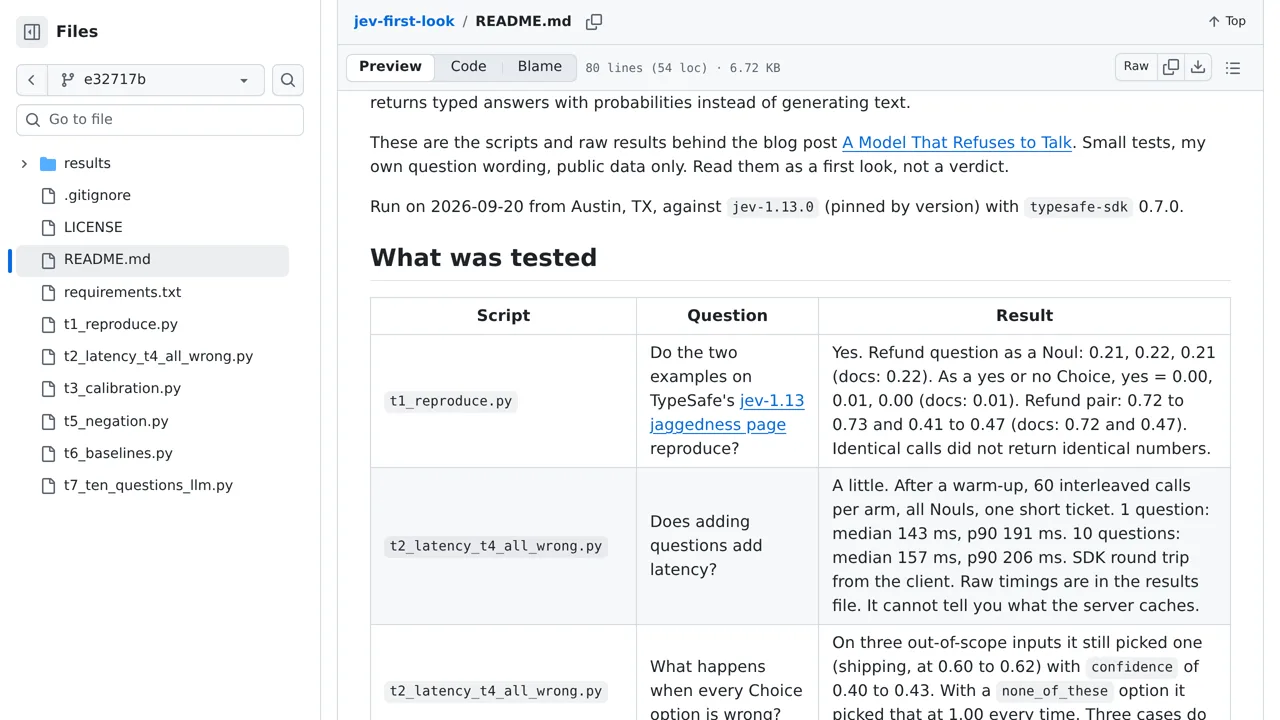
A first hands-on measurement of Jev: seven small scripts probing its documented jaggedness, latency scaling, calibration, negation consistency and behaviour when every option is wrong.
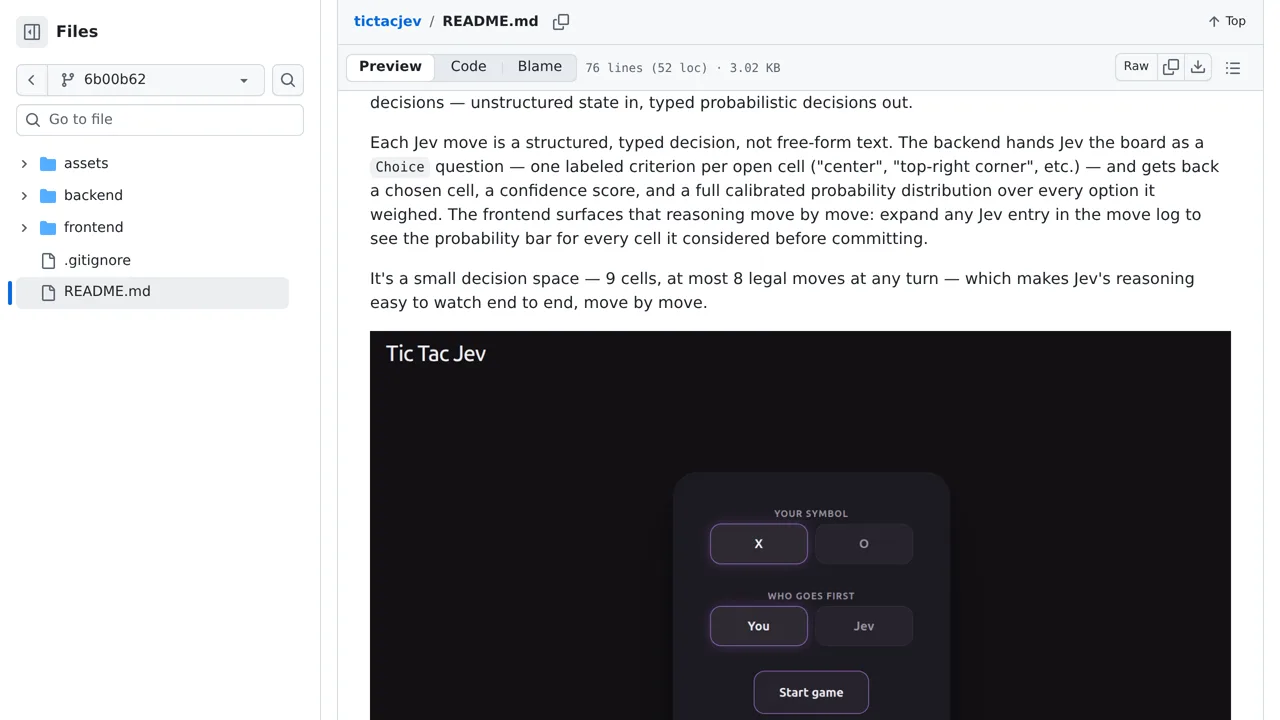
Tic-tac-toe where one side is Jev: each turn is one Choice whose criteria are the empty cells, and the move log expands to show the probability it gave every cell.
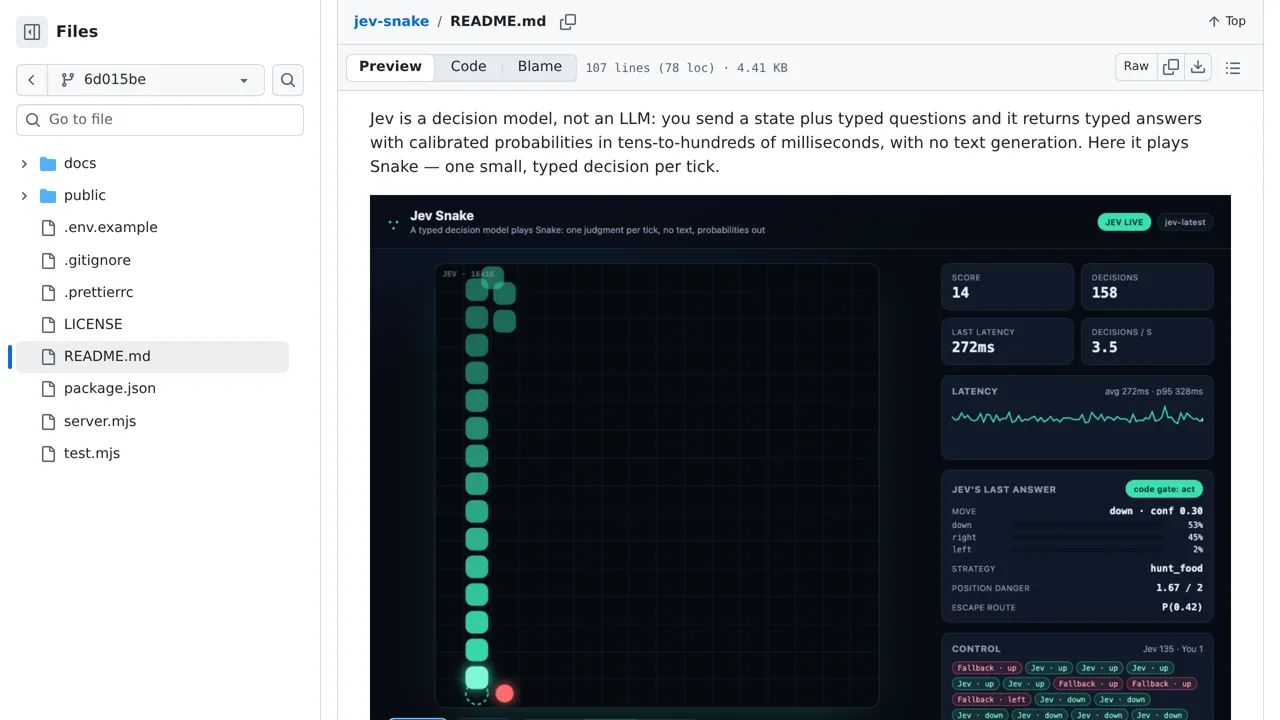
Snake played by Jev, one typed decision per tick, with the dashboard showing the exact request, the answer, the latency and the running cost.
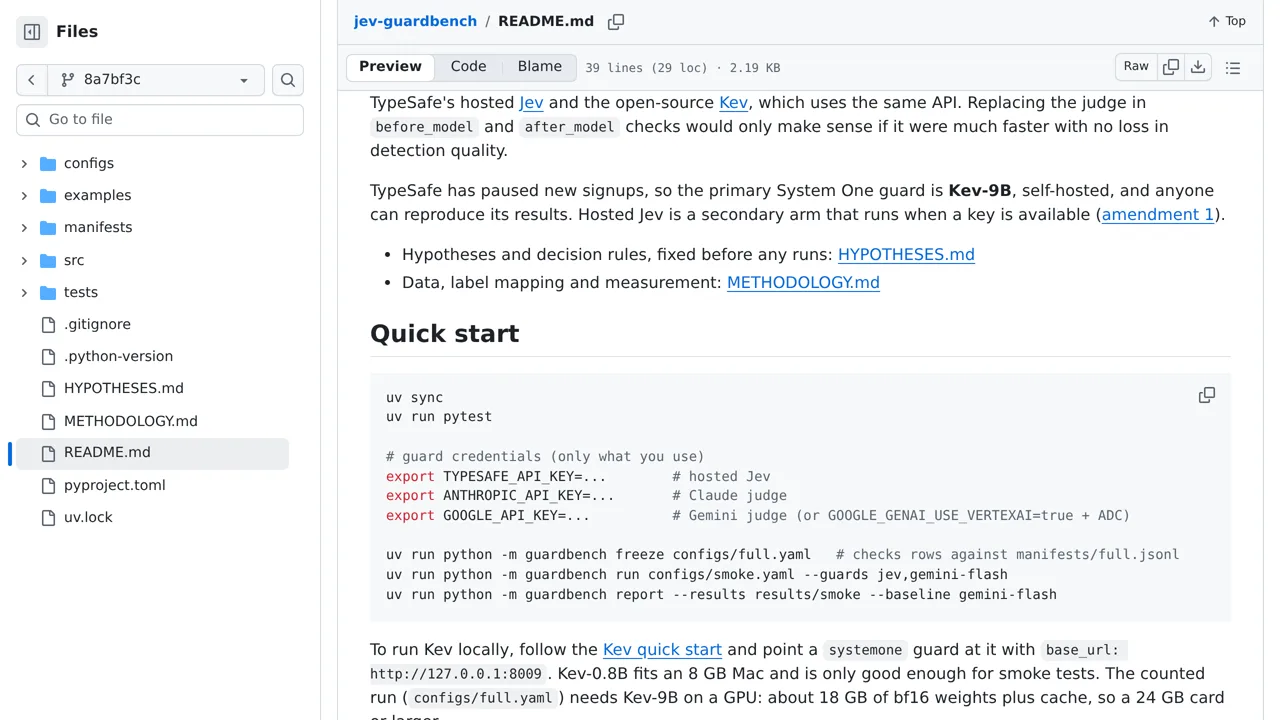
Asks whether a System One model can do the job of an LLM judge in an agent guardrail, with the hypotheses and decision rules fixed before any run.
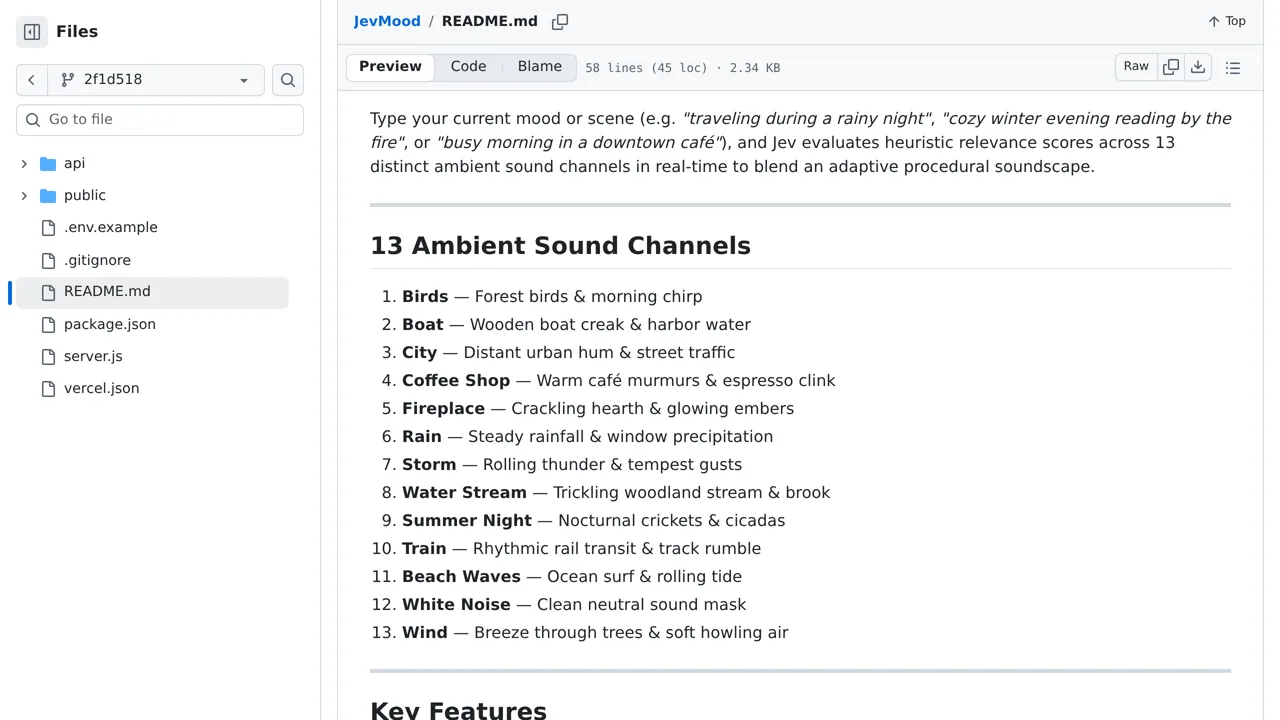
You type a mood or a scene and one parallelised Jev score request rates how prominent each of thirteen ambient channels should be, which the browser then blends live.
A name-analysis page: three Choice questions in one request give peak generational era, linguistic origin and gender association, drawn as a birth-wave curve and a probability spread.

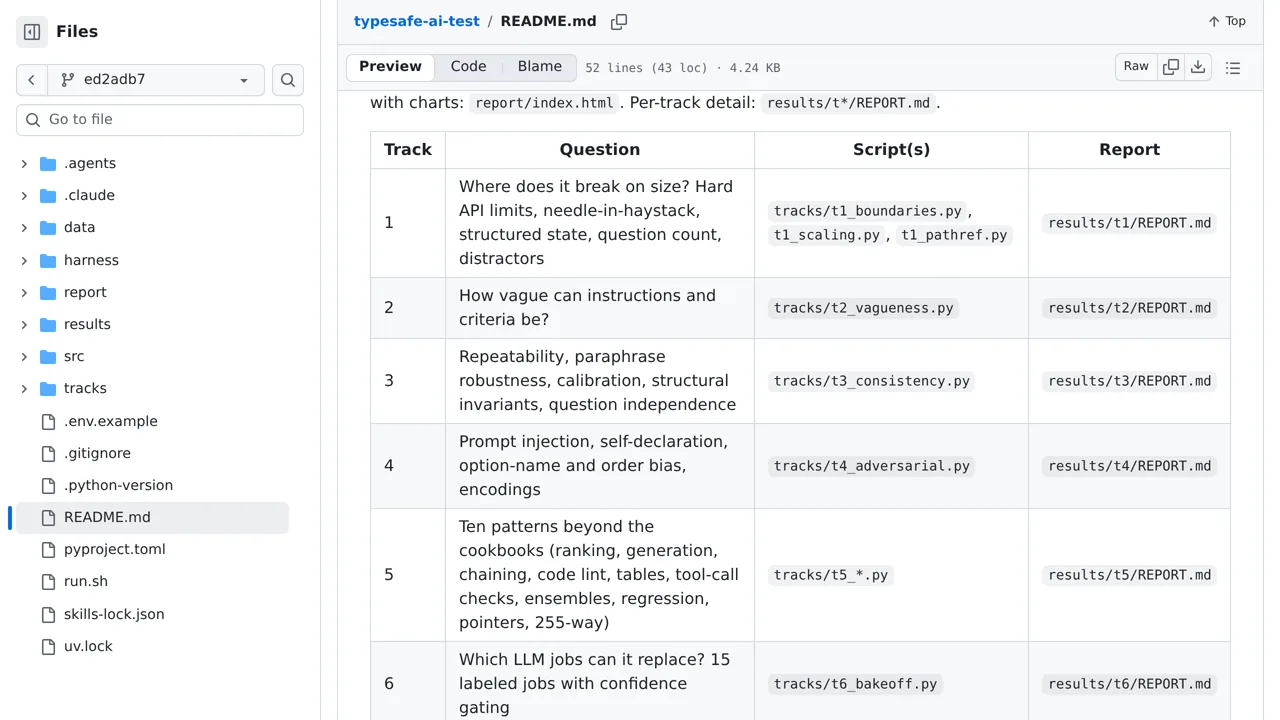
Six tracks of experiments against the System One endpoint, from size limits and needle-in-a-haystack retrieval to prompt injection, option bias and a fifteen-job bake-off.
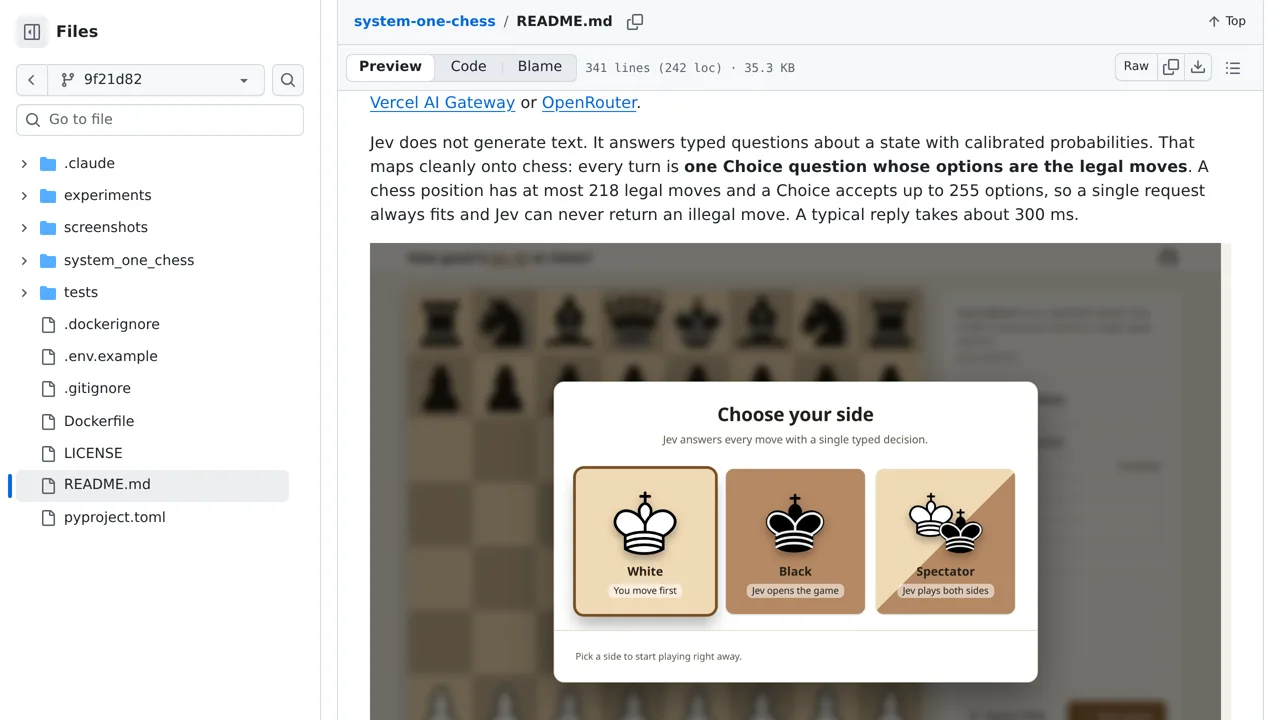
Play chess against Jev in the browser with Stockfish analysing locally; each turn is one Choice over the legal moves, so an illegal answer is impossible.
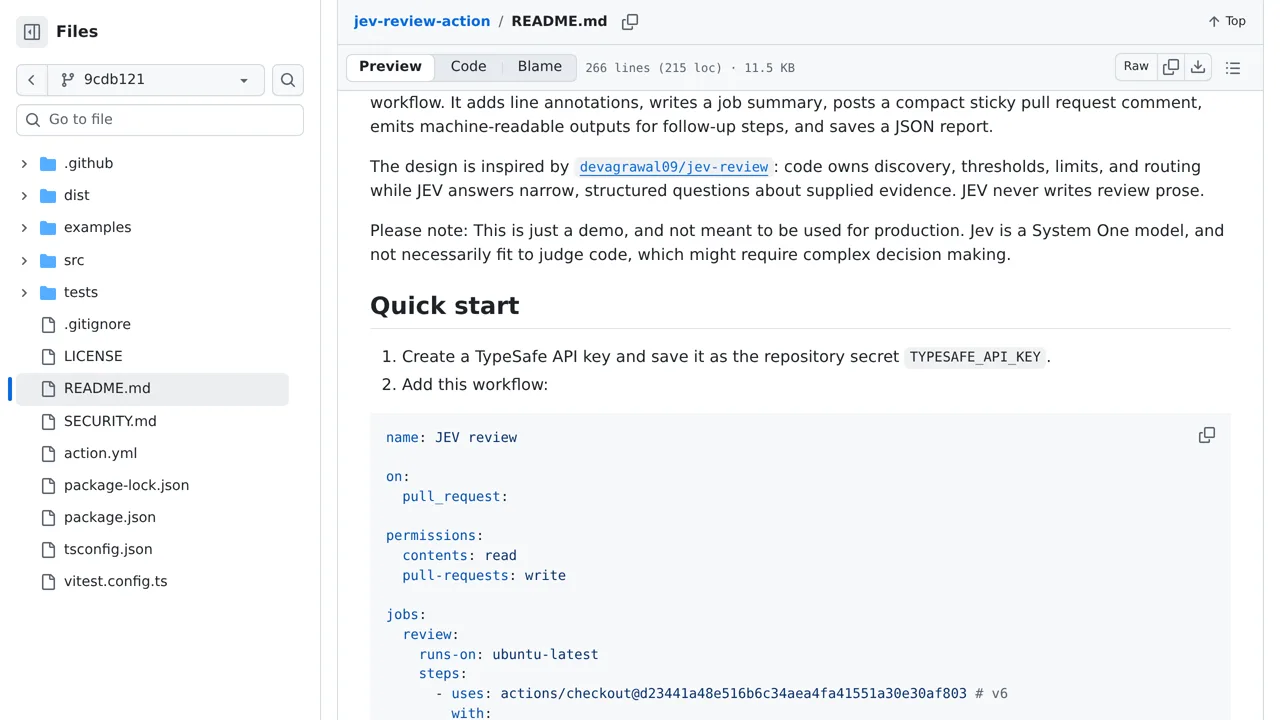
A GitHub Action that reviews changed JavaScript and TypeScript in a pull request, posting line annotations and one sticky comment.
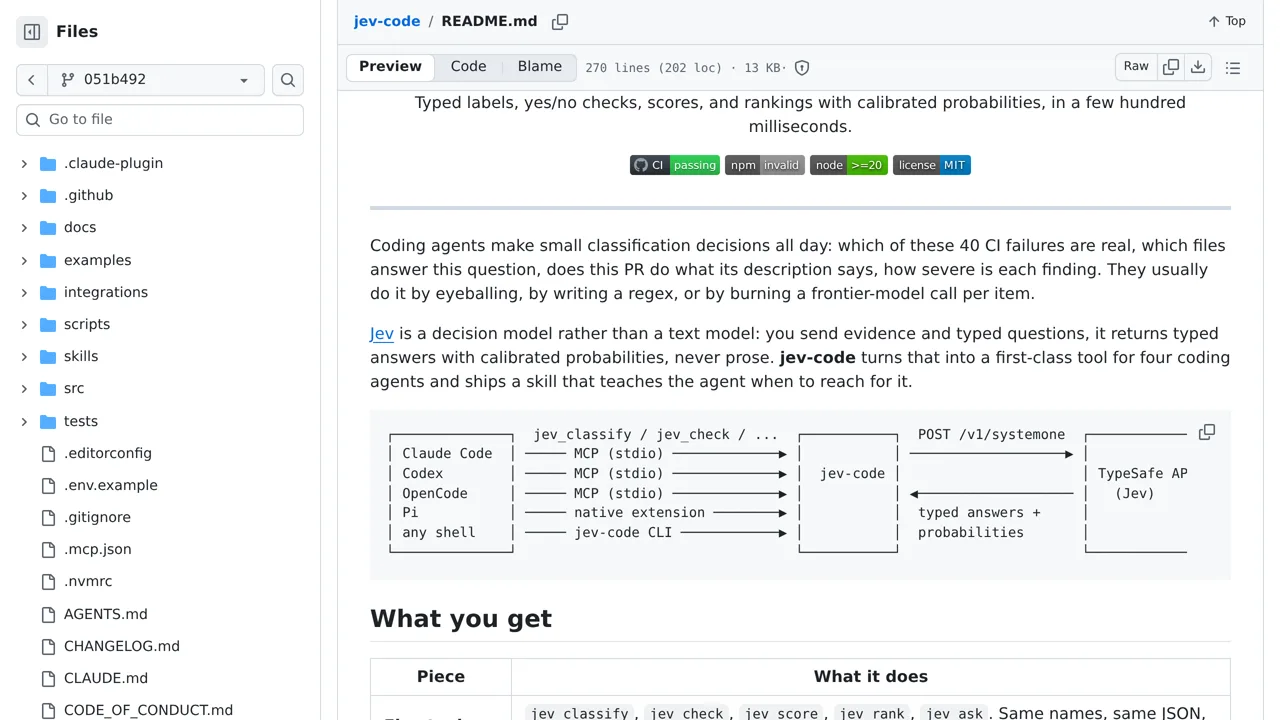
Packages Jev as five tools — classify, check, score, rank and ask — and installs the same skill into Claude Code, Codex, Pi and OpenCode with one command.
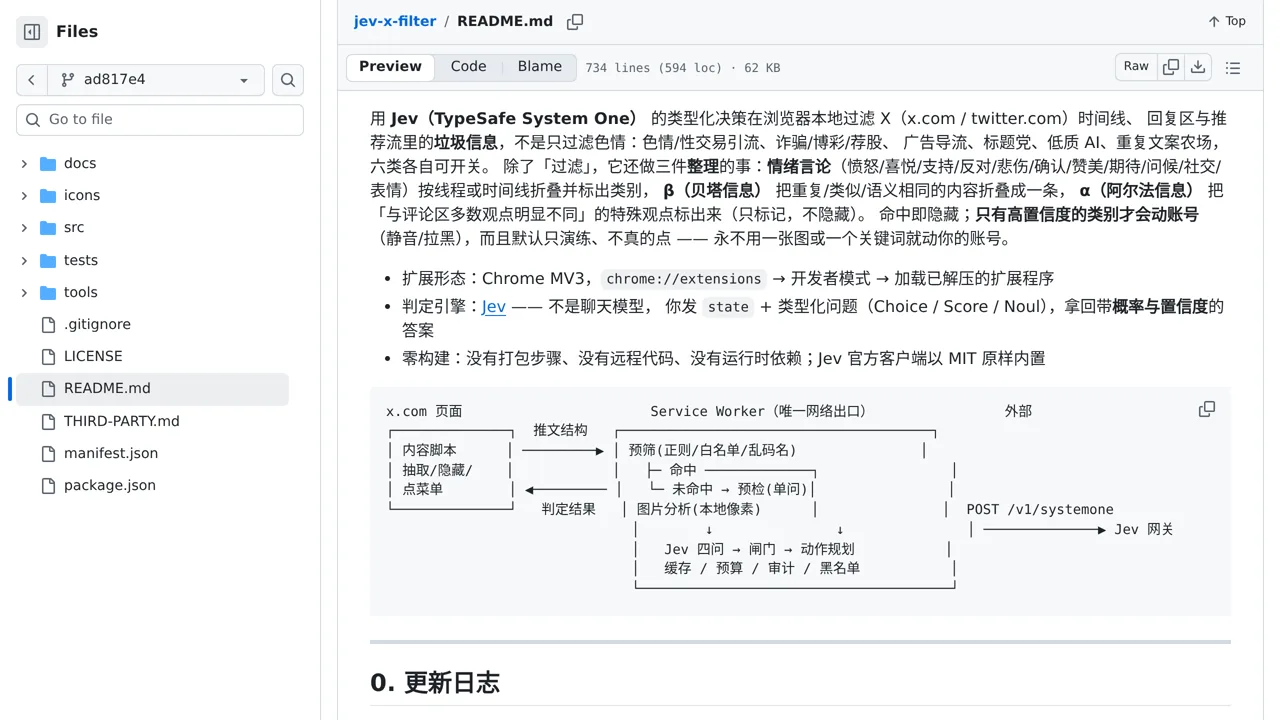
A Chrome extension that filters spam from the X timeline across six independently switchable categories, acting only on high-confidence hits.
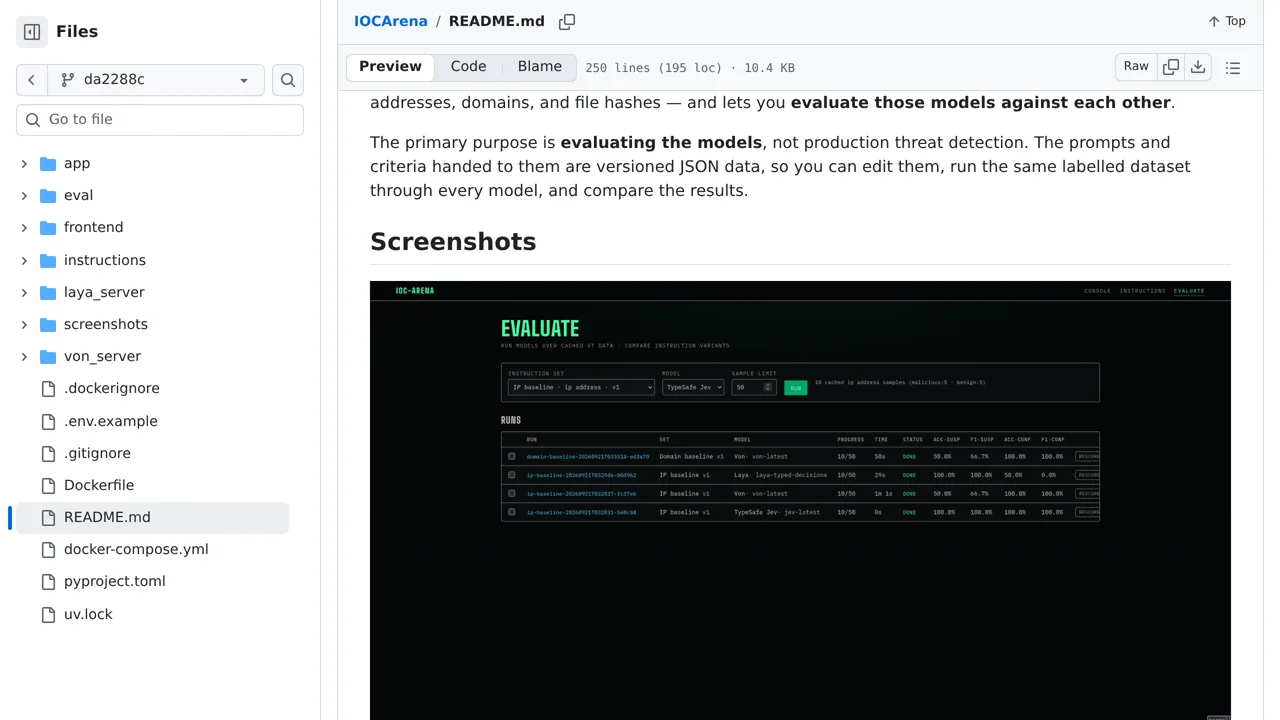
A self-hosted console that runs VirusTotal summaries through System One models and evaluates those models against each other on the same labelled dataset.
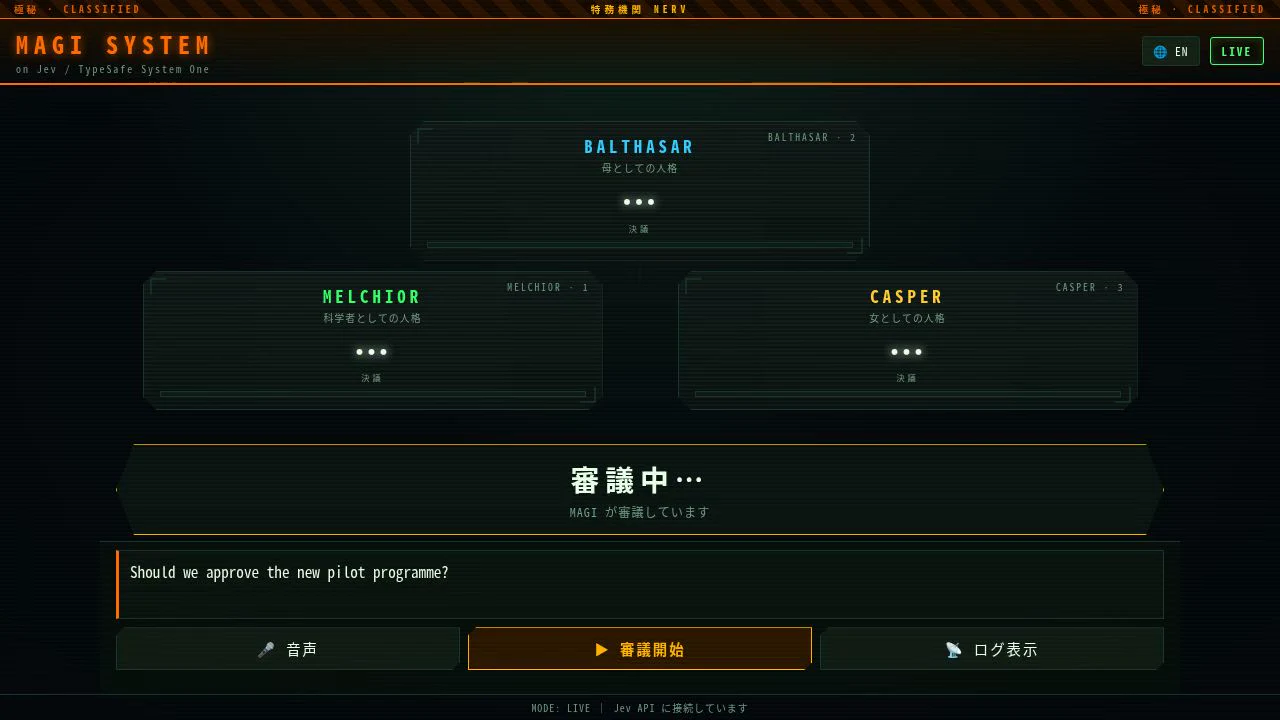
Recreates the MAGI supercomputer from Evangelion: three sages answer the same yes/no question and the app decides by majority vote.
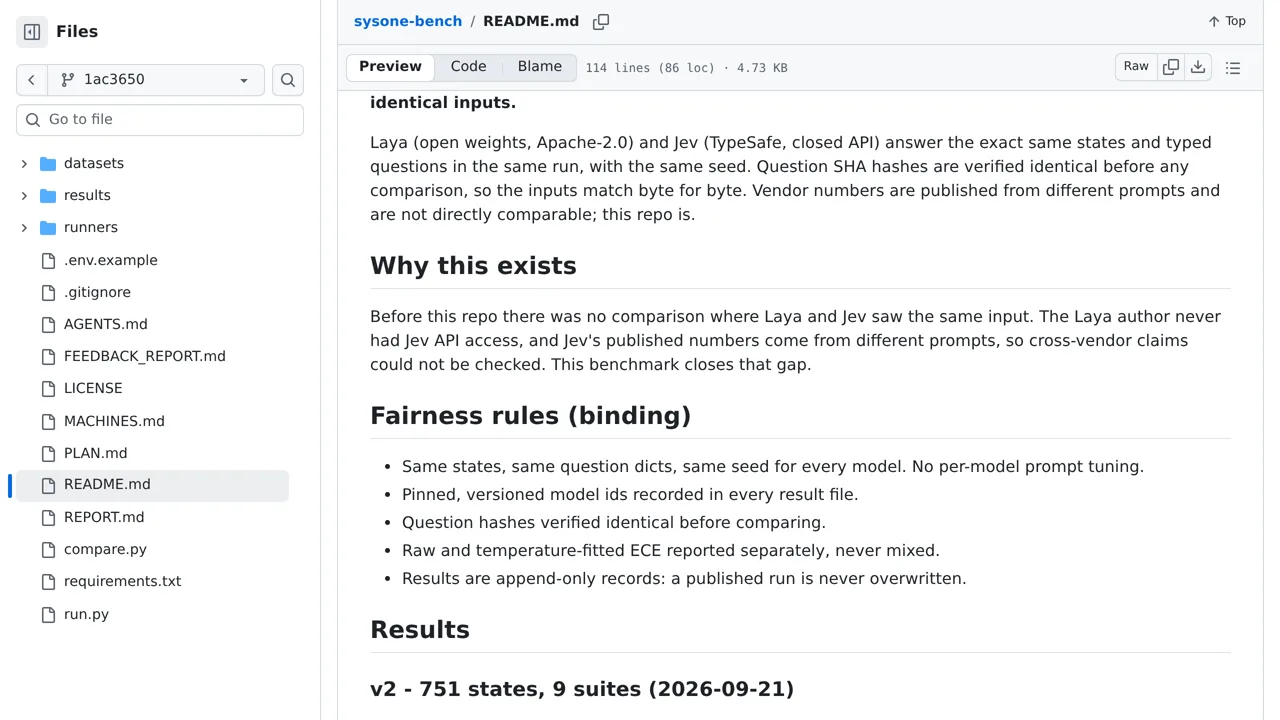
A head-to-head benchmark of open Laya against hosted Jev on byte-identical inputs in the same run, with question hashes verified identical before comparison.
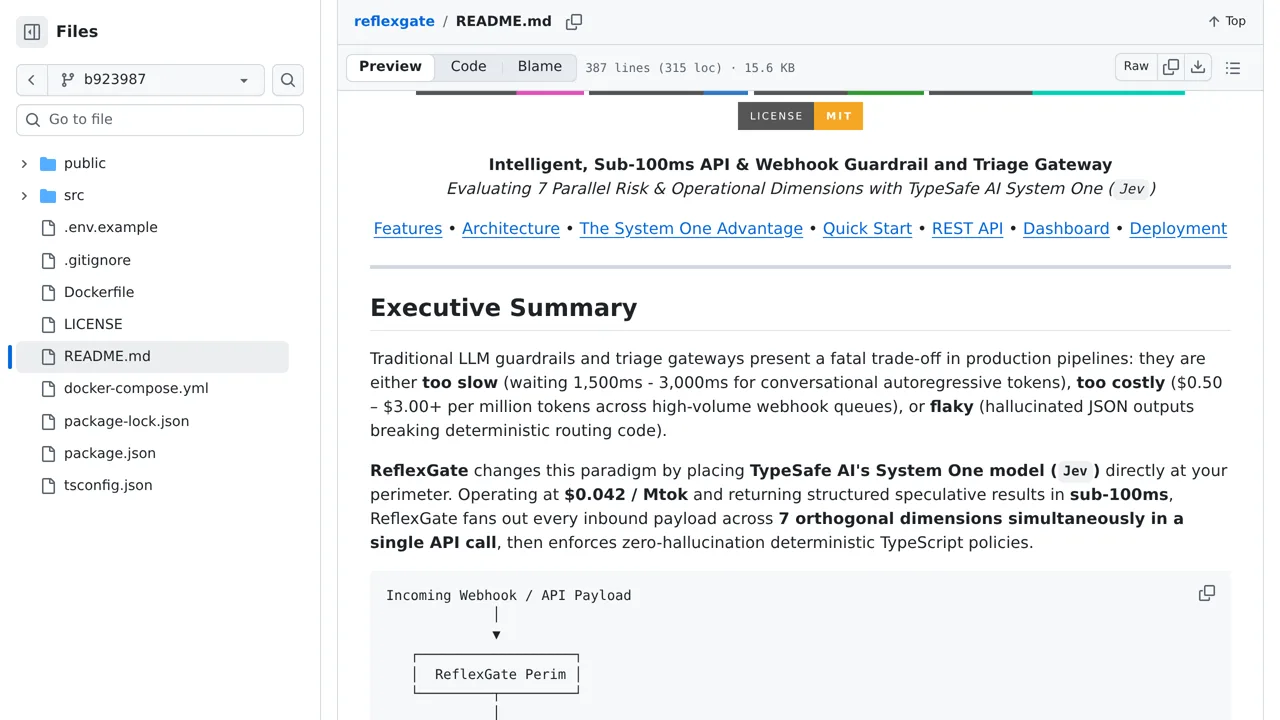
A guardrail gateway that fans every inbound payload across seven risk and operational dimensions in one System One call, then routes with deterministic TypeScript policy.
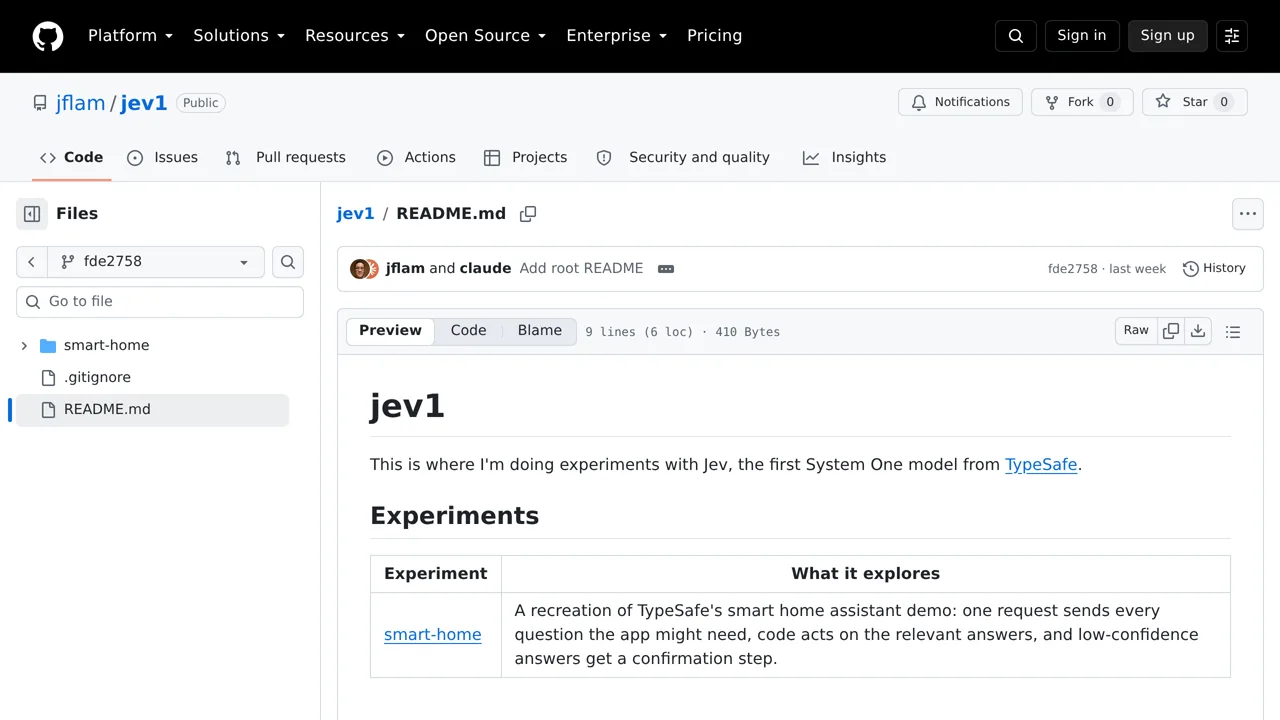
A smart-home assistant demo that recreates TypeSafe's own: one request carries every question the app might need, and low-confidence answers get a confirmation step.
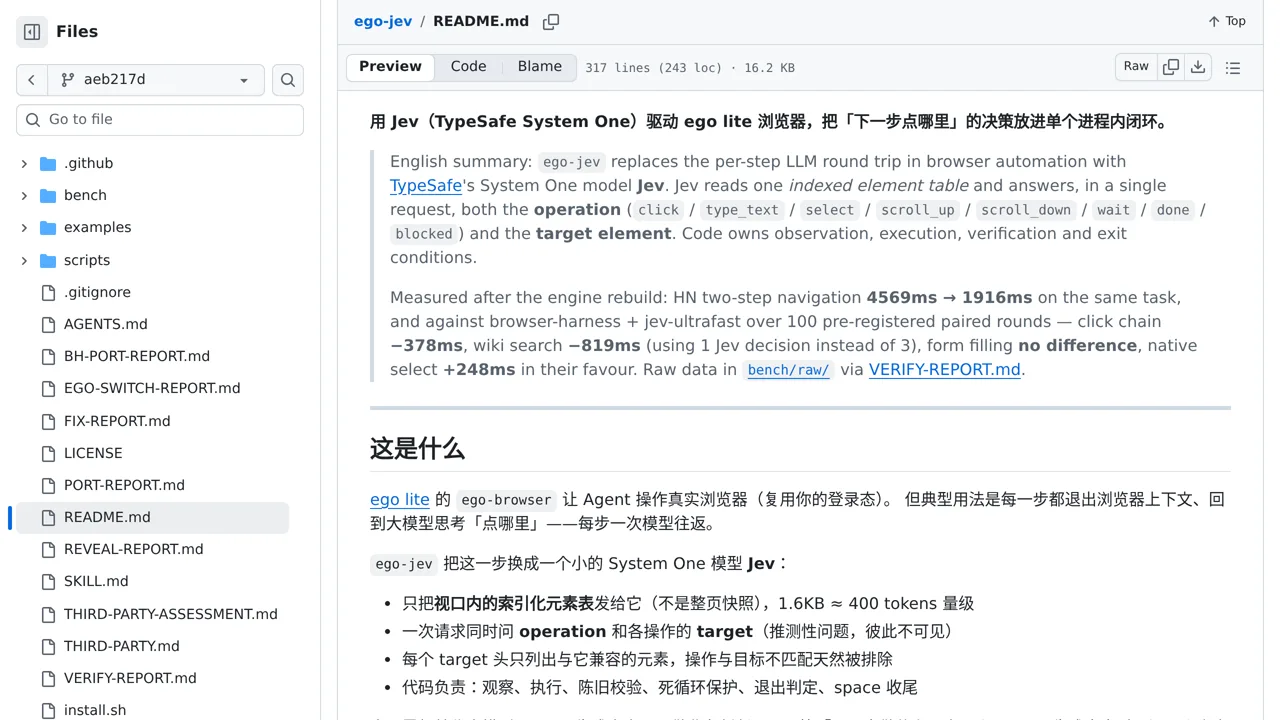
Drives the ego lite browser by sending one table of the page's elements and asking Jev for both the operation and its target at once.
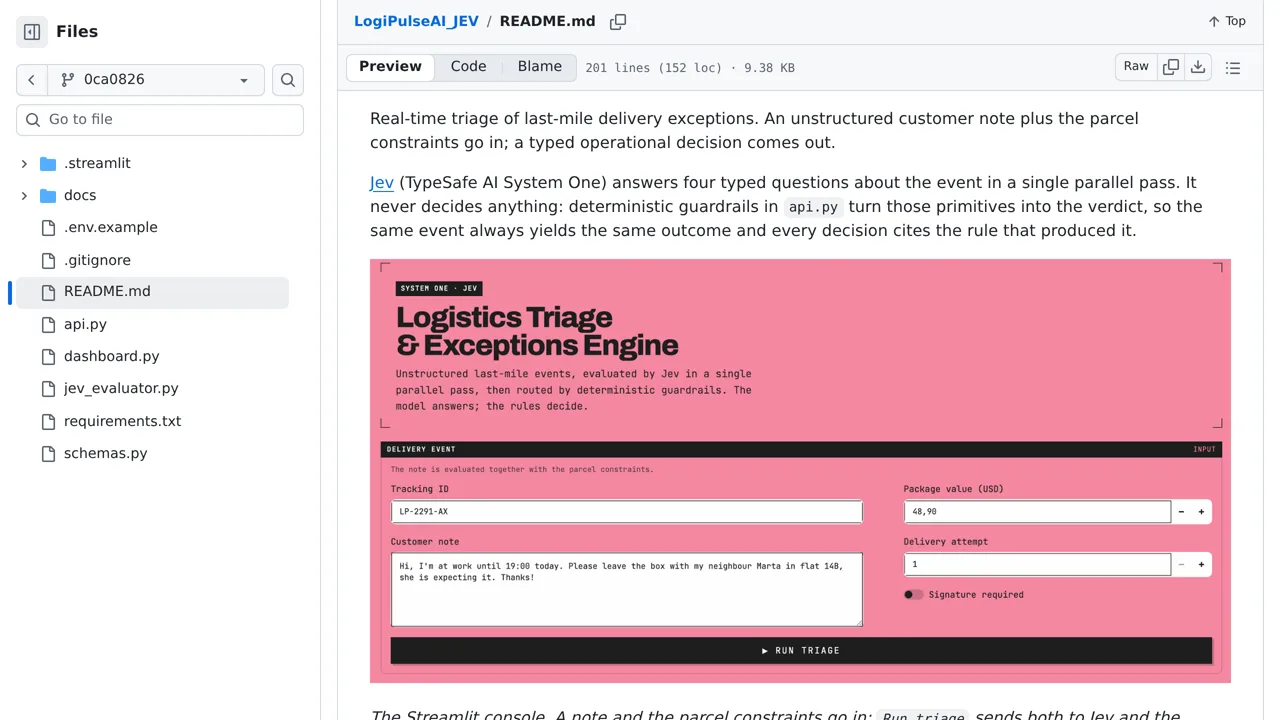
Real-time triage of last-mile delivery exceptions: a customer note and parcel constraints go in, four typed answers come back, and guardrails turn them into a verdict.
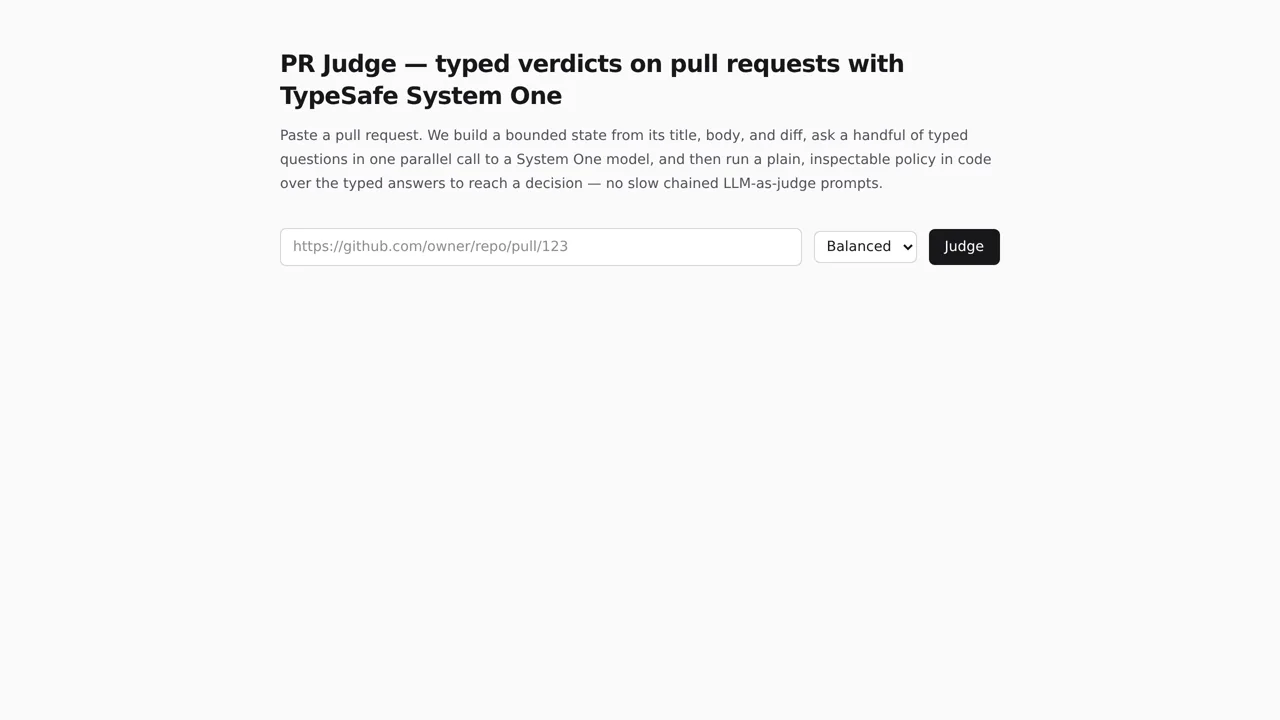
Judges whether a GitHub pull request does what it claims, from one parallel System One call over the title, body and diffs, with policy kept in tested TypeScript.
Checks content an agent is about to read for instructions aimed at the agent, and returns a trust verdict plus capability advice rather than a boolean.

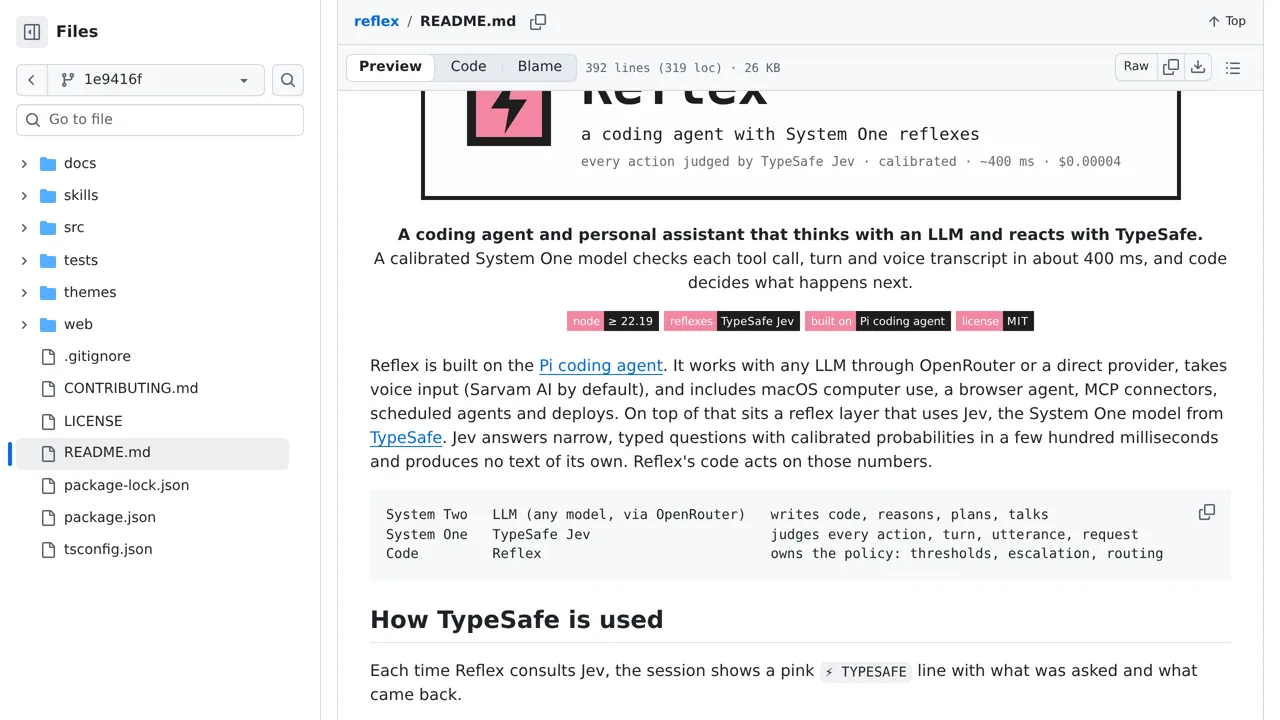
A coding agent that thinks with an LLM and reacts with Jev: every tool call, turn and voice transcript is checked in about 400 milliseconds and code decides.
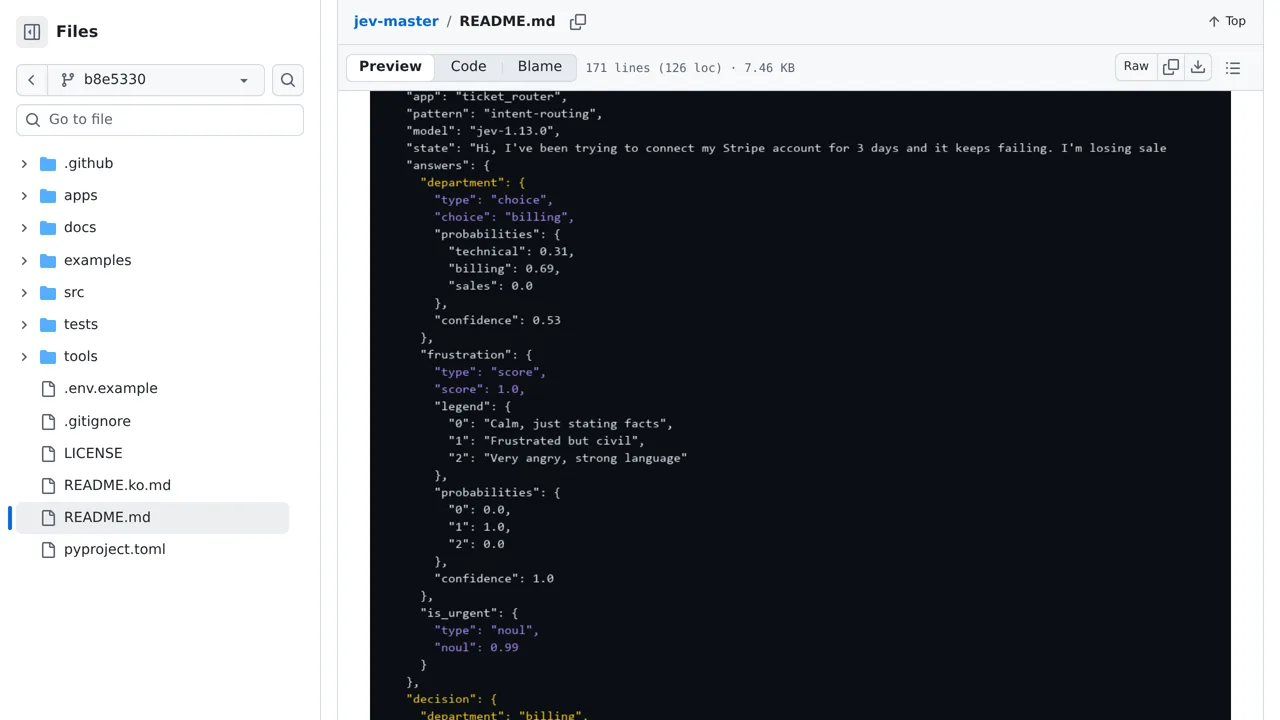
Seven small compose apps on a live System One client: ticket routing, a confidence gate, pitch scoring, a canned bot, a tool harness, a merge gate and a browser playground.
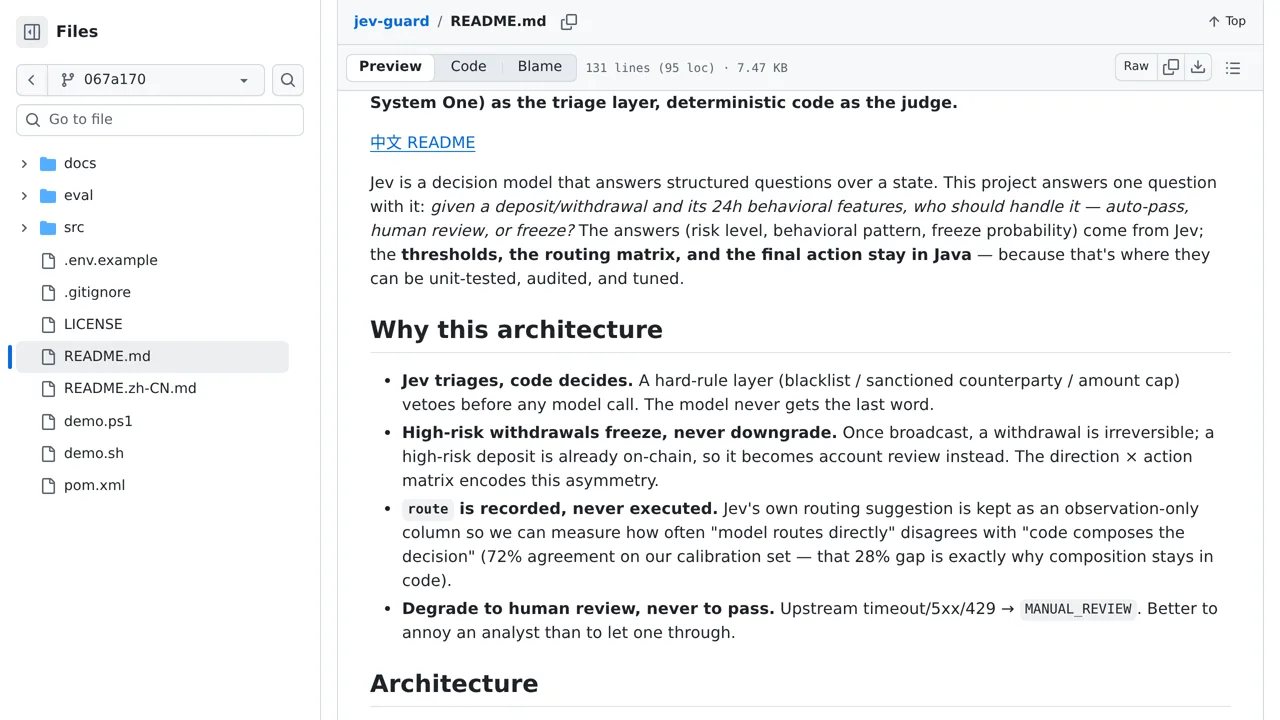
A risk triage gateway for crypto exchange deposits and withdrawals, where hard rules veto first and Jev answers four questions after them.
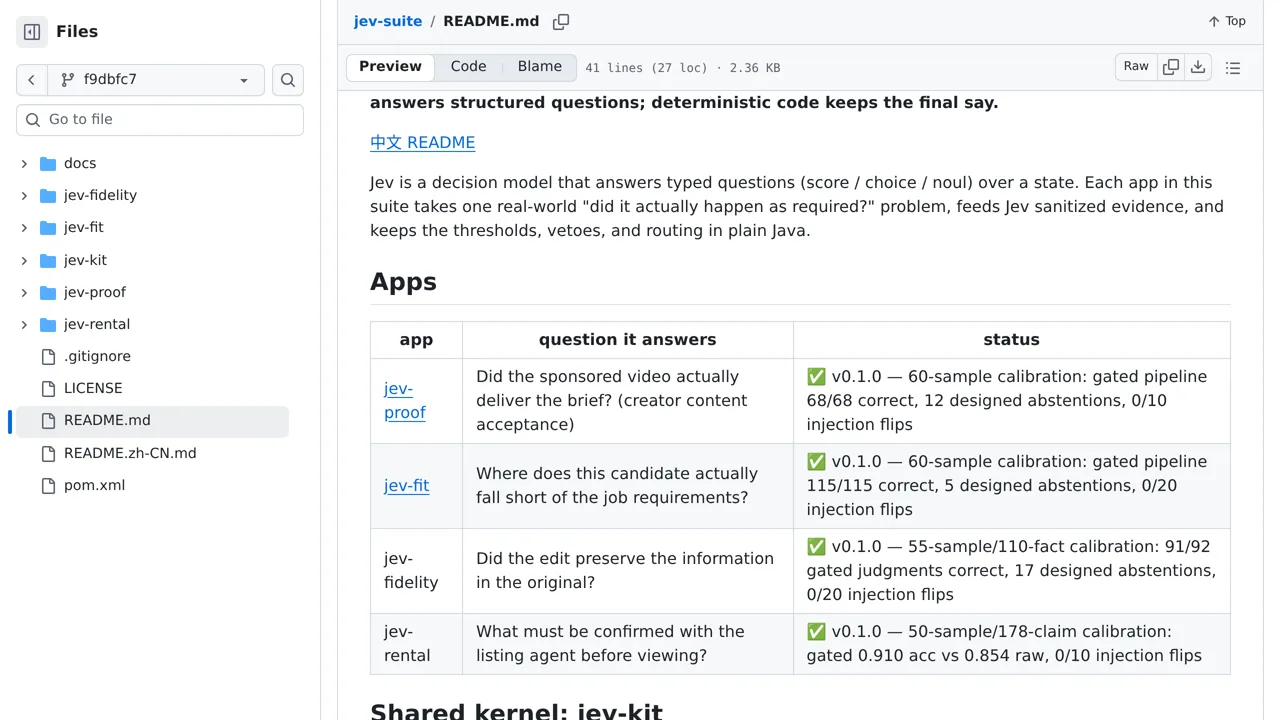
Four decision-quality tools on one shared kernel: did a sponsored video deliver the brief, where does a candidate fall short, did an edit preserve the information, and what needs confirming before a viewing.
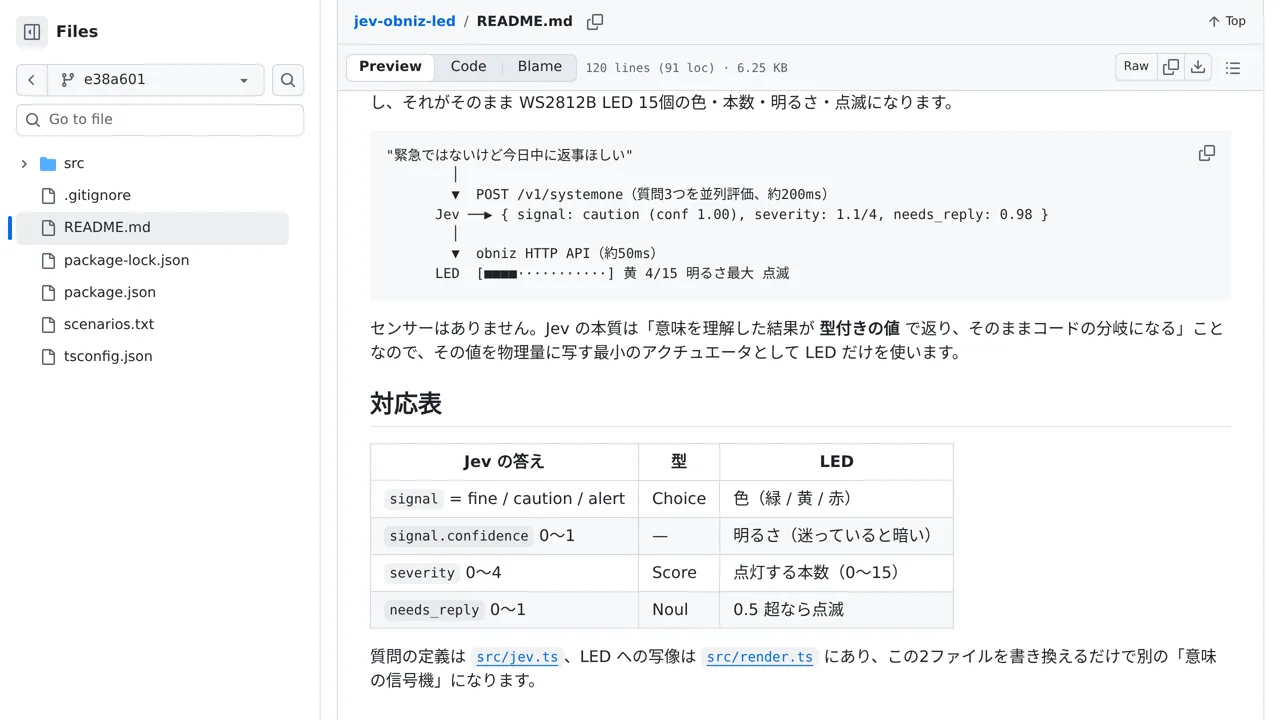
A physical hello world: one line of text becomes the colour, count, brightness and blinking of fifteen addressable LEDs on an obniz board.
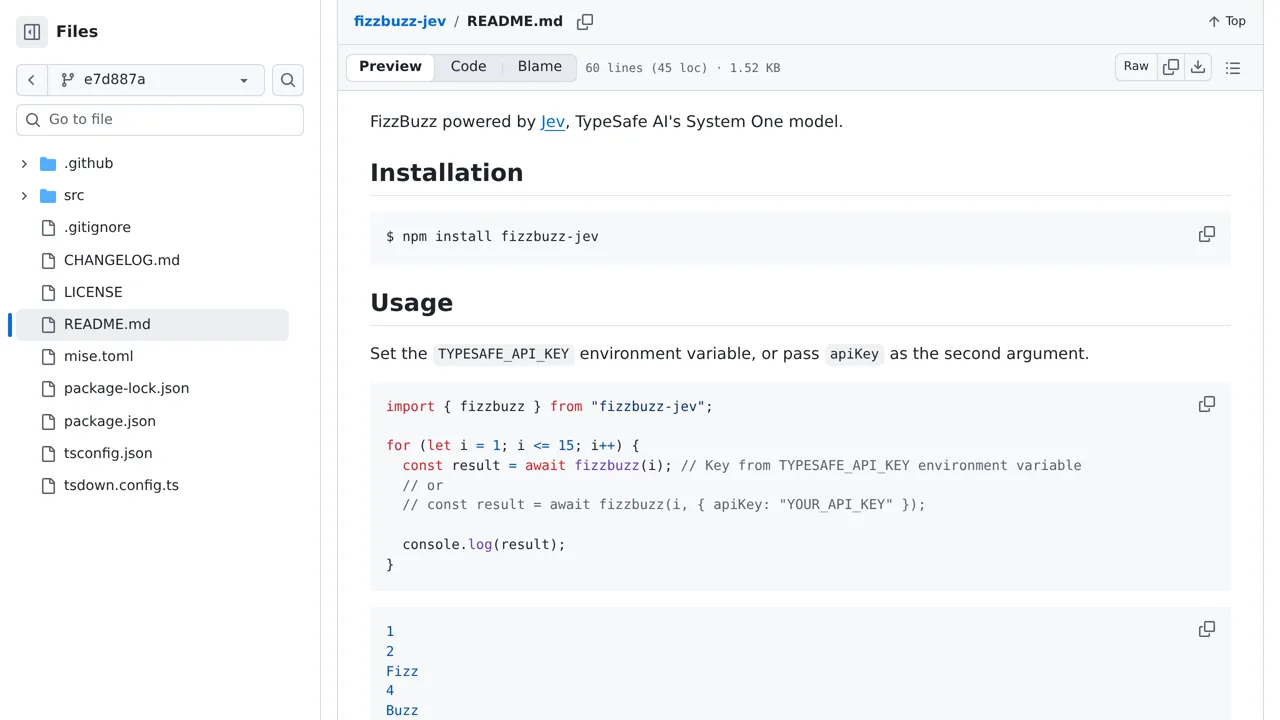
FizzBuzz implemented by asking Jev which term each number gets, one typed Choice per number.
Jev, briefly
A chat model generates text token by token and hopes you parse it. Jev never generates a word. Your code sends the state of the world plus typed questions; Jev returns every answer in one parallel pass — typed values with calibrated probabilities and a confidence score your code can trust. About 70–500 ms end to end, $0.042 per million input tokens, output free. Trained with what TypeSafe calls Reinforcement Learning for Calibrated Decisions.
You define the options. Jev returns the chosen option, a probability for every option, and a confidence. The workhorse of routing, agents, and games — the answer space is always legal, so there is nothing to parse and nothing to hallucinate.
You describe ordered levels — say trivial / normal / critical. Jev returns the level, the probability of each, and a confidence. Scores turn fuzzy judgment (“how severe is this log line?”) into a number-free decision your code can branch on.
You assert a statement; Jev returns the probability that it is true — a noul. Moderation, verification, guardrails, “does this diff actually fix the bug?”: one question, one calibrated probability.
Official material lives at typesafe.ai and docs.typesafe.ai. JevMade is an independent community registry — not affiliated with or endorsed by TypeSafe AI.
Recurring lessons
Games, drones, trading bots, and browser agents all converge on the same loop: serialize the state, ask one decisive question, act, repeat. Jev’s latency makes the loop feel instant — the model lives inside the control loop, not outside it.
The answer says what; the confidence says whether to act. The most reliable entries threshold on confidence to route edge cases to a slower model or a human — automation with an honest escape hatch.
Makers rarely ask Jev to pick from everything. Local tactics prune 225 gomoku moves to ~40; DOM filters turn a page into an element table; code narrows options, Jev judges within them.
A recurring split: Jev makes every decision cheaply and instantly, and a small LLM is only invoked when a human-facing string must actually be written. Decision and generation are separate budgets.
Send the link — repo, live demo, post, or video — plus a line on what it does and which primitives it uses. Every entry is verified against its primary source before it ships.
Submit your experiment → hello@JevMade.com