JevMade hello@JevMade.com
← Back to guides

JevMade field notes / Research paper

Using an AI tool to check medical reports for factual mistakes

This guide explains how researchers test an AI tool that compares computer-generated medical reports against human-written ones. The software breaks down sentences to spot added, missing, or changed medical facts.

Original by Jiaju Huang, Hao Yang, Xinyu Ma, Xinglong Liang, Kunyan Cai, Junqiang Ma, Shaobin Chen, Yue Sun, and Tao TanEvaluation

Listen to this guide

JevMade’s plain-English explanation

0:00 /

AI narration

Credits

“Can Jev Judge Radiology Reports? Evaluating a System One Model for Clinical Factuality” by Jiaju Huang, Hao Yang, Xinyu Ma, Xinglong Liang, Kunyan Cai, Junqiang Ma, Shaobin Chen, Yue Sun, and Tao Tan. Read the original source.

This expanded guide is an AI-narrated adaptation prepared by JevMade. It expands the source’s essential ideas, examples and caveats in JevMade’s own words and is not a word-for-word reading. The synthetic voice does not imitate the author or imply their endorsement.

Our summary

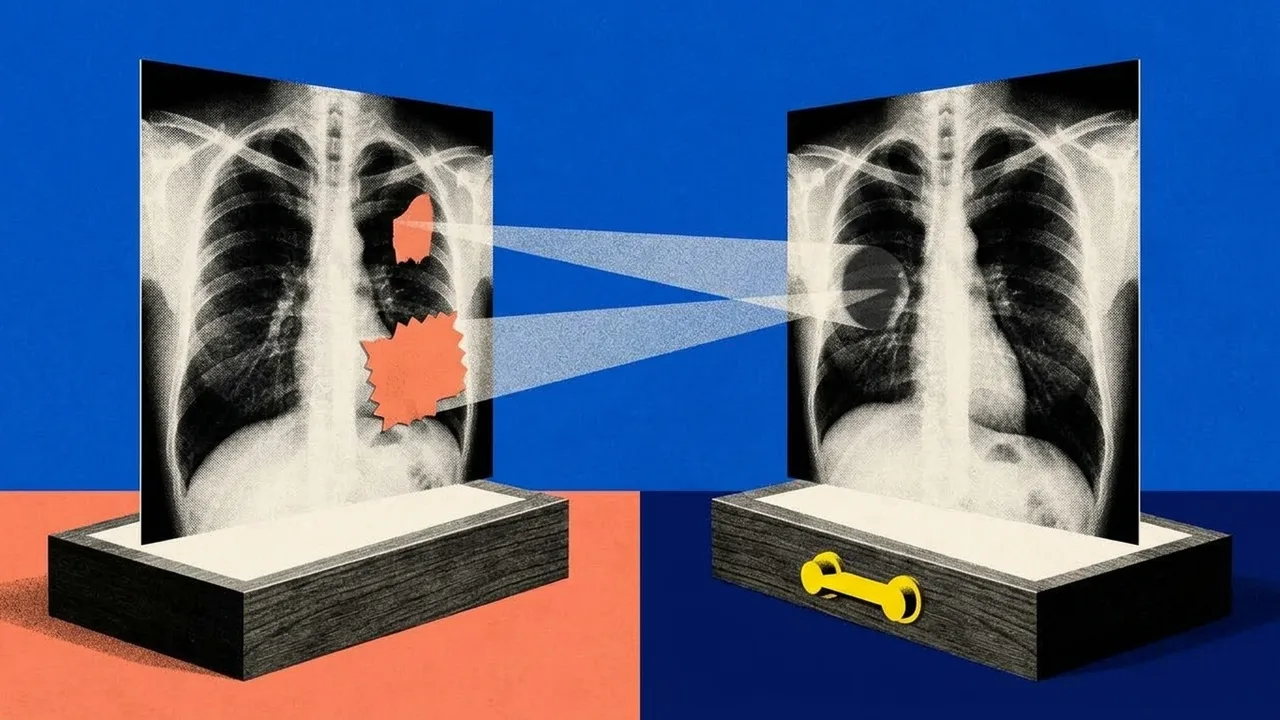
Researchers test a way to check if computer-generated X-ray reports match what a human doctor wrote. Developers use this method to evaluate their AI assistants. It helps them see if the software invents medical conditions or leaves out important details from a patient record.

The software splits both reports into single medical facts. It then uses Jev, an AI tool that chooses from options rather than writing an answer. For every fact, Jev decides if the opposing report supports it, contradicts it, or ignores it completely. Checking both directions catches missing information.

This approach is useful for researchers building medical AI assistants. The authors report that the tool's scores correlated with expert ratings, and asking one question per fact reduced the amount of text processed by 43 to 45 percent. However, in these tests, a different method called RadMatch caught more serious medical mistakes.

Key takeaways

  1. The software breaks reports into single facts before comparing them to avoid missing small details.
  2. Checking facts in both directions helps find both invented claims and missing medical information.
  3. Asking one question per fact reduced the amount of text processed by 43 to 45 percent.

The reported low cost excludes the initial text-splitting step, and the software only compares text without proving the human doctor's report is medically correct. These findings rely on author-reported tests using small expert groups rather than independent checks.

arXiv preprint · Source reviewed · Original published

Read the original guide Opens the author’s site in a new tab.