Getting started
Start with the essentials.
Choose an introduction, then explore a worked example.
86 videos · showing 49–72
 ▶
4:58
▶
4:58
by EzCademy
Prakash introduces TypeSafe's Jev model, explaining how its three primitives—Noul, Score, and Choice—score predefined answers with probabilities. The tutorial covers pairing reflexive System 1 routing with larger generative models and demonstrates use cases like agent skill selection.
Duration: 4 minutes 58 seconds.
 ▶
11:14
▶
11:14
by Franklin AI
Franklin reviews TypeSafe AI's Jev decision engine, demonstrating its structured choice-making across gameplay, guardrails, classification playground examples, and developer documentation.
Duration: 11 minutes 14 seconds.
 ▶
10:20
▶
10:20
by hdeleon.net
Héctor de León explains TypeSafe AI's Jev decision model and demonstrates querying its HTTP API in C#. He walks through formatting JSON payloads for binary Noul evaluations and multiclass choice categorizations.
Duration: 10 minutes 20 seconds.
 ▶
10:24
▶
10:24
by mariusbuilds
Marius explains how TypeSafe AI's Jev differs from generative LLMs by outputting fast structured decisions rather than text. He demonstrates its three decision types—choice, score, and Noul—and shares informal custom comparison experiments evaluating speed, parallel evaluation, and classification consistency.
Duration: 10 minutes 24 seconds.
 ▶
10:07
▶
10:07
by Yash Thakker
Yash Thakker introduces TypeSafe AI's Jev model, explaining its positioning as a fast system-one decision engine. He walks through Jev's core primitives—Noul, choice, and score—in the web playground and demonstrates a demo repository testing decision tasks against GPT-4o mini.
Duration: 10 minutes 7 seconds.
 ▶
14:41
▶
14:41
by AI Revolution
This video breaks down TypeSafe AI's Jev model, explaining its parallel decision architecture, pricing and speed claims, evaluation caveats, and practical software automation use cases.
Duration: 14 minutes 41 seconds.
 ▶
40:40
▶
40:40
by Carlos Alarcón - AI
Carlos Alarcón explains TypeSafe AI's Jev model architecture, contrasting System 1 parallel sampling against autoregressive LLMs. He reviews its core decision primitives, tests moderation and triage scenarios, and implements a ticket classification pipeline using the Python SDK.
Duration: 40 minutes 40 seconds.
 ▶
32:12
▶
32:12
by David Ondrej
David Ondrej explains Jev's parallel decision architecture and demonstrates building and deploying an intelligent lead qualification web app powered by Jev on a Hostinger VPS with Coolify.
Duration: 32 minutes 12 seconds.
 ▶
16:16
▶
16:16
by Hasan Faraz Khan
This tutorial introduces TypeSafe's Jev decision model in Hindi. The presenter contrasts parallel option scoring against autoregressive LLM generation, walks through the TypeSafe web playground, inspects JSON scoring and resume screening schemas, and demonstrates sending requests to the REST API via a Python script.
Duration: 16 minutes 16 seconds.
 ▶
5:02
▶
5:02
by Innovator Coffee
This overview explains TypeSafe AI's Jev as a System 1 decision engine that scores and chooses among predefined options instead of generating tokens. It addresses viral demo misconceptions and explores practical applications like model routing, security guardrails, and parallel agent execution.
Duration: 5 minutes 2 seconds.
 ▶
4:10
▶
4:10
by Julian Goldie SEO
This tutorial shows how to access TypeSafe AI's Jev model on Vercel's AI Gateway. It explains API key generation, card-on-file verification requirements, and provides demonstrations of Jev executing fast real-time decisions for voice browser control and image modification workflows.
Duration: 4 minutes 10 seconds.
 ▶
22:07
▶
22:07
by Latent AI
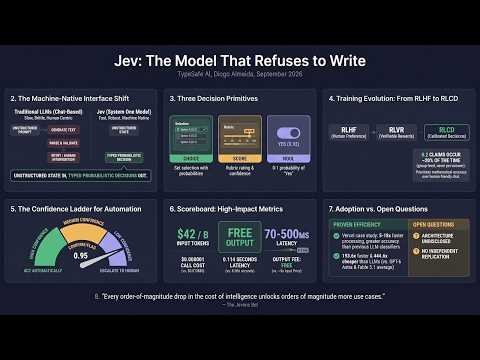
This deep dive details Jev, a non-generative decision model designed for backend automation using choice, score, and Noul primitives. It explores its synthetic RLCD training, parallel evaluation architecture, vendor-claimed performance metrics, and the developer burden of confidence-based thresholding.
Duration: 22 minutes 7 seconds.
 ▶
8:20
▶
8:20
by tacosdedatos
This video examines TypeSafe AI's Jev model, explaining its parallel evaluation of structured questions over a single state. It covers supported question formats, access options, and key operational limitations.
Duration: 8 minutes 20 seconds.
 ▶
13:36
▶
13:36
by Brandon Roberts
Brandon Roberts explains TypeSafe AI's Jev model as a fast system-one decision engine. He reviews core differences from traditional chat LLMs, examines platform primitives like choices, scores, and booleans, and demonstrates an automated GitHub issue triage CLI script using the TypeSafe SDK.
Duration: 13 minutes 36 seconds.
 ▶
25:51
▶
25:51
by Dan Vega
Dan Vega demonstrates how to interact with TypeSafe's Jev decision model using standard HTTP requests. He covers Jev's core primitives (Noul/boolean, choice, score) and shows how to call the REST endpoint using plain Java 25 HttpClient and Spring Boot RestClient with Java records.
Duration: 25 minutes 51 seconds.
 ▶
25:11
▶
25:11
by EDteam
EDteam explains Jev's architecture as a probability-based decision engine rather than a generative text LLM. They cover API payload design (state, questions, criteria) across choice, Noul, and score question types, run playground experiments highlighting prompt sensitivity, and showcase an MVP course recommender sorting real catalog entries using confidence scores.
Duration: 25 minutes 11 seconds.
 ▶
7:11
▶
7:11
by Caleb Writes Code
Caleb analyzes TypeSafe AI's Jev, examining how structured probabilistic outputs and primitive types enable rapid workflow automation compared to autoregressive LLMs.
Duration: 7 minutes 11 seconds.
 ▶
10:52
▶
10:52
by Gary Explains
Gary Explains breaks down TypeSafe AI's Jev model, contrasting System 1 probabilistic decision engines with conversational LLMs. He details the input state, query modes, pricing structure, and demonstrates interactive CLI requests showing sentiment analysis capabilities alongside logic and math limitations.
Duration: 10 minutes 52 seconds.
 ▶
7:10
▶
7:10
by 堀江貴文 ホリエモン
Takafumi Horie explains Jev, TypeSafe AI's specialized model focused strictly on decision-making rather than text generation. He discusses its probability outputs, tiered routing systems, and practical operational implications.
Duration: 7 minutes 10 seconds.
 ▶
7:48
▶
7:48
by Joe Maddalone
Joe Maddalone introduces TypeSafe's Jev model, explaining its typed decision primitives (choice, score, boolean). He demonstrates a TypeScript script processing video transcripts for routing and scoring before calling traditional LLMs.
Duration: 7 minutes 48 seconds.
 ▶
10:49
▶
10:49
by Lukas Margerie
Lukas Margerie sets up a coding assistant with TypeSafe’s quickstart and remixes community demos into custom tools. The examples include a Chrome extension, a video-component workflow, and voice-driven game changes; Jev is one component of the larger toolchain.
Duration: 10 minutes 49 seconds.
 ▶
4:53
▶
4:53
by Mau Seco
Mau Seco introduces TypeSafe AI's Jev, explaining how it trades verbose generative chat responses for fast, structured probabilistic decision outputs. Reviewing community demonstrations—including invoice verification, Super Mario gameplay, web browsing, ad categorization, and Claude integration—he explores how Jev functions in agentic pipelines.
Duration: 4 minutes 53 seconds.
 ▶
20:18
▶
20:18
by Riley Brown
Riley Brown explains TypeSafe's Jev decision model, demonstrating its structured outputs (choice, score, Noul) and showcasing practical applications in routing and email classification.
Duration: 20 minutes 18 seconds.
 ▶
15:04
▶
15:04
by Sarthaksavvy
The creator reviews TypeSafe AI's claimed metrics for Jev, contrasts its decision design with traditional conversational LLMs, and tests the invite-only web console playground using criteria definitions and structured queries.
Duration: 15 minutes 4 seconds.