The full collection
A different way to learn.
197 videos · showing 121–144
 ▶
10:36
▶
10:36
by Simplify Backend
This video breaks down the architectural contrast between generative LLMs and decision-oriented models like Jev. It examines how agent pipelines can replace monolithic LLM generation with specialized scoring, deterministic code, and routing.
Duration: 10 minutes 36 seconds.
 ▶
5:14
▶
5:14
by TechnoCouple
This video demonstrates using TypeSafe AI's Jev model with WebRTC and Deepgram to provide real-time decision-making and compliance guidance for human customer service agents.
Duration: 5 minutes 14 seconds.
 ▶
30:29
▶
30:29
by Theo - t3․gg
Theo examines Jev from TypeSafe AI, framing it as a fast System 1 classifier that guarantees JSON schema adherence. He demonstrates practical classification workflows, analyzes claimed speed and cost metrics, and explains why Jev cannot replace reasoning models for complex tasks.
Duration: 30 minutes 29 seconds.
 ▶
10:07
▶
10:07
by Yash Thakker
Yash Thakker introduces TypeSafe AI's Jev model, explaining its positioning as a fast system-one decision engine. He walks through Jev's core primitives—Noul, choice, and score—in the web playground and demonstrates a demo repository testing decision tasks against GPT-4o mini.
Duration: 10 minutes 7 seconds.
 ▶
17:34
▶
17:34
by AI mit Arnie
This German-language guide explains Jev's architecture as a decision-only model, dispels viral misconceptions about visual capabilities, analyzes limits like counting and negation, and demonstrates interactive classification alongside an open-source alternative.
Duration: 17 minutes 34 seconds.
 ▶
14:41
▶
14:41
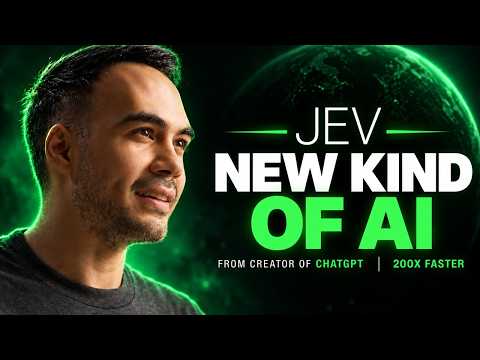
by AI Revolution
This video breaks down TypeSafe AI's Jev model, explaining its parallel decision architecture, pricing and speed claims, evaluation caveats, and practical software automation use cases.
Duration: 14 minutes 41 seconds.
 ▶
8:11
▶
8:11
by AI with Surya
Surya demonstrates Jev AI's decision-focused API, showing how it evaluates text across predefined multiple-choice questions, numeric scales, and boolean checks. Through custom UI tests, he benchmarks ticket routing and runs batch compliance audits over 200 customer support agent transcripts, highlighting reported speed, confidence probabilities, and pricing dynamics.
Duration: 8 minutes 11 seconds.
 ▶
8:21
▶
8:21
by Albert Olgaard
Albert Olgaard tests categorical choices, binary criteria, and rating scales in the TypeSafe console. He then combines Jev with Claude for task-complexity routing and a small guardrail demonstration that checks drafted replies for internal prompt disclosure.
Duration: 8 minutes 21 seconds.
 ▶
40:40
▶
40:40
by Carlos Alarcón - AI
Carlos Alarcón explains TypeSafe AI's Jev model architecture, contrasting System 1 parallel sampling against autoregressive LLMs. He reviews its core decision primitives, tests moderation and triage scenarios, and implements a ticket classification pipeline using the Python SDK.
Duration: 40 minutes 40 seconds.
 ▶
32:12
▶
32:12
by David Ondrej
David Ondrej explains Jev's parallel decision architecture and demonstrates building and deploying an intelligent lead qualification web app powered by Jev on a Hostinger VPS with Coolify.
Duration: 32 minutes 12 seconds.
 ▶
9:26
▶
9:26
by Deep Learner, One Step at a Time
This video examines TypeSafe's Jev model, explaining its three mathematical primitives (Choice, Score, Noul) and parallel classification architecture. It critically dissects TypeSafe's benchmark methodology, benchmark judge consensus limitations, why 0% hallucination guarantees schema format rather than factual truth, and the rapid emergence of open-source community replicas.
Duration: 9 minutes 26 seconds.
 ▶
16:16
▶
16:16
by Hasan Faraz Khan
This tutorial introduces TypeSafe's Jev decision model in Hindi. The presenter contrasts parallel option scoring against autoregressive LLM generation, walks through the TypeSafe web playground, inspects JSON scoring and resume screening schemas, and demonstrates sending requests to the REST API via a Python script.
Duration: 16 minutes 16 seconds.
 ▶
5:02
▶
5:02
by Innovator Coffee
This overview explains TypeSafe AI's Jev as a System 1 decision engine that scores and chooses among predefined options instead of generating tokens. It addresses viral demo misconceptions and explores practical applications like model routing, security guardrails, and parallel agent execution.
Duration: 5 minutes 2 seconds.
 ▶
11:53
▶
11:53
by Jack Roberts
Jack Roberts demonstrates TypeSafe's Jev model across practical micro-decision tasks, comparing observed latency and cost against frontier models. He explains Jev's output modes—binary decisions, preloaded option selection, and numerical scoring—and illustrates how to leverage Jev alongside generative LLMs for email triage, slop detection, design matching, and model routing.
Duration: 11 minutes 53 seconds.
 ▶
2:44:40
▶
2:44:40
by Jeremy Chone
Jeremy Chone live-codes an ergonomic Rust library for TypeSafe AI's Jev model, inspecting its API request structure, typed criteria, probability outputs, and architectural trade-offs.
Duration: 164 minutes 40 seconds.
 ▶
4:10
▶
4:10
by Julian Goldie SEO
This tutorial shows how to access TypeSafe AI's Jev model on Vercel's AI Gateway. It explains API key generation, card-on-file verification requirements, and provides demonstrations of Jev executing fast real-time decisions for voice browser control and image modification workflows.
Duration: 4 minutes 10 seconds.
 ▶
22:07
▶
22:07
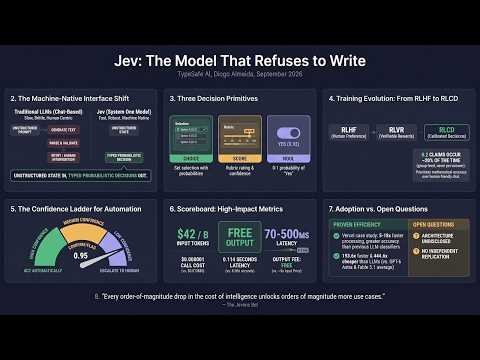
by Latent AI
This deep dive details Jev, a non-generative decision model designed for backend automation using choice, score, and Noul primitives. It explores its synthetic RLCD training, parallel evaluation architecture, vendor-claimed performance metrics, and the developer burden of confidence-based thresholding.
Duration: 22 minutes 7 seconds.
 ▶
17:51
▶
17:51
by LVLUP
Didier Sampaolo demonstrates Jev on support tickets, batch classification, and blog tags. He contrasts its zero-shot setup with a trained classifier and proposes testing alternative category trees before reorganizing a product catalog.
Duration: 17 minutes 51 seconds.
 ▶
16:08
▶
16:08
by Nate Herk | AI Automation
Nate Herk tests Jev across various practical classification workflows, including inbox sorting, an X feed Chrome extension, meeting analytics, and real-time paper trading. He explains Jev's output modalities (boolean, categorical choices, numeric scores) and highlights that production use requires rigorous golden-set evals and handoffs to generative models for execution.
Duration: 16 minutes 8 seconds.
 ▶
8:08
▶
8:08
by plain.
This video examines TypeSafe's Jev model, explaining its non-autoregressive parallel sampler architecture, three question primitives, and RLCD training. It critically analyzes vendor speed and cost claims versus third-party tests by Every, and details where fast, typed probabilistic judgments fit within production AI stacks.
Duration: 8 minutes 8 seconds.
 ▶
8:20
▶
8:20
by tacosdedatos
This video examines TypeSafe AI's Jev model, explaining its parallel evaluation of structured questions over a single state. It covers supported question formats, access options, and key operational limitations.
Duration: 8 minutes 20 seconds.
 ▶
7:12
▶
7:12
by AgentenFabrik
AgentenFabrik tests TypeSafe AI's Jev model for classification, browser automation, and gaming. Comparing it directly against GPT in small email triage tests, the creator evaluates execution speed against decision quality, including an XRP paper trading test and the practical engineering hurdles of connecting Jev to live game state feeds.
Duration: 7 minutes 12 seconds.
 ▶
28:37
▶
28:37
by まさおAIじっくり解説ch
This video breaks down TypeSafe AI's Jev model, explaining its typed decision structure, practical optimization tips for states and criteria, hands-on empirical comparisons against LLMs, and how to effectively divide labor between code, Jev, and generative LLMs.
Duration: 28 minutes 37 seconds.
 ▶
6:47
▶
6:47
by AI Democracy
This Telugu walkthrough introduces TypeSafe's Jev model for classification tasks. It compares latency and costs against standard LLMs on a 100-tweet sentiment test, walks through client code setting custom choices like bot detection, and explains Jev's parallel decision-making design.
Duration: 6 minutes 47 seconds.