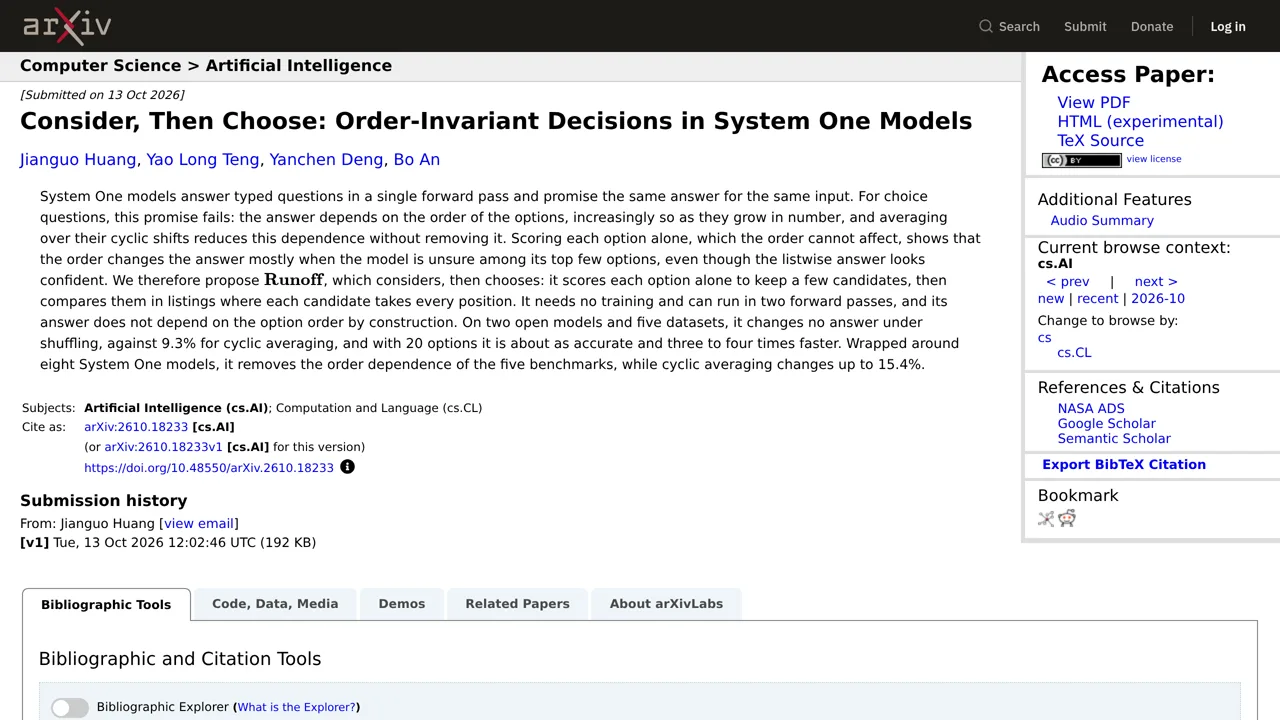
Standard fast classification models often change their answers simply because option presentation order changes, especially when comparing many choices. Runoff tackles this without extra model training via a two-stage process: it isolates each choice into an independent yes/no prompt to collect top contenders, then runs cyclic position shifts among those finalists. In reported benchmarks, Runoff achieved a 0.0% flip rate across deterministic open models. However, its effectiveness drops slightly on complex reasoning tasks, and small flip rates persist when remote service connections return inconsistent probabilities.
How you can use it
If your app changes its answer when you reorder a menu, borrow Runoff’s two-stage comparison. Score each option on its own, keep the leading candidates, then rotate those candidates through every position and average their scores. A developer must implement the method; it does not guarantee correct reasoning or eliminate inconsistent remote-service answers.