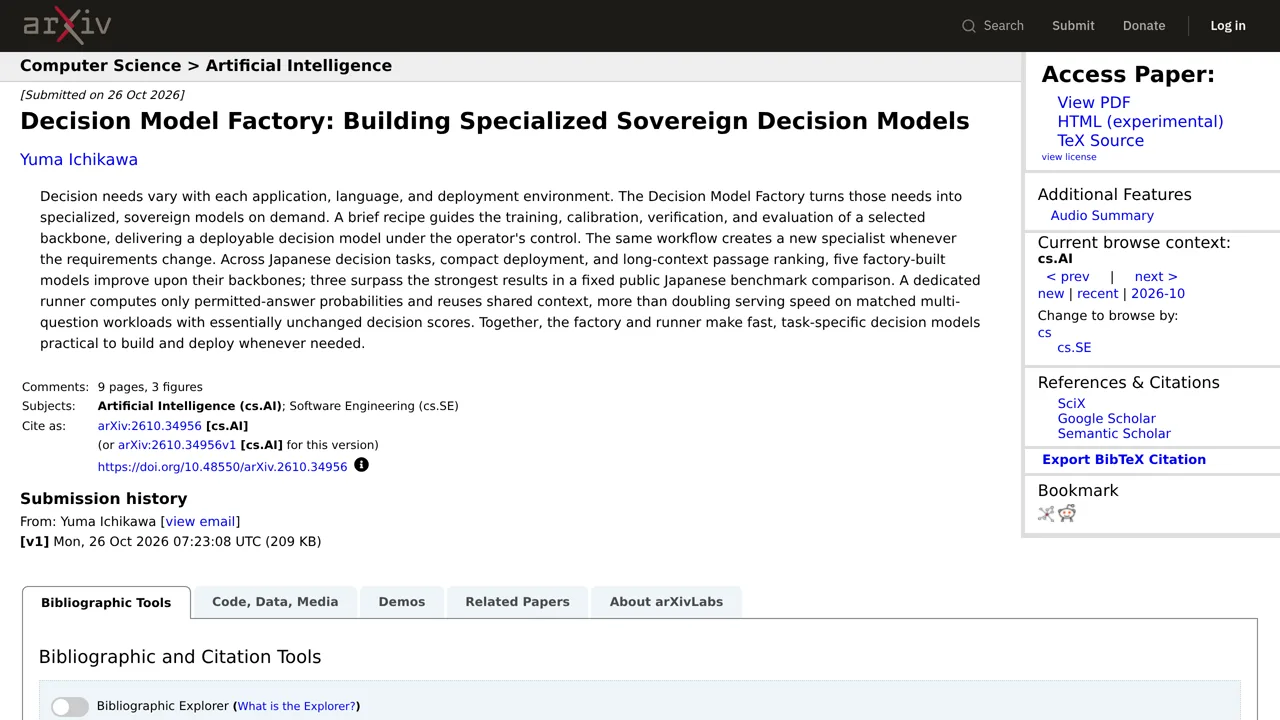
Fujitsu Research's Decision Model Factory turns a short recipe into a specialised decision model: one pipeline trains, calibrates, verifies and evaluates a chosen backbone, so a new language or task changes the recipe, not the pipeline.
Yuma Ichikawa's preprint reports five factory-built models, for Japanese decision tasks, compact deployment and long-context passage ranking, all improving on their backbones; three beat the strongest results in a fixed public Japanese benchmark comparison. A dedicated runner scores only the allowed answers and reuses shared context, which Fujitsu says gave a 2.44× speedup for eight questions about the same state. It is a single-author preprint and has not been peer reviewed.
How you can use it
You can have a developer borrow this preprint's approach to building specialised decision models. Instead of rebuilding the whole setup for each new job, the team writes a short recipe that guides how a chosen base model is trained, calibrated, checked and tested for one task.
A second idea is the runner: when several questions share the same background text, it reuses that text and scores only the allowed answers. The abstract page links no ready-to-use code, so your team would build this themselves, and the results are the author's own, not peer reviewed.