What it does
The tests hold candidate lists fixed, so they measure reranking rather than an entire recommendation service. Jev runs through a hosted API while the other models run locally; the latency comparison is not hardware-normalized.
Benchmarks & research
A study compares Jev with Qwen and recommendation models when reordering candidate books, games and films for a reader's next choice.
Only you can see your notes.
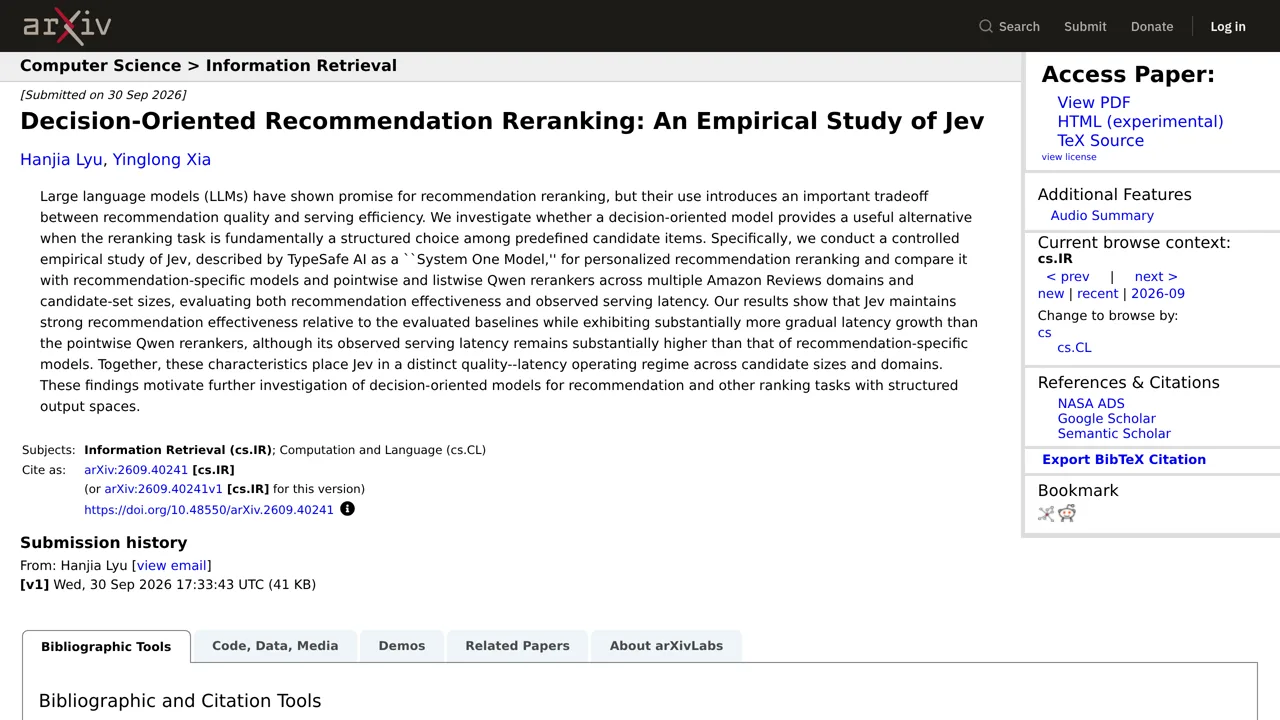
Screenshot unavailable. Open the experiment ↗
The tests hold candidate lists fixed, so they measure reranking rather than an entire recommendation service. Jev runs through a hosted API while the other models run locally; the latency comparison is not hardware-normalized.
A developer can borrow this testing method to evaluate recommendation tools for an app. The developer provides a user's recent history and a short list of options. This fixed list contains one correct answer and several believable choices.
To try Jev, a developer sends these options over the internet to a remote service. The service decides how likely a user is to pick each item. An app uses these scores to put the best suggestions first. This method only tests reordering items, not searching an entire catalog.