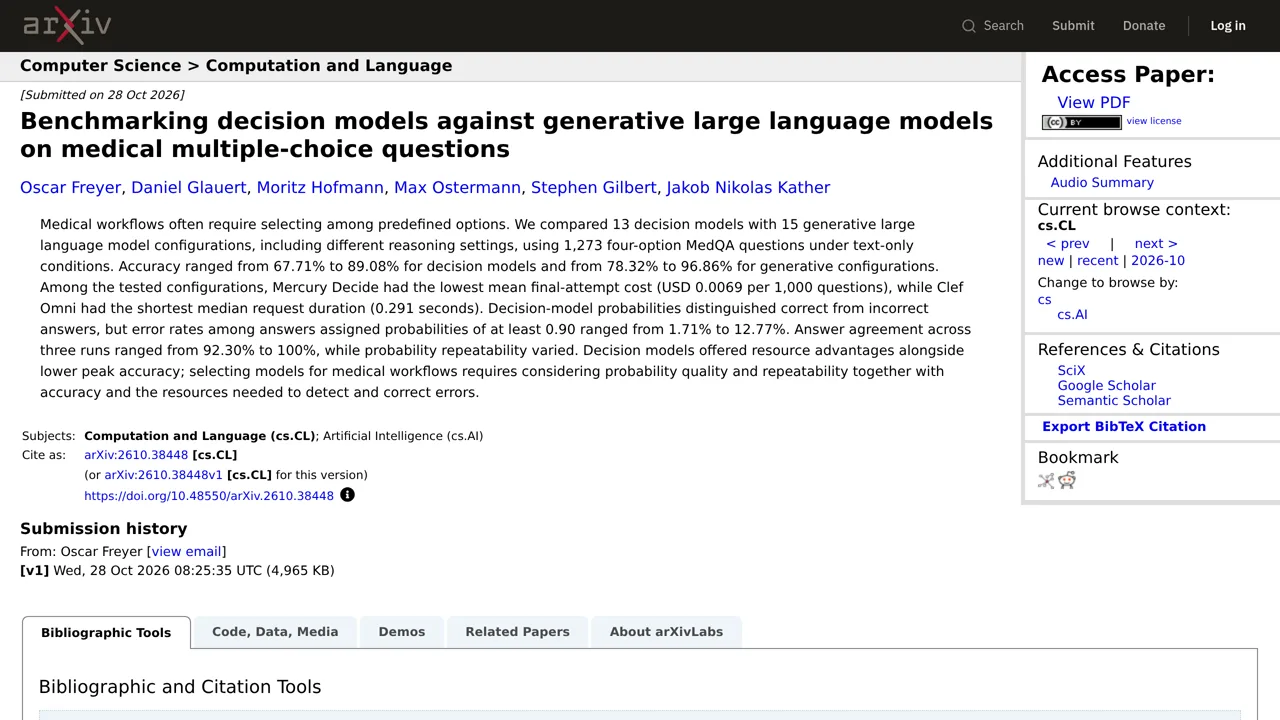
Six researchers put 13 decision models and 15 generative AI setups through 1,273 four-option MedQA exam questions, comparing accuracy, cost, speed and how far each model's confidence can be trusted.
Decision models scored 67.71% to 89.08% and generative setups 78.32% to 96.86%; Jev reached 88.30%. The decision models were usually cheaper and faster, yet answers they gave at least 0.90 probability were still wrong 1.71% to 12.77% of the time. These are exam questions with the options already supplied, so the results say nothing about clinical safety.
How you can use it
You can adapt this evaluation method to test how well different AI systems pick answers from a fixed list of options. A developer can use the researchers' open-source code and a sample set of multiple-choice questions to compare accuracy, cost, and speed across various models.
The study also shows how to track the confidence scores that decision models report. Even when a model claims high certainty, it can still choose the wrong answer. Because these were standardized exam questions, the results do not prove that any model is safe for actual medical care.