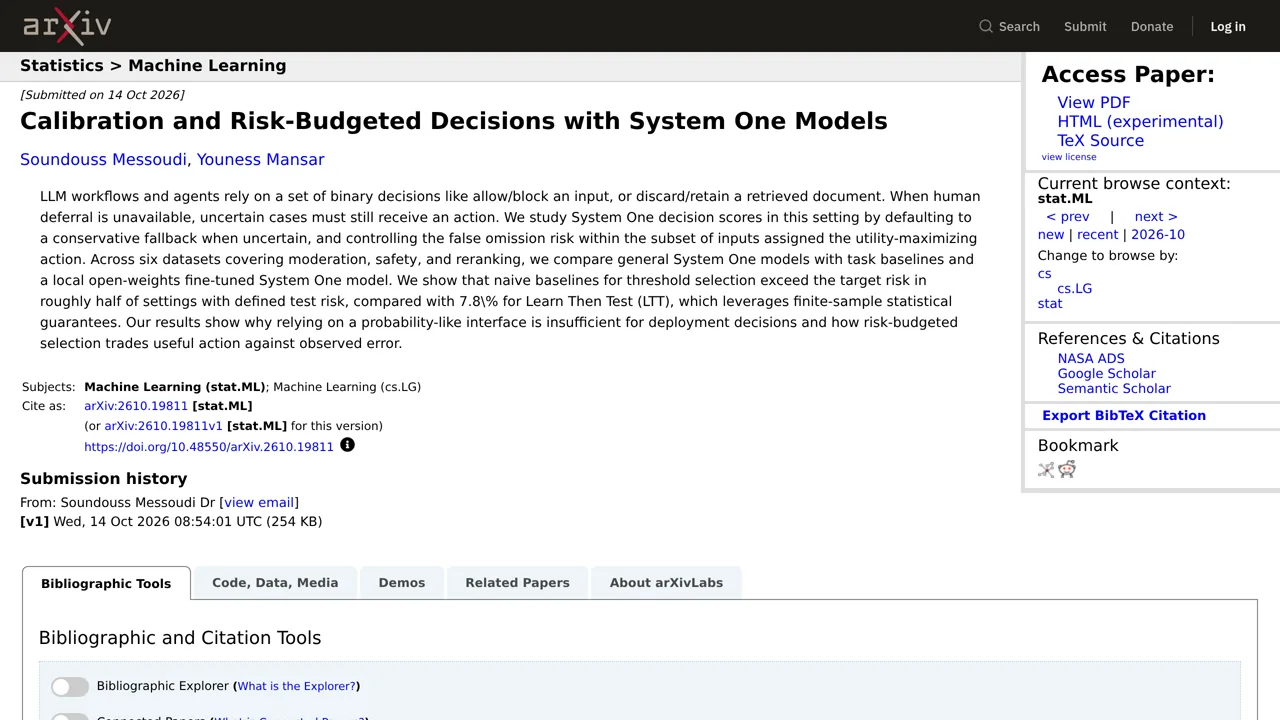
A research experiment testing statistical threshold certification on fast binary language model decisions when deferring to human reviewers is impossible.
Automated language model workflows often require quick yes-or-no choices, such as blocking unsafe prompts or discarding unneeded documents, without human intervention. While lightweight models provide probability scores, researchers evaluated whether these scores reliably guard against critical mistakes. Across six moderation, safety, and reranking benchmarks, naive score cutoffs frequently breached targeted error budgets. Applying Learn Then Test (LTT) statistically controls false omissions under finite-sample assumptions, but strict risk budgets often result in no certifiable policy, forcing systems to default entirely to conservative safety fallbacks.
How you can use it
For software that cannot ask a person, copy the paper’s separation of useful actions from cautious defaults. Test candidate score cutoffs on labelled examples kept apart from training. An uncertified input stays blocked, while an uncertain document stays retained. A developer needs to implement the statistical test; sometimes no useful cutoff qualifies.