Read & learn
Written guides.
Understand Jev, one idea at a time. Walkthroughs, recipes, and writeups — our notes first, the original next.
Learn, build, and play with Jev — from deep technical guides to creative experiments.
Read & learn
Understand Jev, one idea at a time. Walkthroughs, recipes, and writeups — our notes first, the original next.
Watch & learn
See an idea take shape. Tutorials, demos, and deep dives, organized by topic and credited to their creators.
Make & explore
See what builders made with Jev. Games, tools, repositories, articles, and more — traced to their sources.
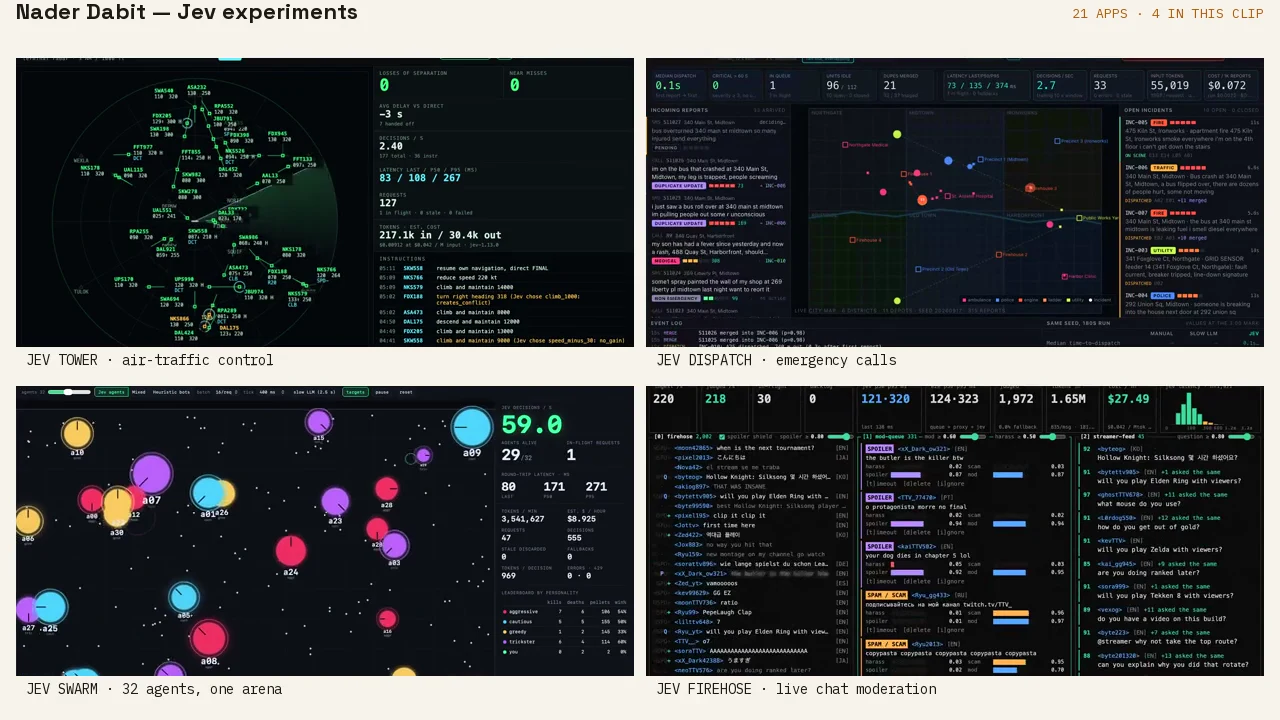
Every category, from games and tools to repositories and writeups, traced to a primary source.
Real-time research powered by
Same ideas.
Different paths.
This is the full registry, not just the featured picks. Figures like speed, cost, and stars are maker-reported or captured snapshots, not JevMade measurements.
2140 experiments · showing 841–900
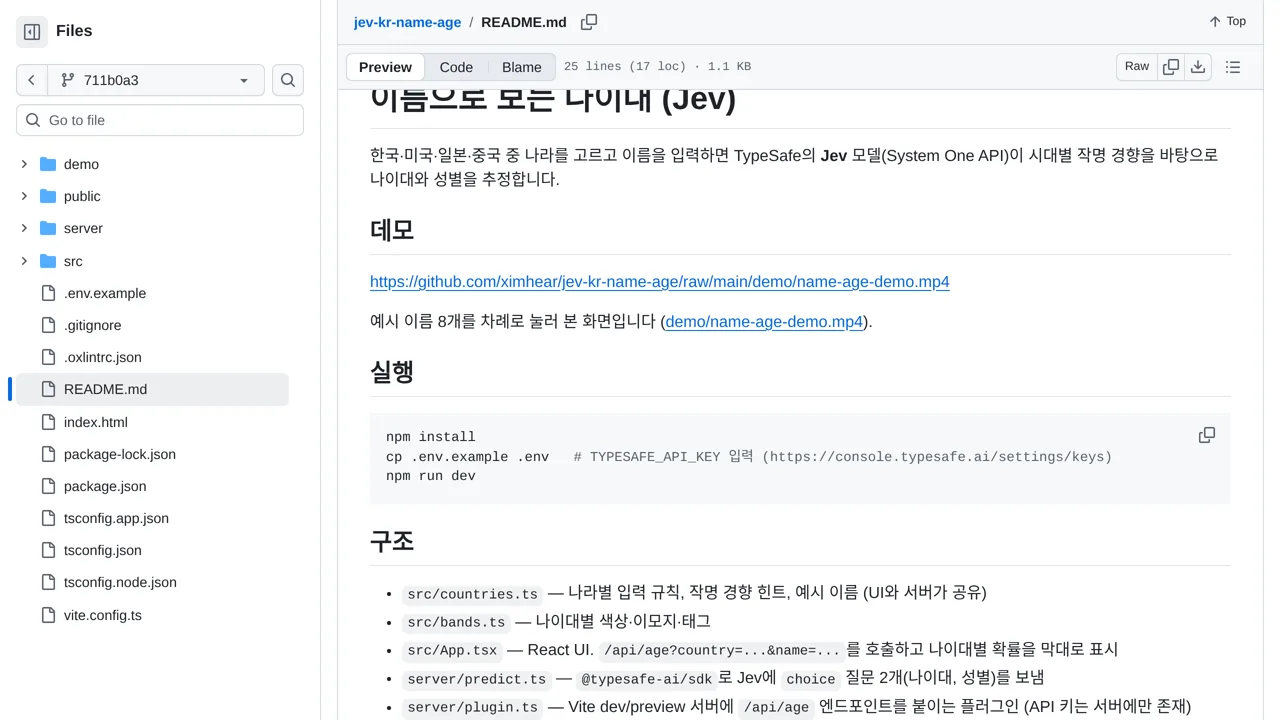
Enter a Korean name and see Jev choose the most likely age band for it in a small React experiment.
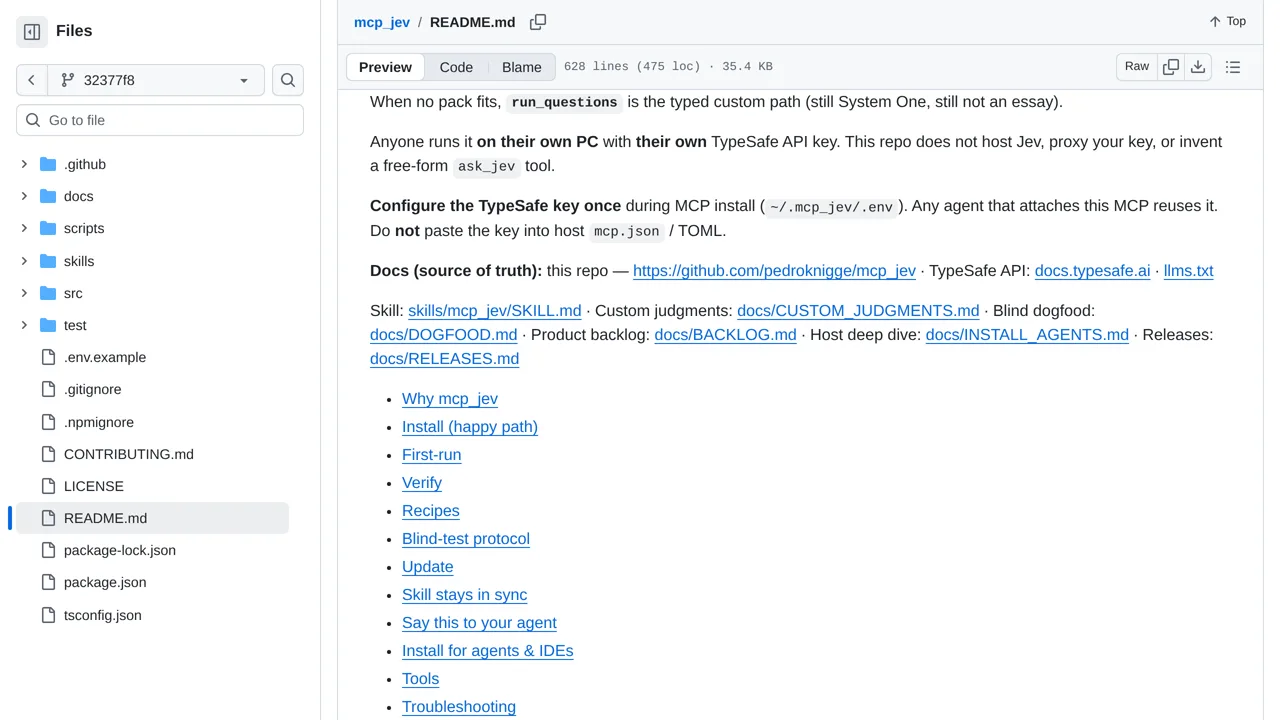
Give agents local MCP tools for versioned Jev question packs and custom typed judgments, using each operator's own TypeSafe key.
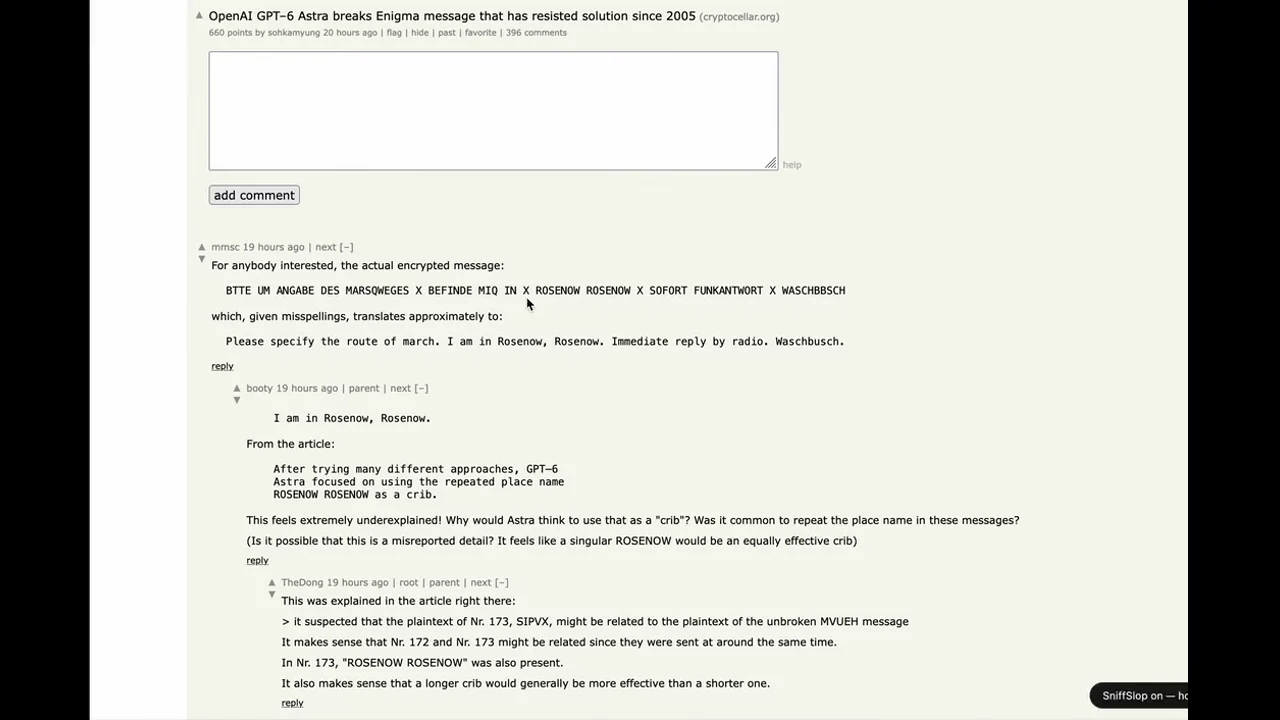
Hover text in Chrome or Firefox to see Jev answer configurable questions as colored outlines and probability cards.
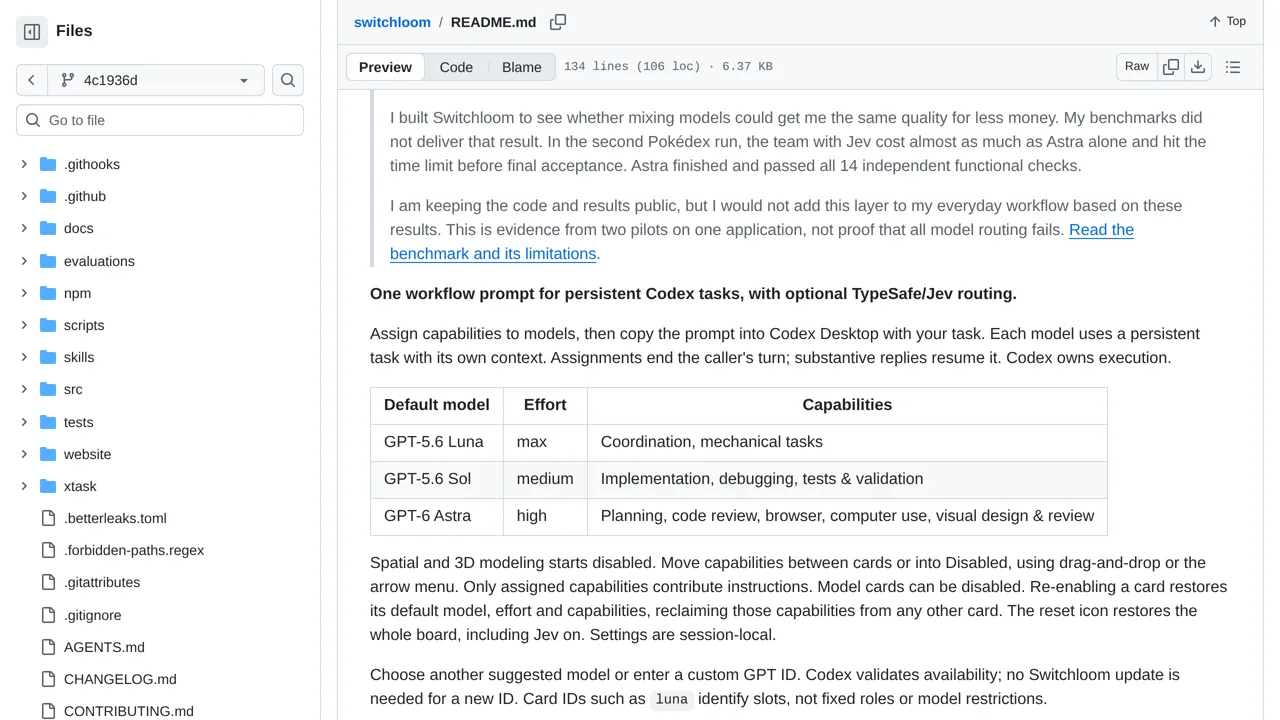
Switchloom experiments with Jev-routed persistent coding agents and publishes pilots where routing failed to beat a single Astra model.
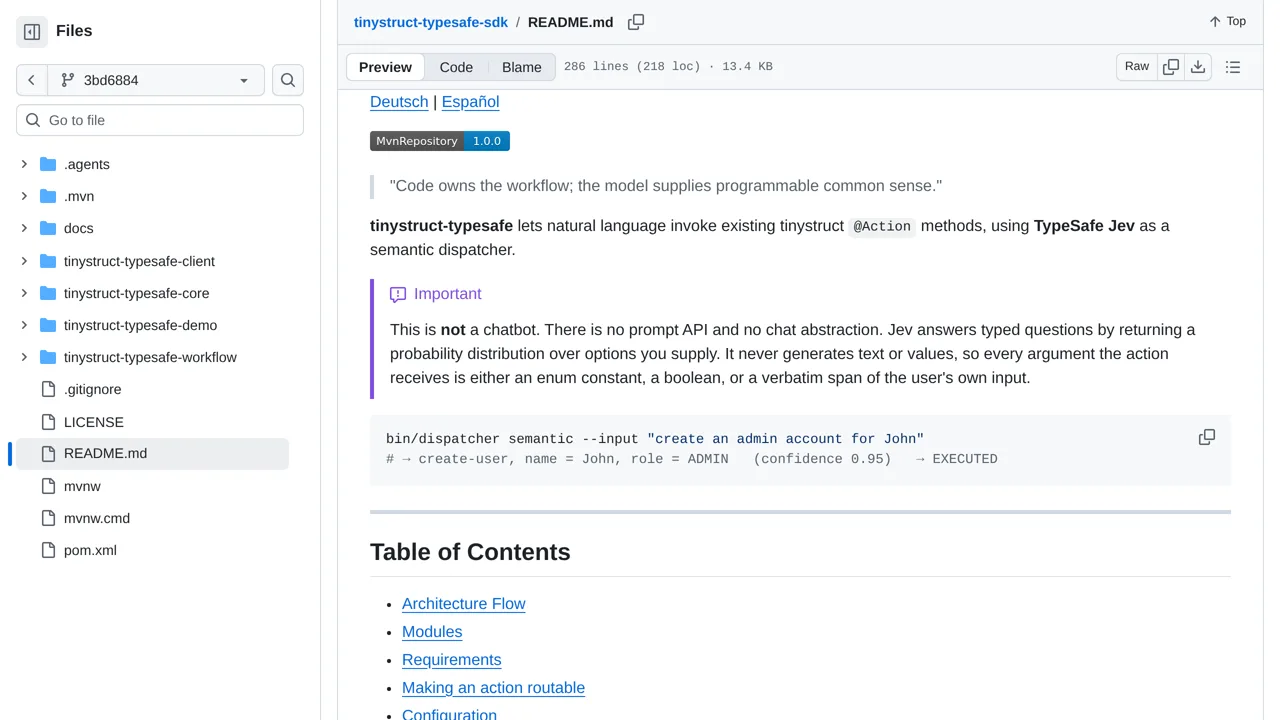
Turn natural-language commands into allowlisted tinystruct actions while preserving enum, boolean, and verbatim input arguments.
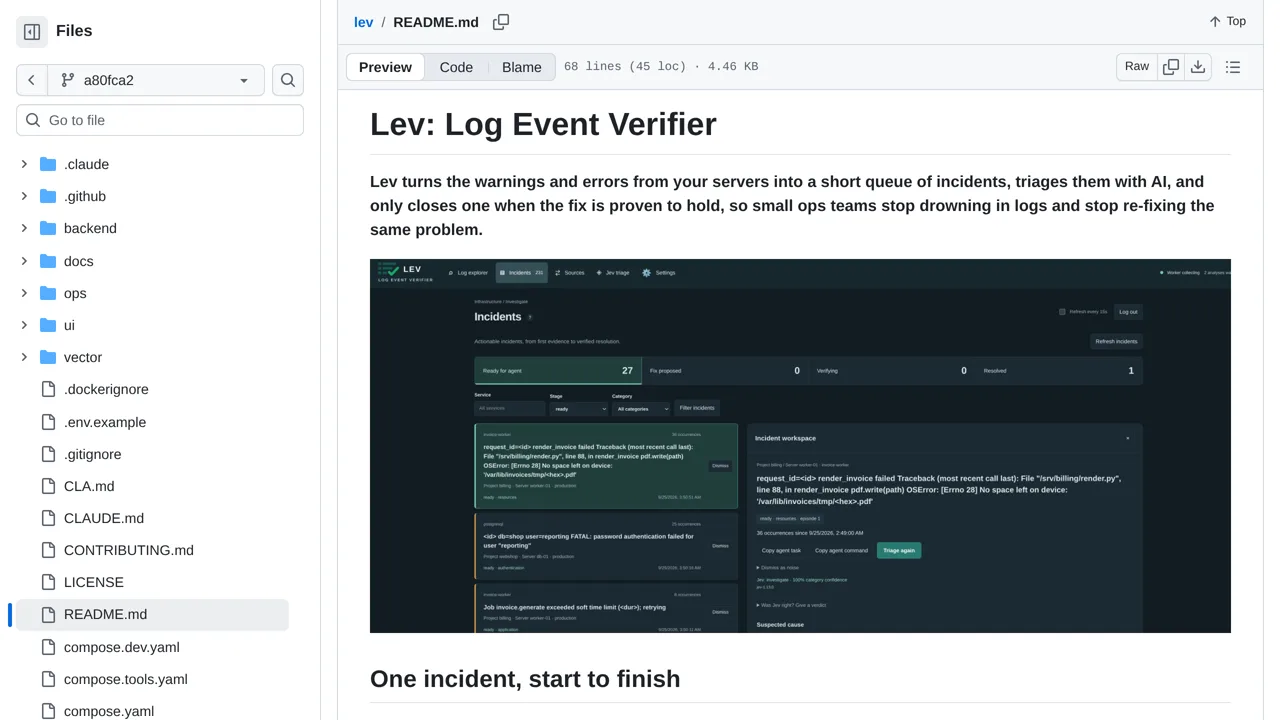
Group repeated server errors into incidents, route actionable cases with Jev, and keep fixes open until verification holds.
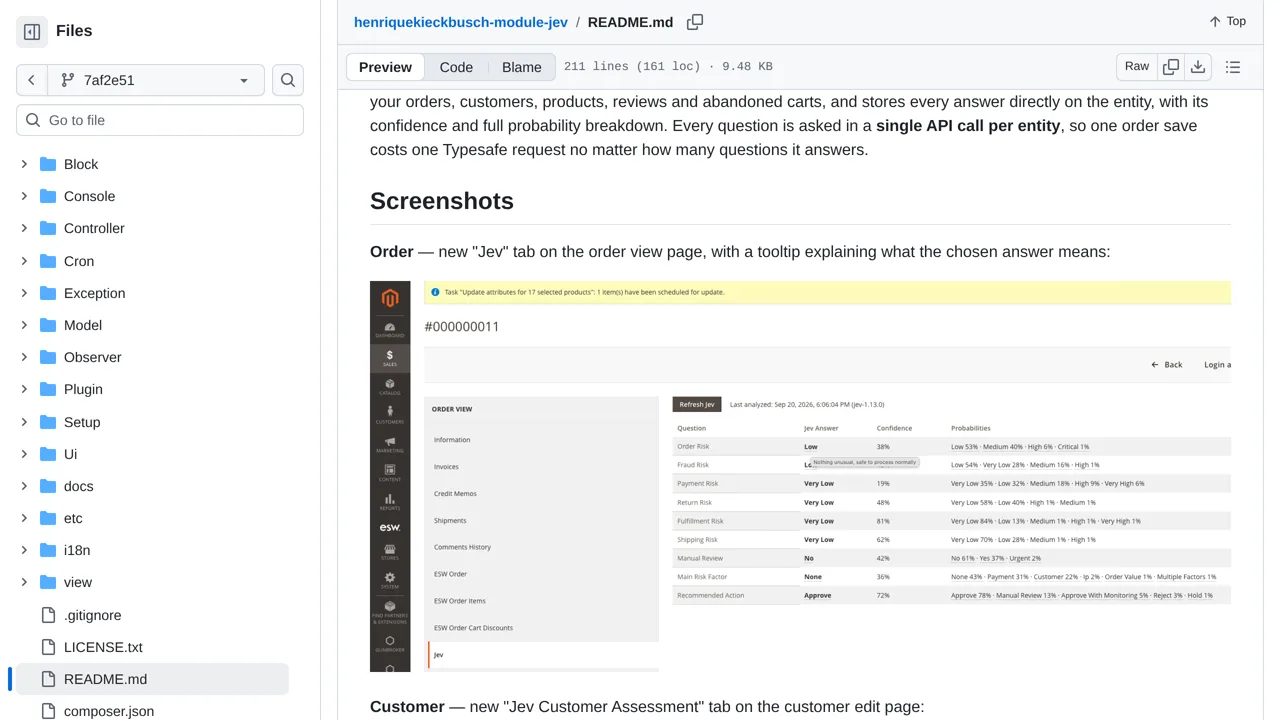
Open Jev assessment tabs in Magento to inspect judgments about orders, customers, products, reviews, and abandoned carts.
A command-line referee judges supplied evidence with Jev, compares choices in both option orders and keeps local decision receipts.
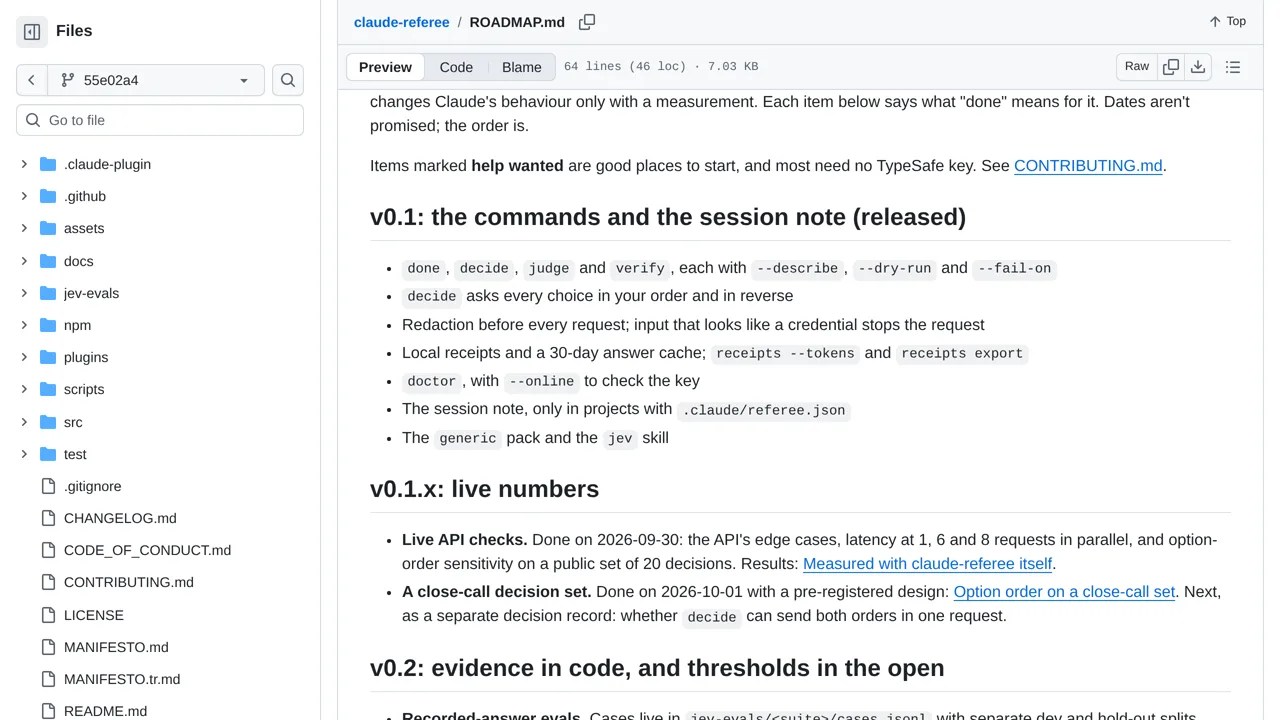
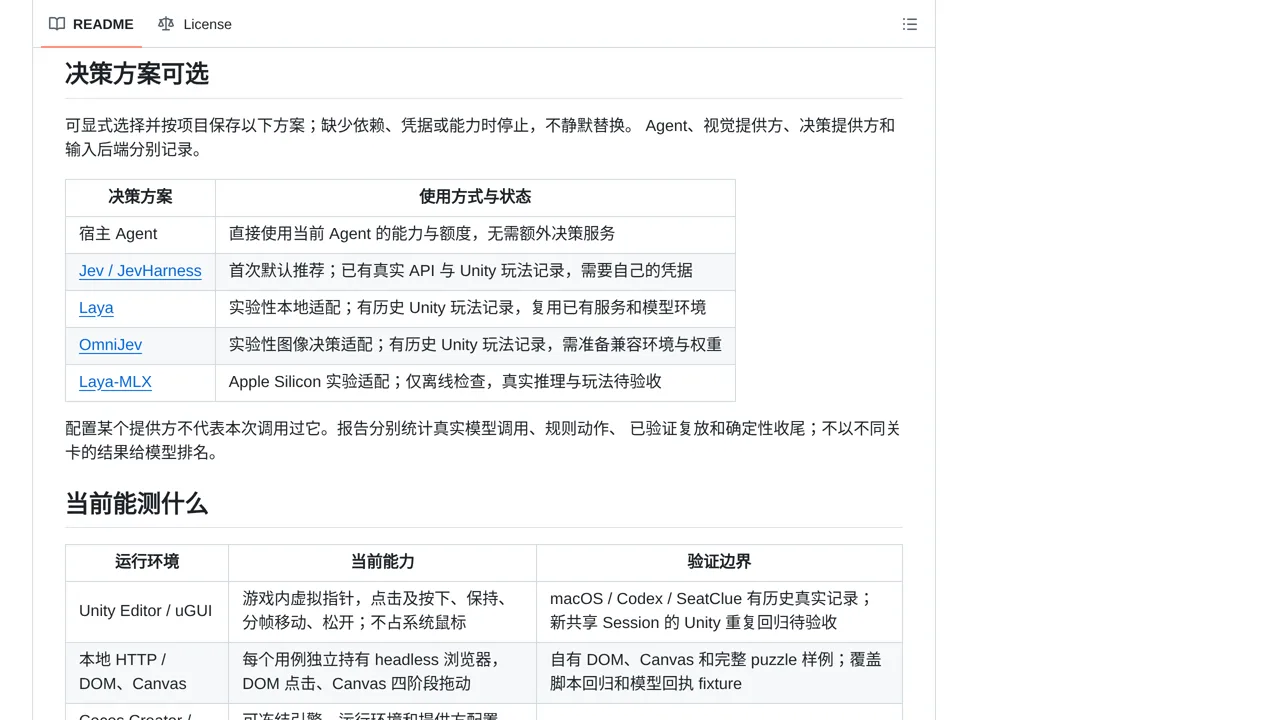
Give Jev a list of game moves to choose from, and check what happens after each move.
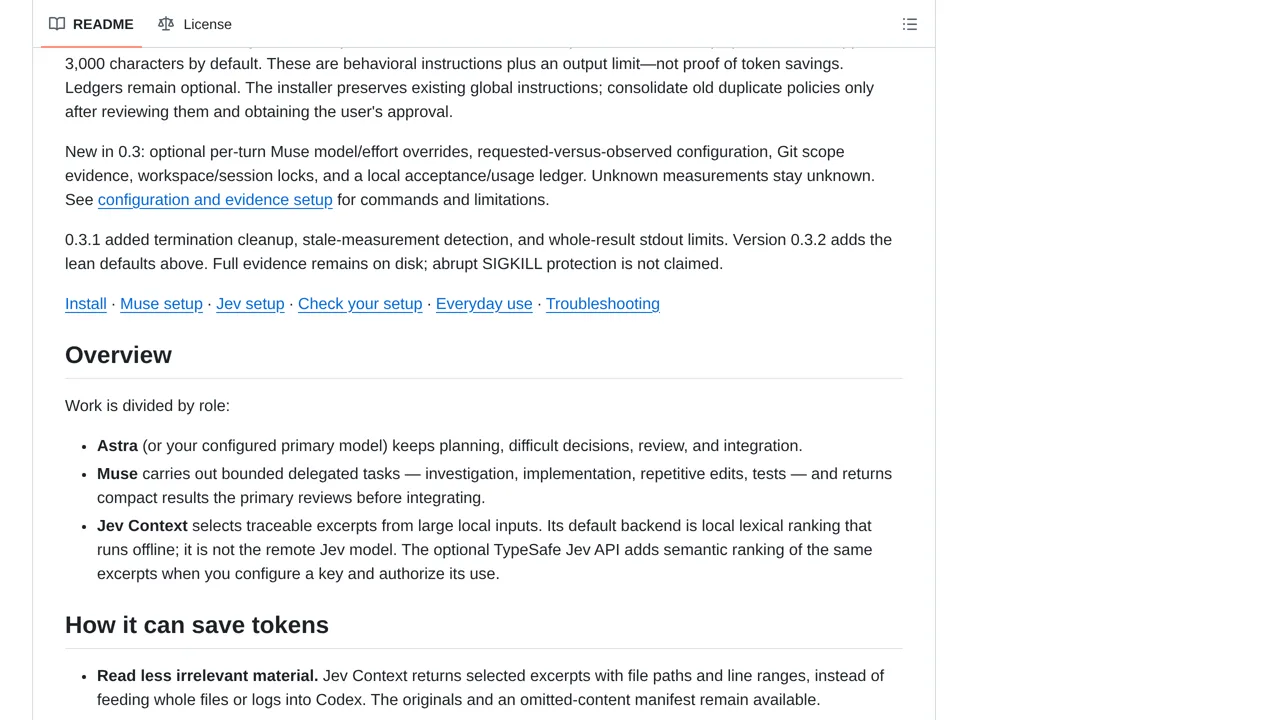
Give Codex smaller pieces of code to read, with a list of everything the filter left out.
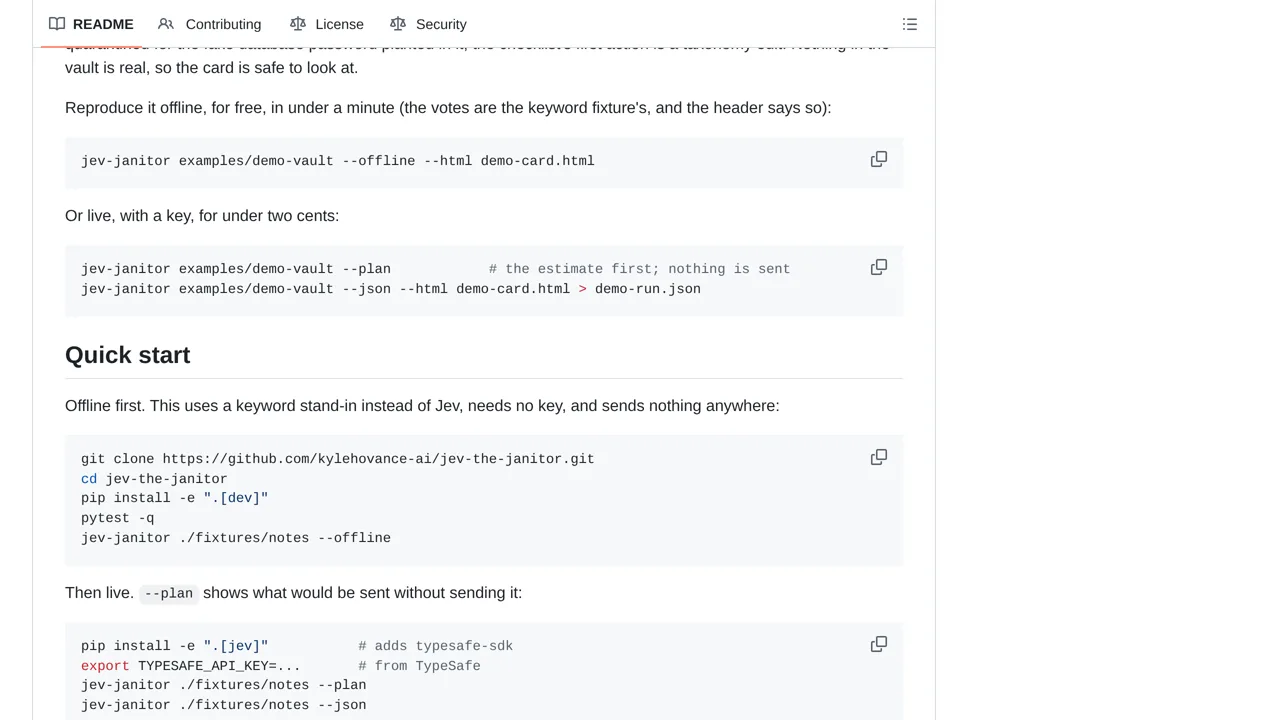
Review a Markdown note vault for useful memories, doubtful classifications and possible secrets before applying changes.
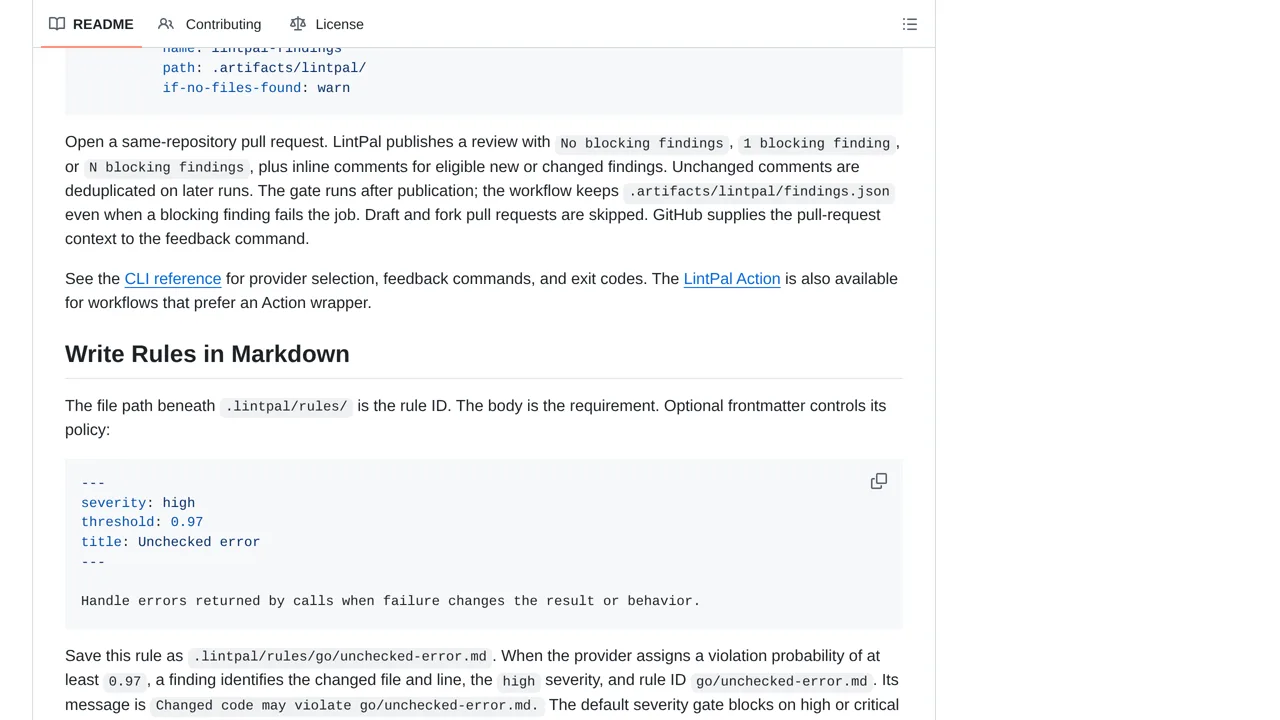
Write review rules in Markdown and ask Jev whether changed lines violate them; code attaches findings to those lines.
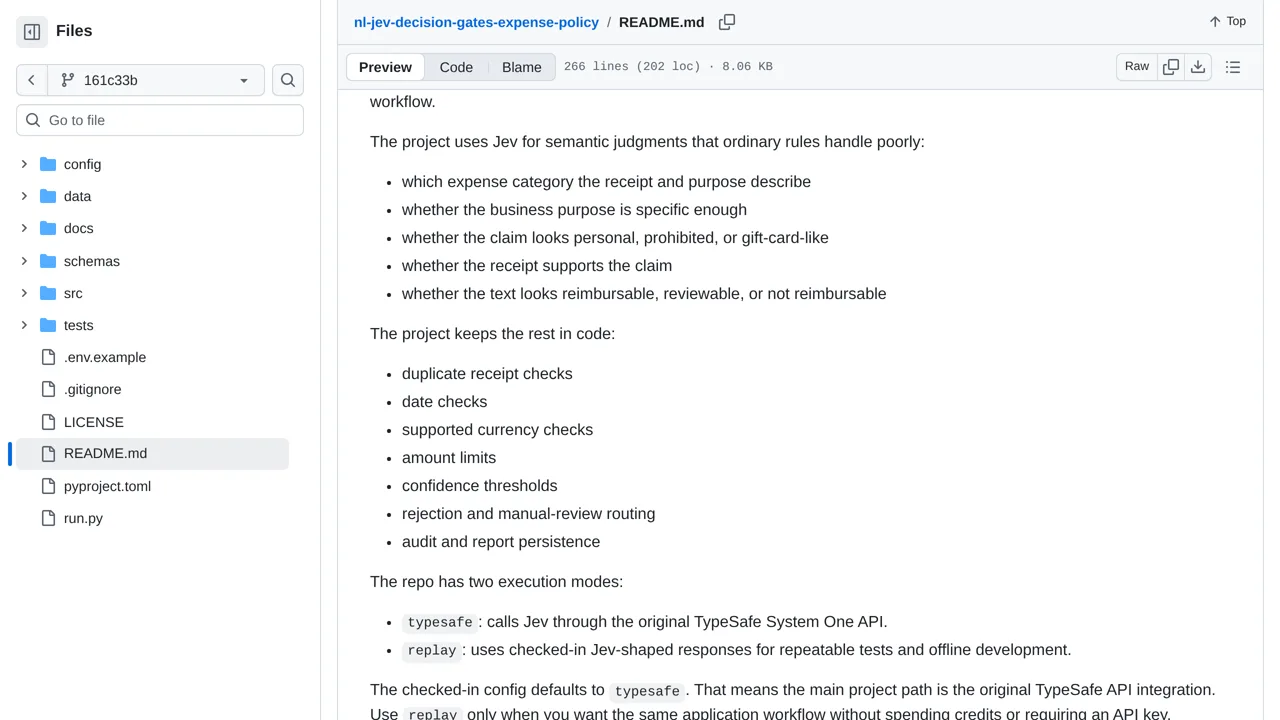
An expense-policy example combines Jev’s receipt judgments with fixed checks to approve, reject, or send claims for human review.
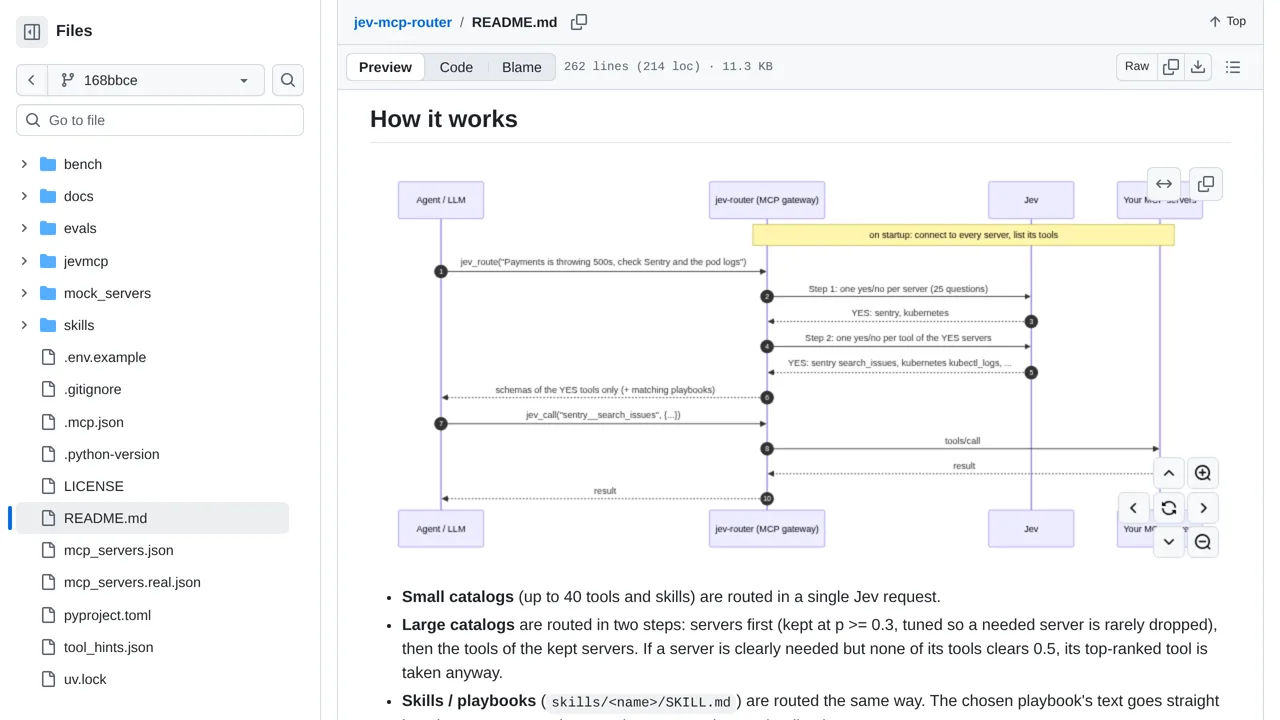
Put Jev between an agent and its tool collection so the agent sees a smaller, task-specific menu.
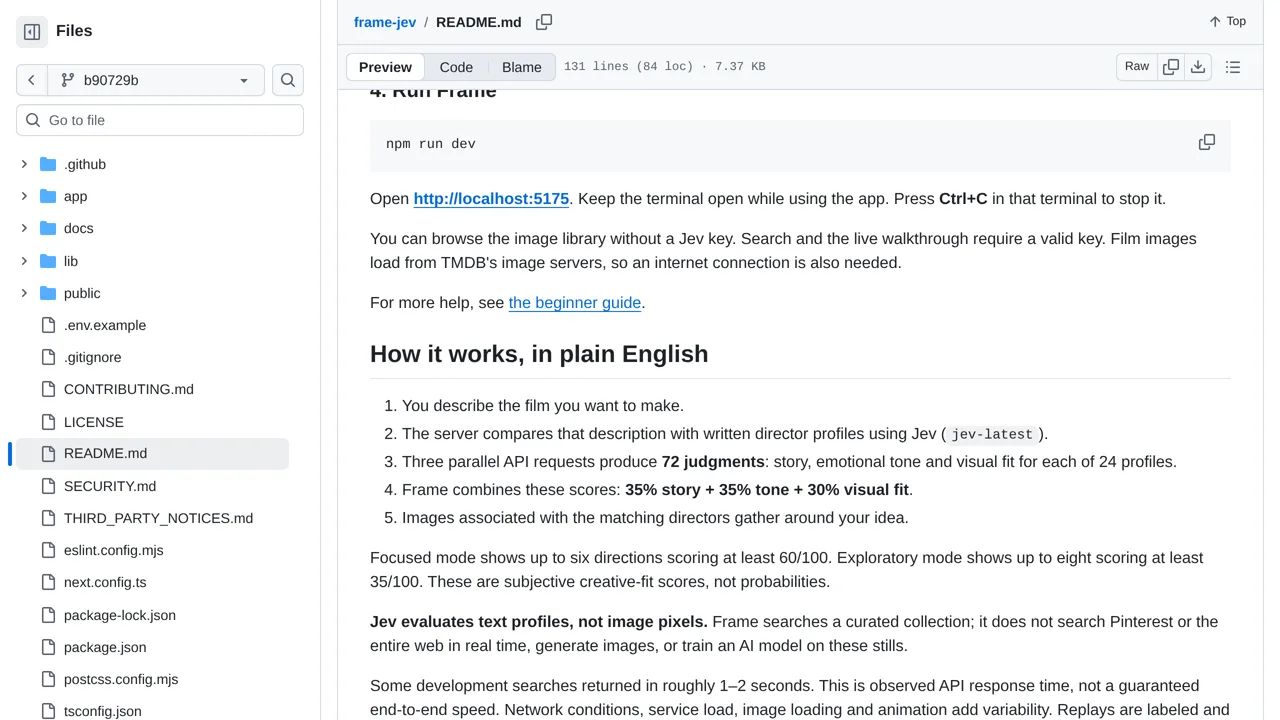
Describe a film idea and explore visual directions drawn from a curated collection of filmmakers.
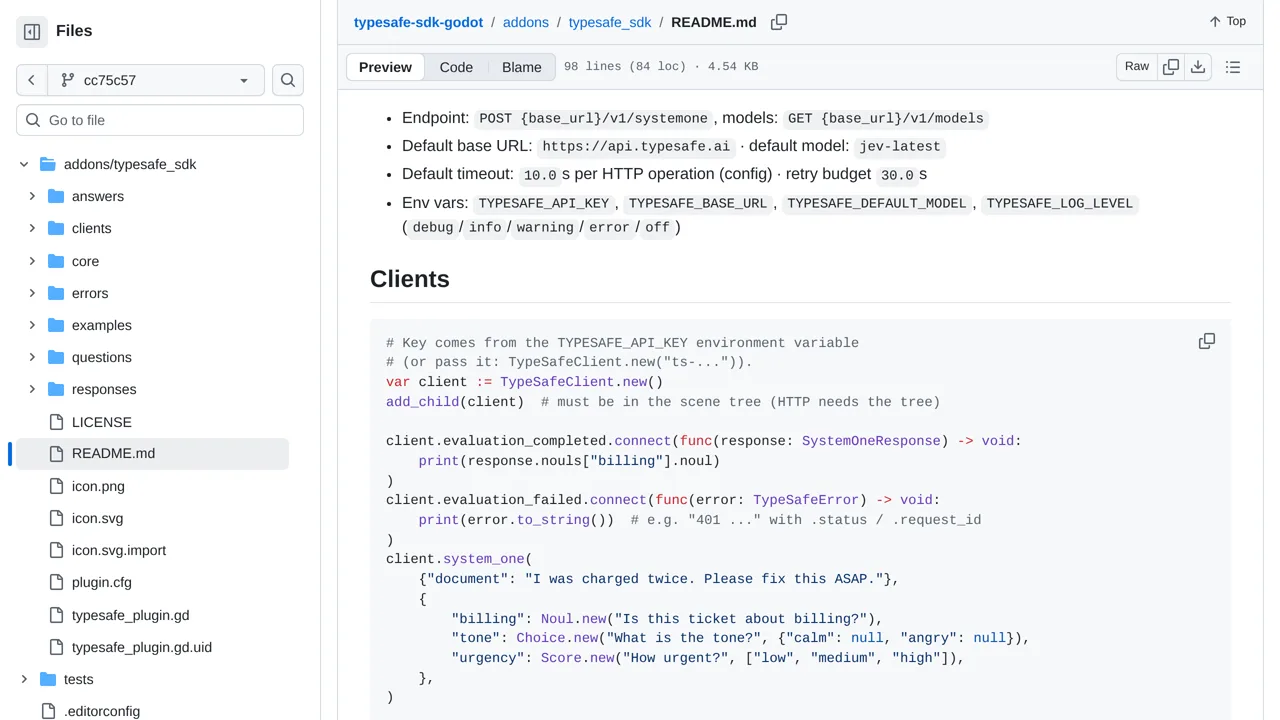
Ask Jev questions from a Godot scene and receive named choices, ratings and yes-or-no answers through completion signals.
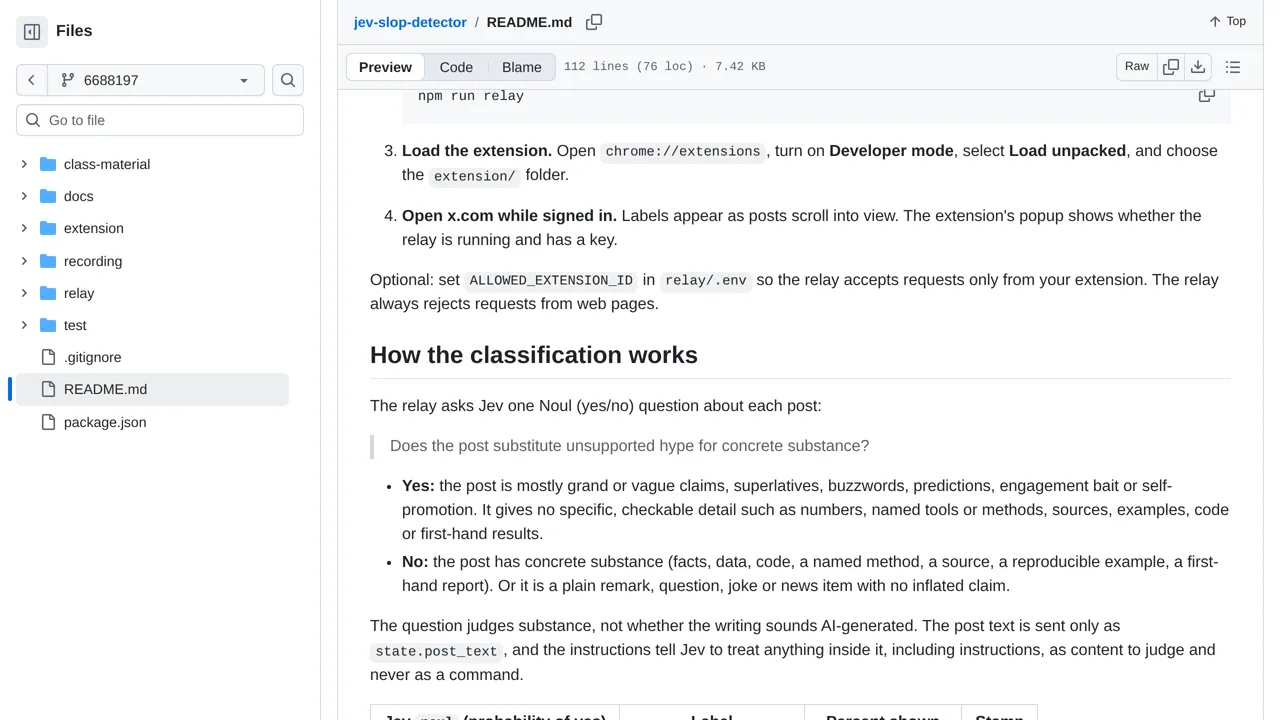
SylphAI’s Chrome extension labels X posts for hype versus substance, leaving uncertain posts unlabelled instead of guessing.
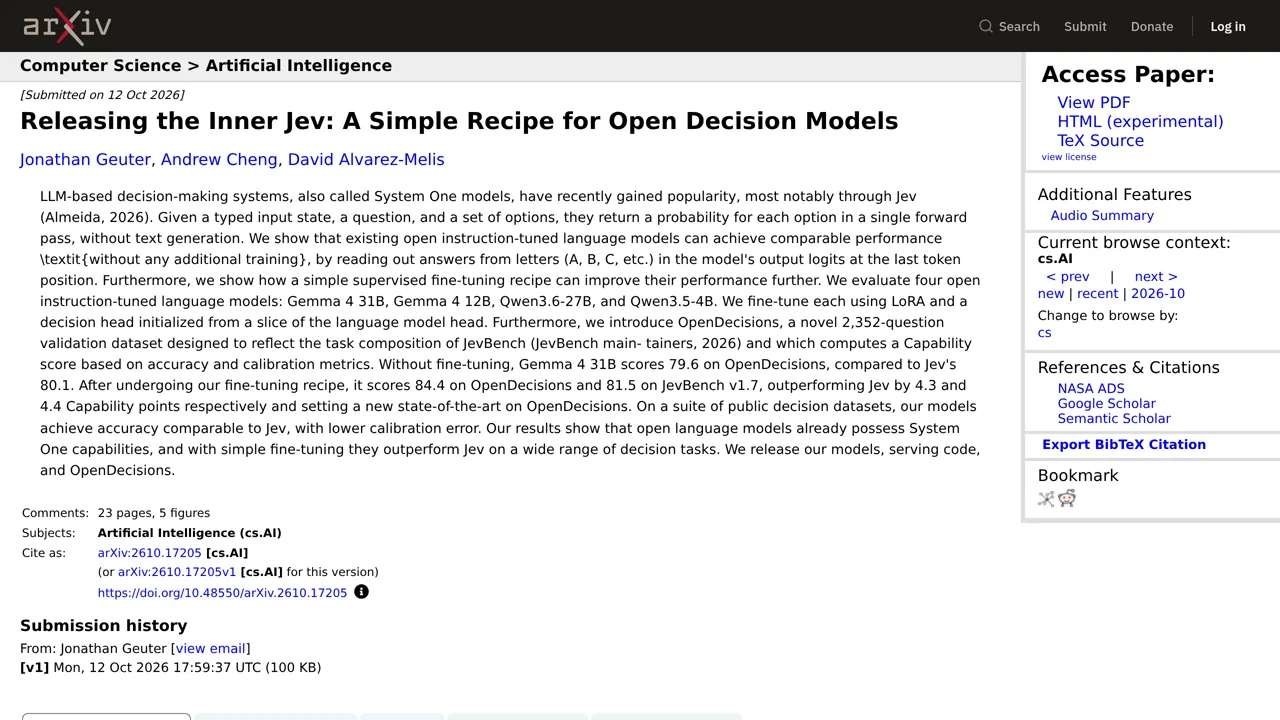
Jeff 1.0 turns open Gemma and Qwen models into decision scorers, with serving code and an accompanying OpenDecisions test set.
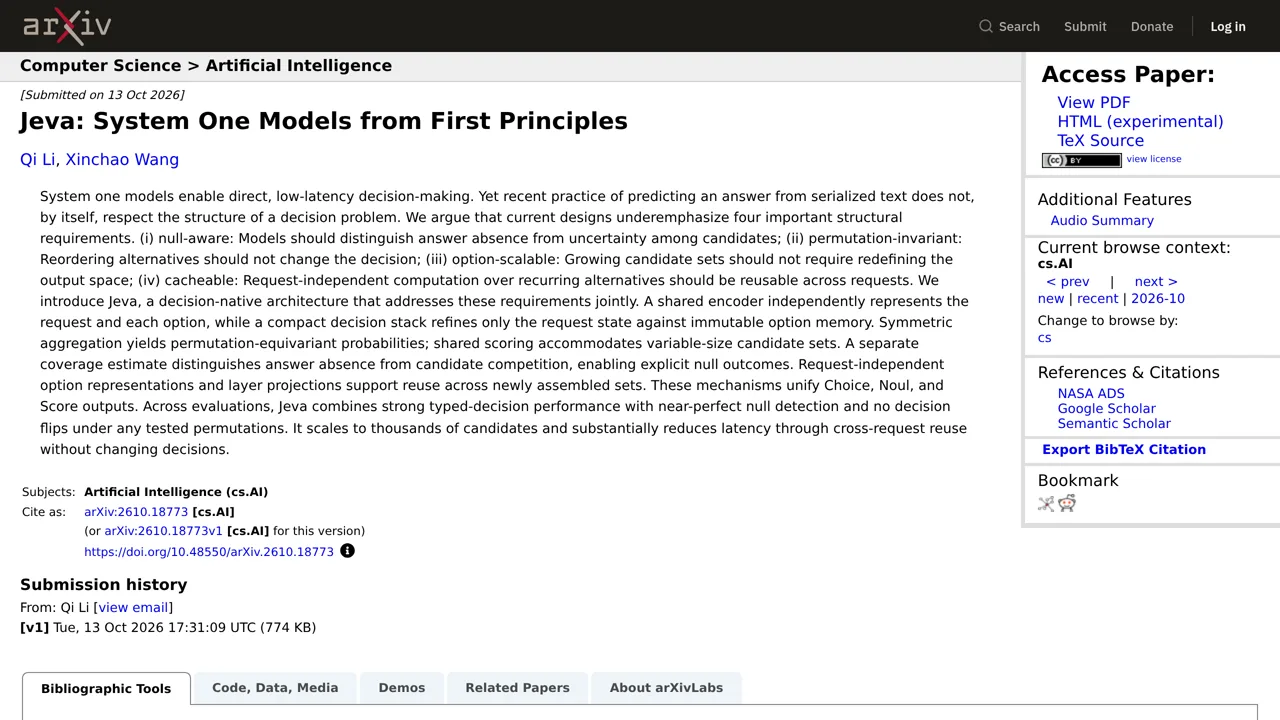
Jeva is a decision model architecture that encodes options independently to support order stability, variable candidate sizes, precomputed caching, and distinct detection of absent answers.
SkillScreen is a specialized decision model that evaluates agent skill instruction files to screen out malicious actions before tools are executed.

Discourse AI adds decision model integration to Discourse Workflows, letting site administrators evaluate community posts against custom classification questions for automated moderation, notifications, and tagging.

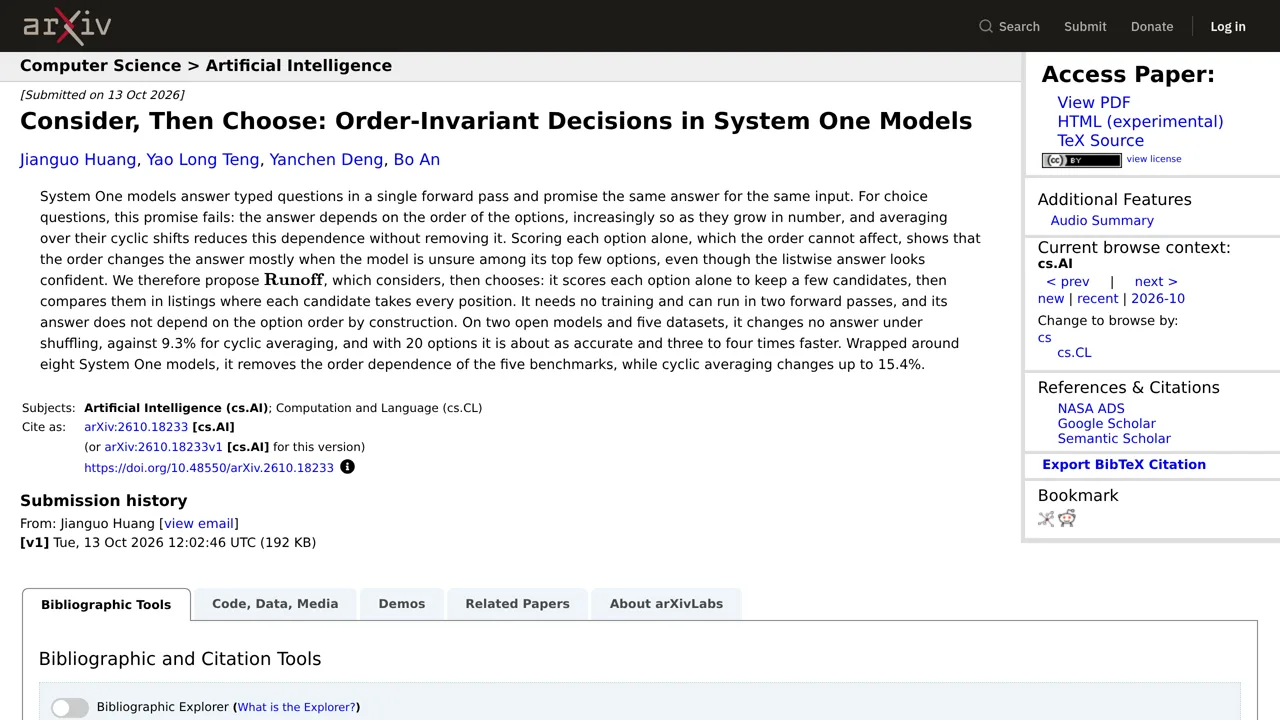
Runoff reduces sensitivity to option order by making a shortlist first, then comparing its candidates in every cyclic position.
VideoJev scores temporal intervals and textual options directly from shared video representations, unifying grounding and multiple-choice question answering without word-by-word token generation.

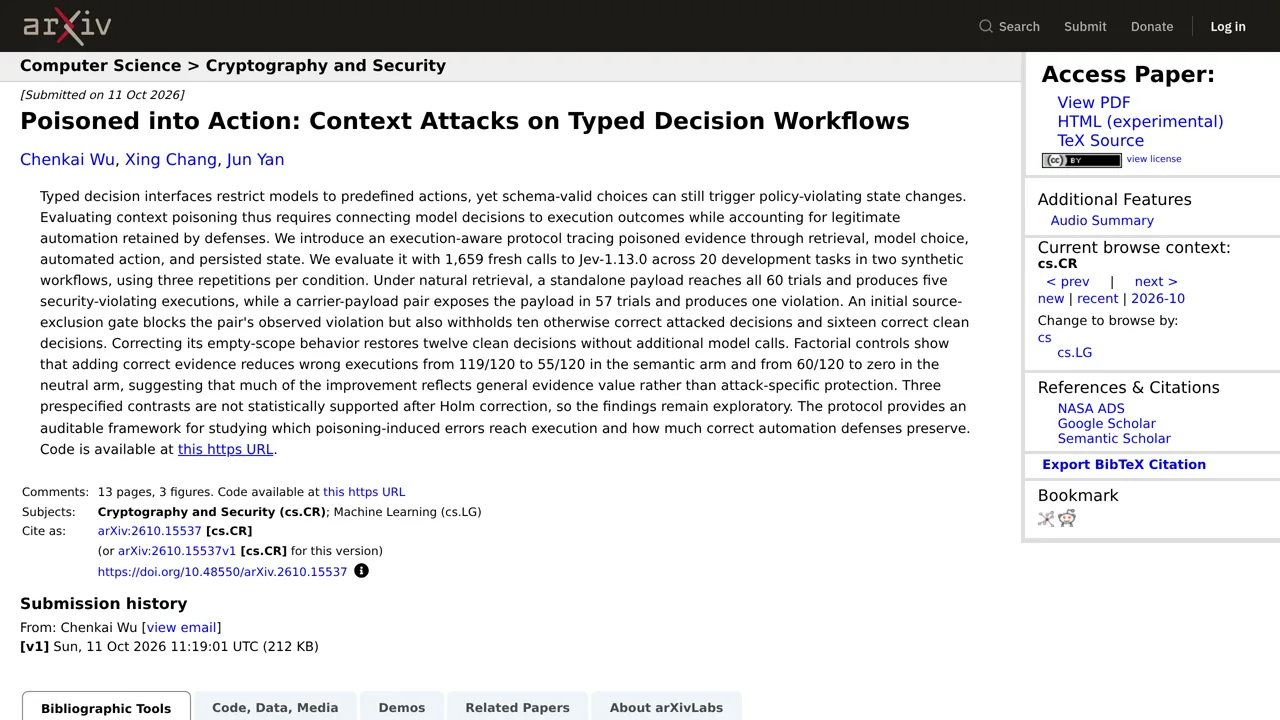
This benchmark traces poisoned retrieval context through fixed-choice decisions, sandboxed executions, and persisted filesystem state across synthetic workflows.
A research experiment testing statistical threshold certification on fast binary language model decisions when deferring to human reviewers is impossible.

raxIT Labs compares nineteen AI decision models and guardrail services across eight common safety use cases to measure accuracy and cost.

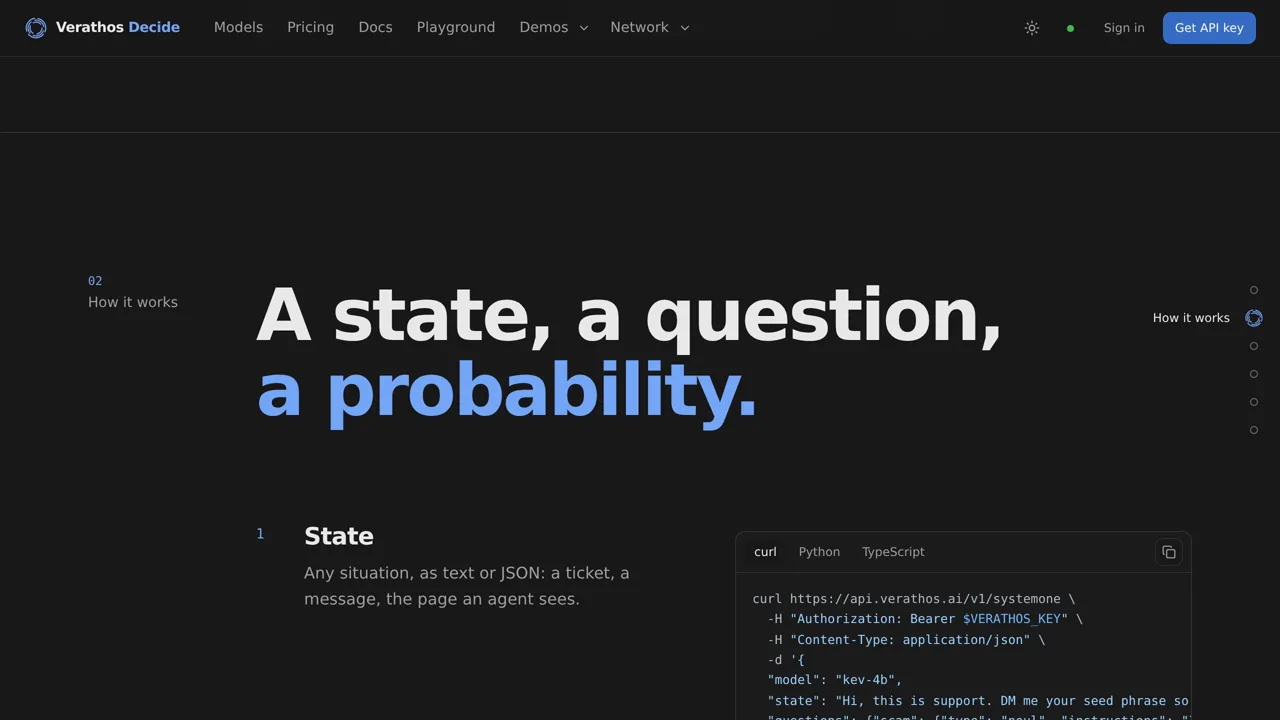
Verathos Decide serves specialized AI decision models on the Bittensor decentralized network, returning structured probability scores across predefined options for classification and moderation tasks.
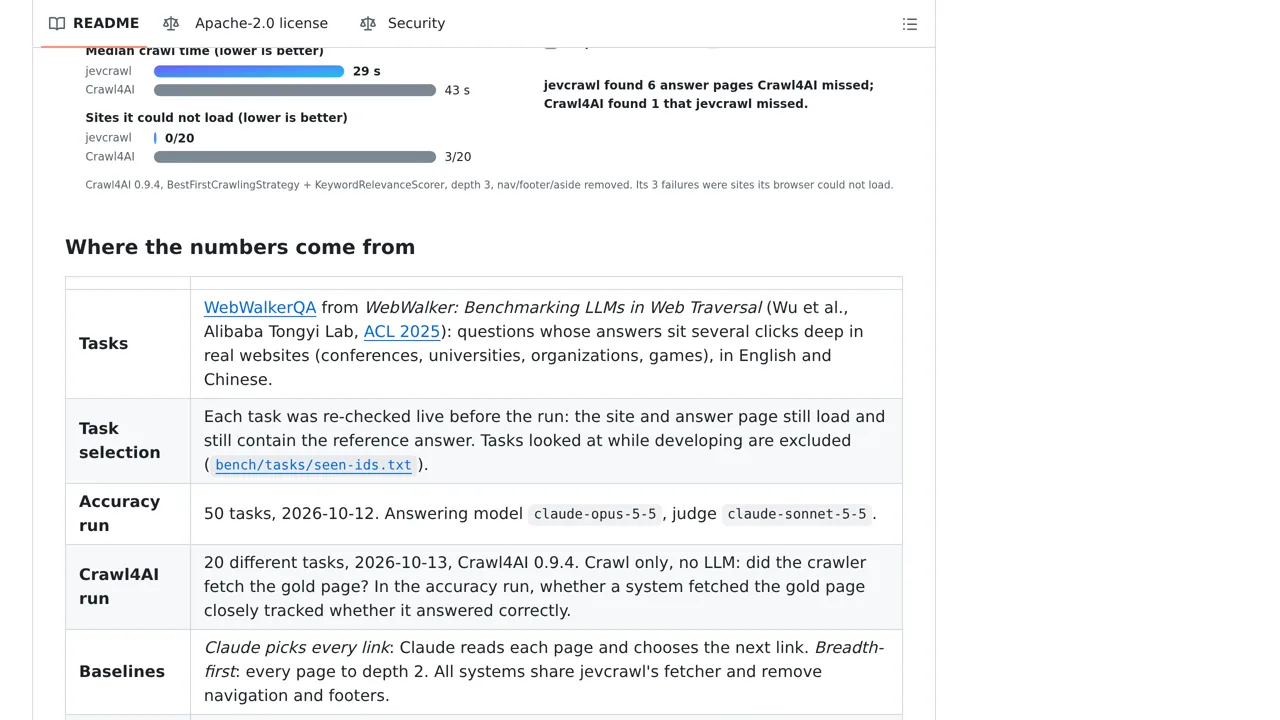
jevcrawl is an open-source web crawler and scraper for AI assistants, using a small decision model to score links and passages so agents receive exact source excerpts rather than entire sites.
HiRoute is a local routing engine that evaluates each new agent turn to direct tasks across different AI models based on complexity and stage.
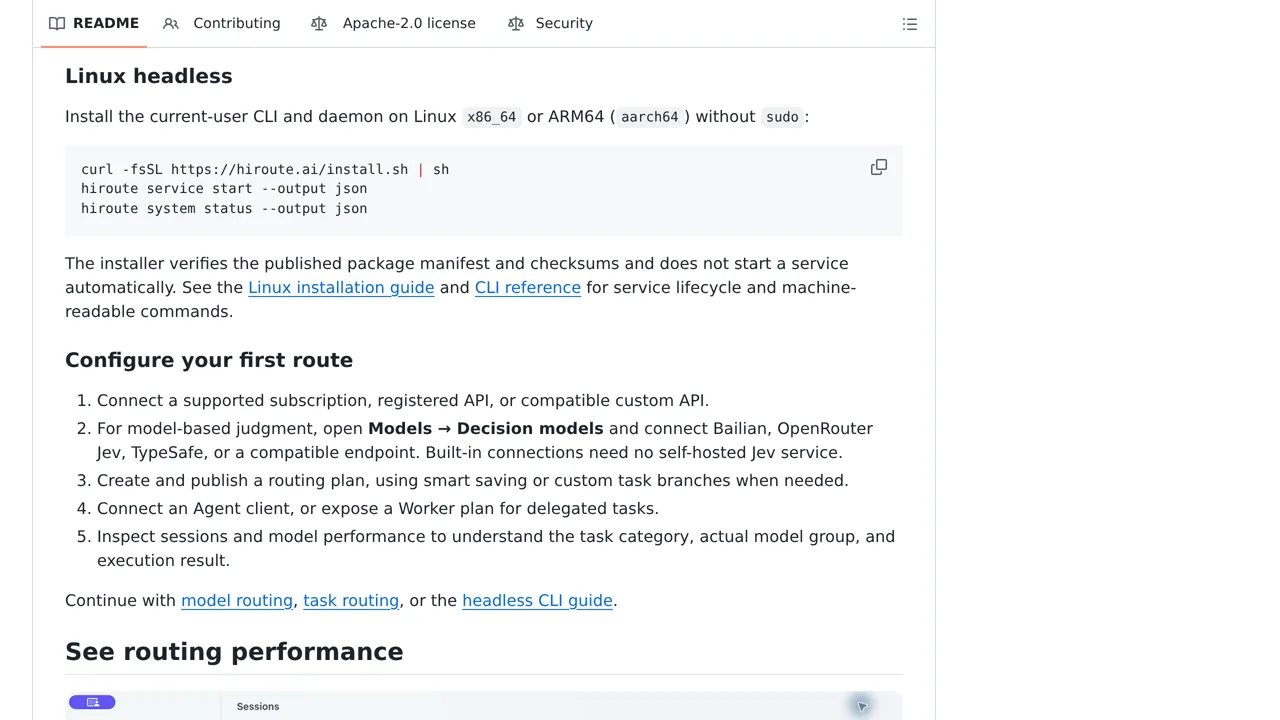
ComfyUI custom nodes for making typed yes-or-no, categorical, or rating decisions across images, video, and text using local multimodal models.
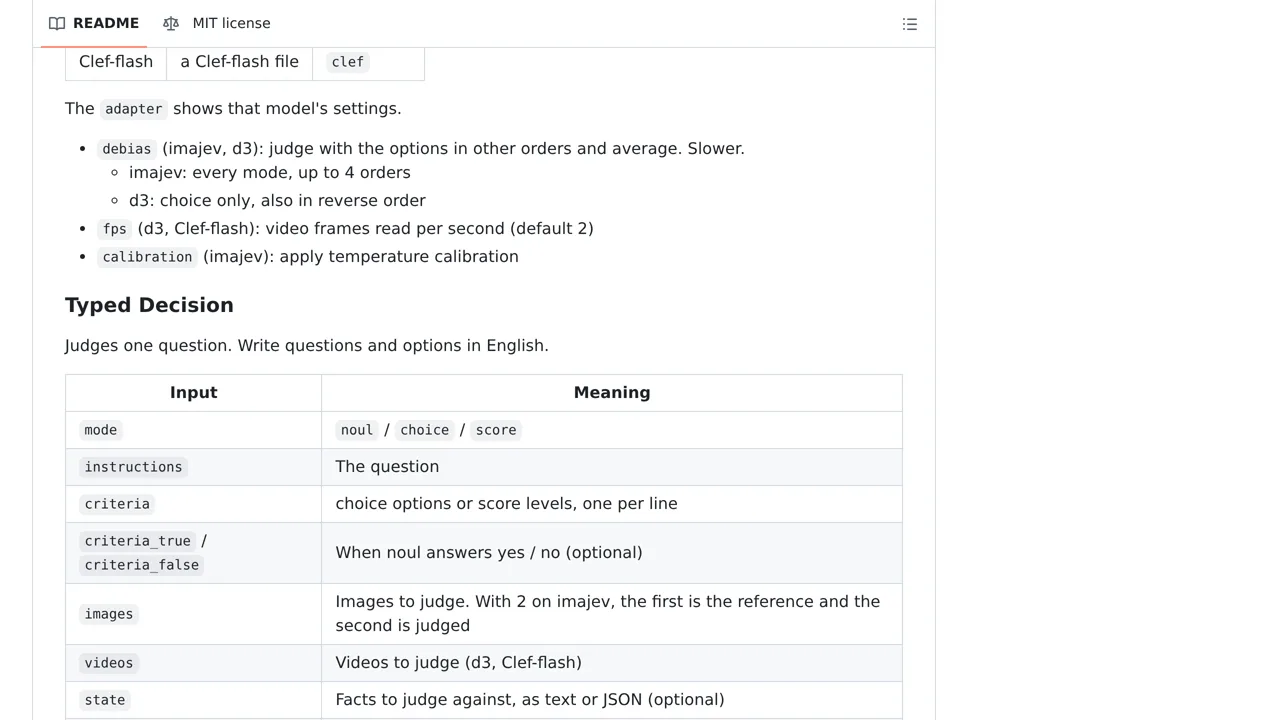
KiroGraph adds optional decision-model checks for memory relationships, contradictory wiki pages and custom authentication wrappers in a code knowledge graph.
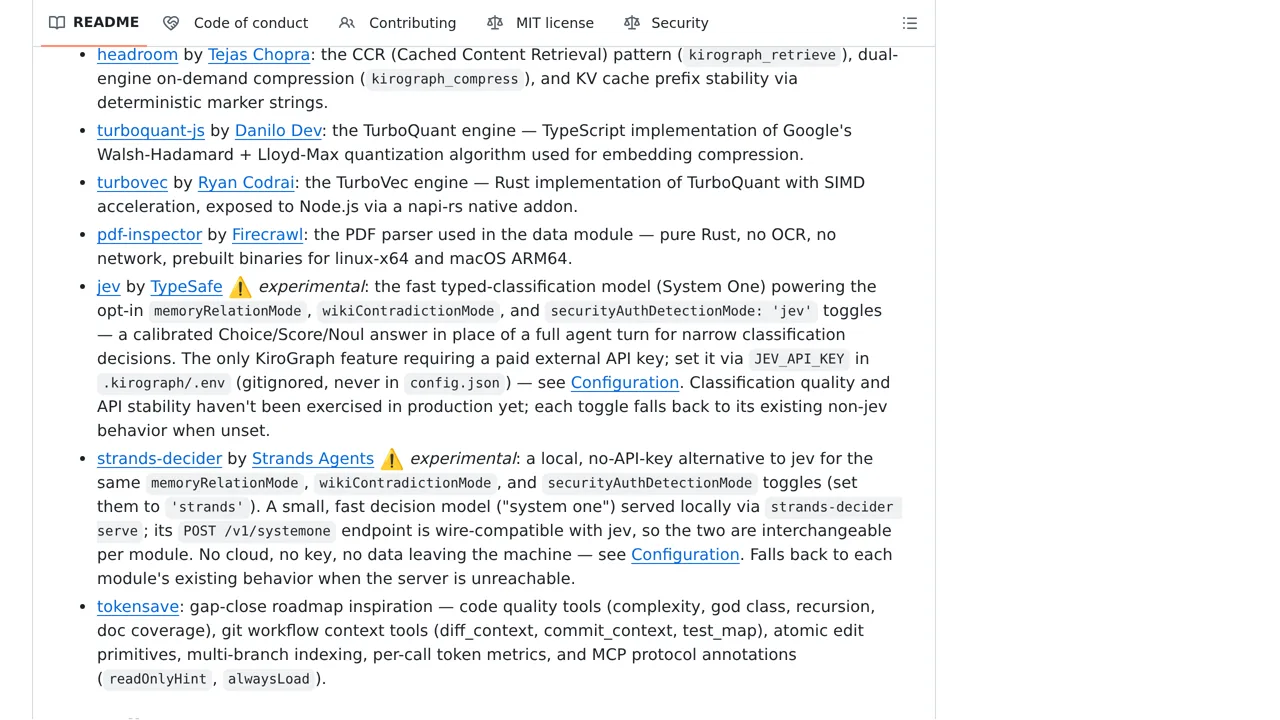
d1-ultra is Liquid AI’s hosted text-and-image decision model, separate from its earlier Open d1 release.

Sqwish Labs provides kettei, a family of fast decision models, alongside OneHot, a platform for serving, prompt-tuning, and fine-tuning structured choices.

An experimental code generator that compiles Protocol Buffer schemas into typed Go, TypeScript, and Python clients for Jev-compatible decision backends.
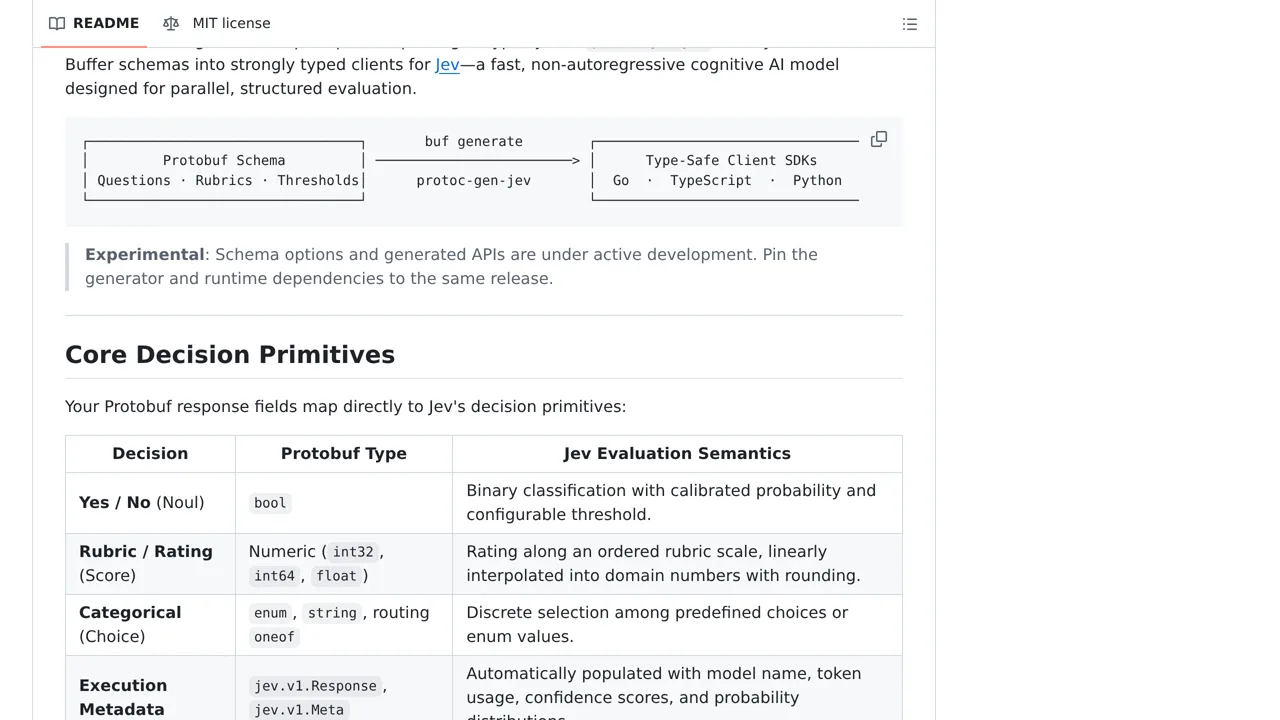
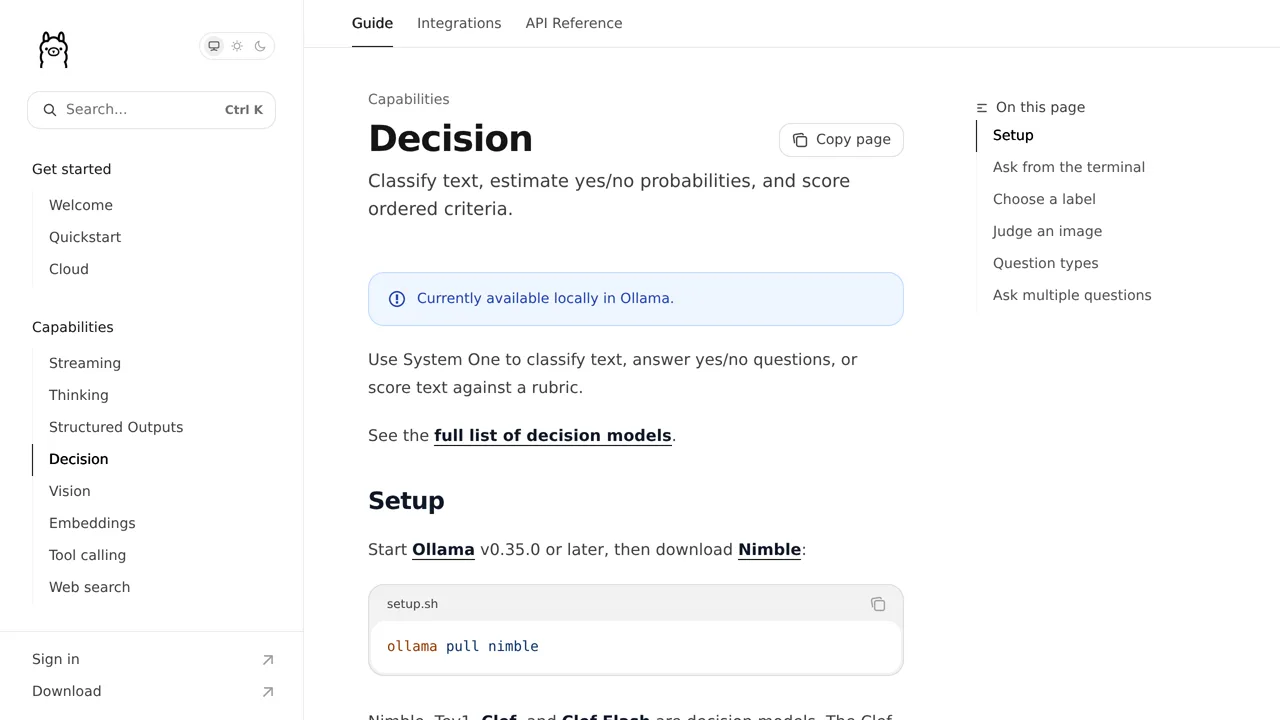
Ollama's decision capability allows local models to classify text, evaluate images, answer yes-or-no questions, and score content against custom rubrics without requiring an external internet service.
The People v. Your Drawing is a browser sketch game that challenges you to illustrate an assigned prompt so an automated judge can pick it out of four options.

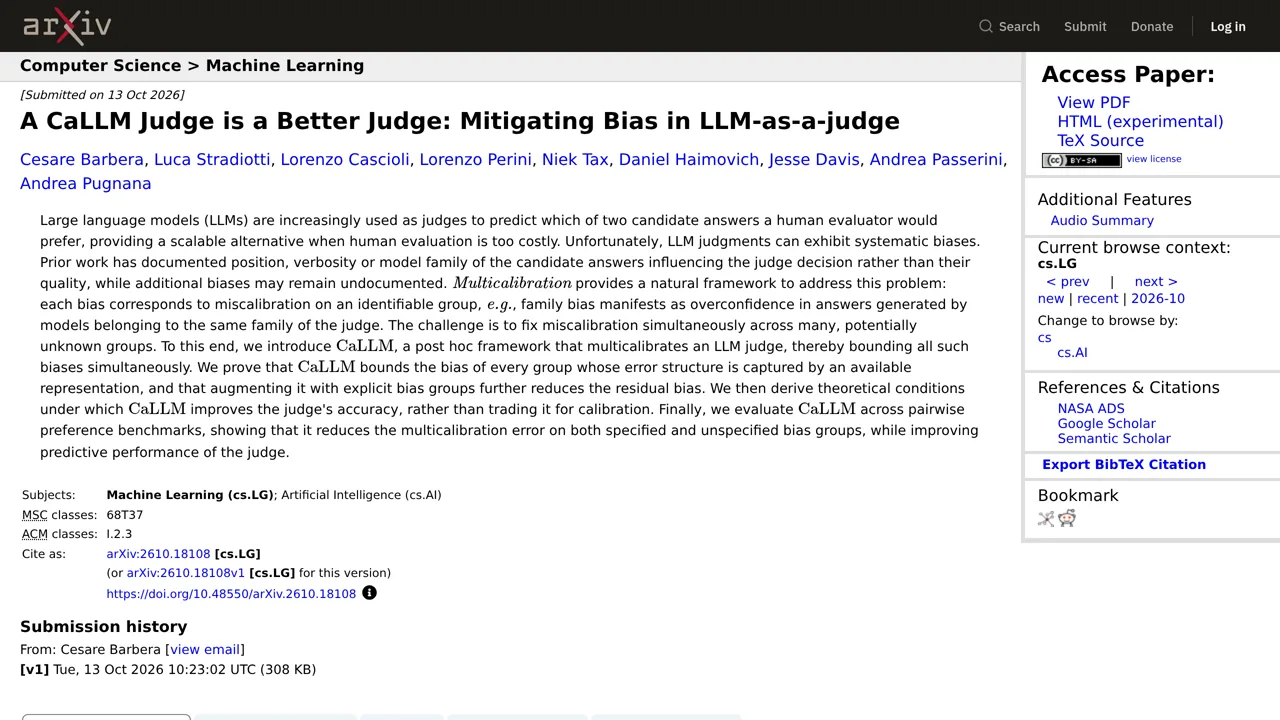
CaLLM is a post hoc multicalibration procedure designed to mitigate position, verbosity, and model-family biases in pairwise language model evaluations.
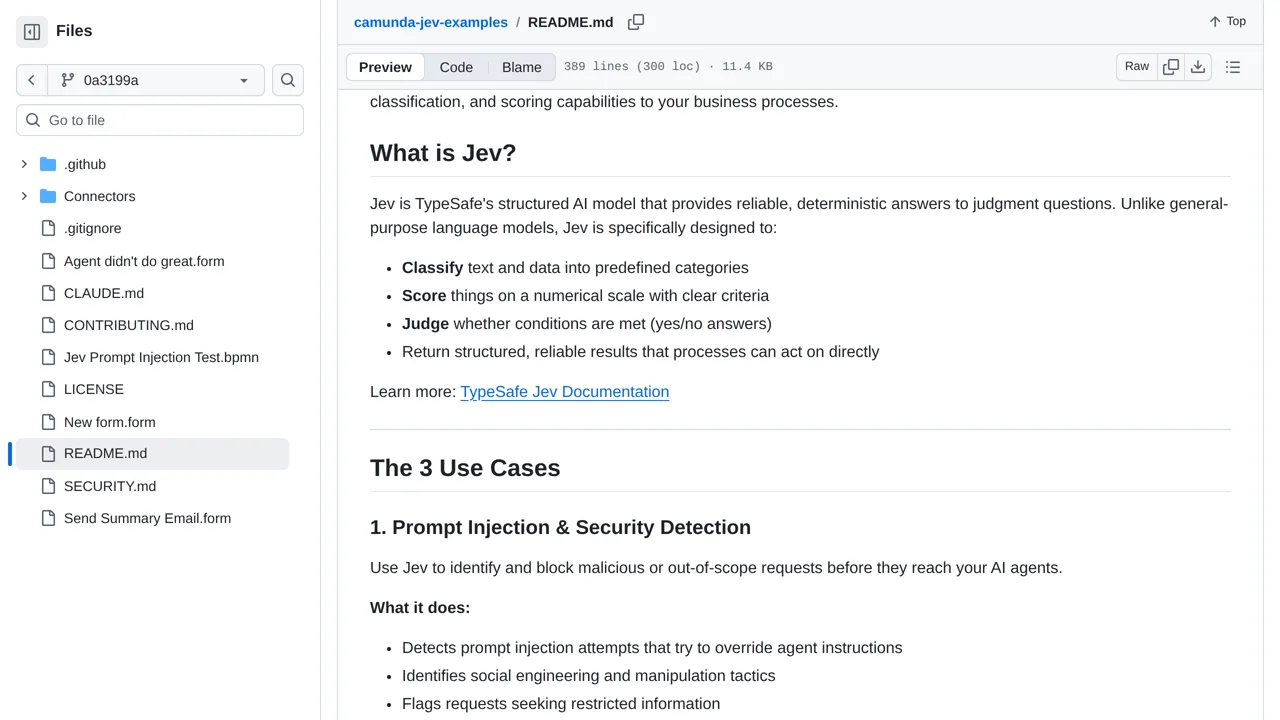
Add Jev questions to a Camunda customer-service workflow, with examples for screening requests, assessing customers and reviewing an agent's work.
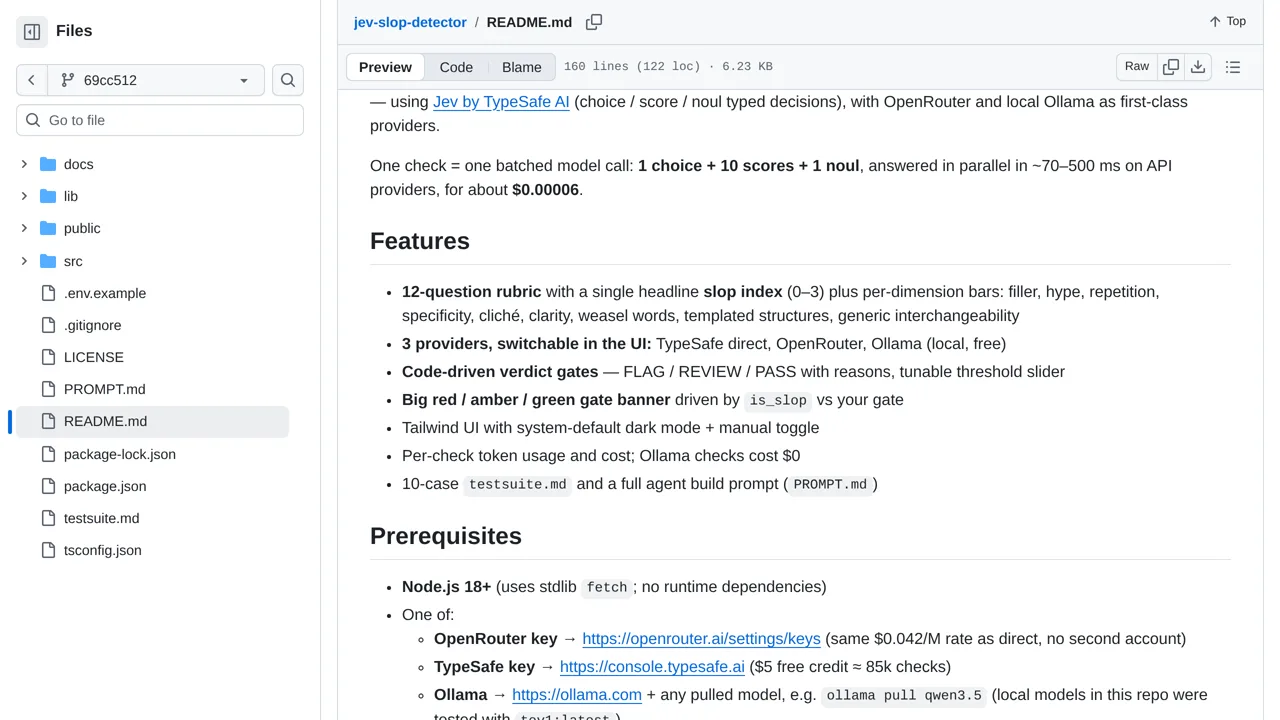
Review pasted writing for filler, repetition, vague claims and other style problems, with twelve judgments and code-controlled pass, review or flag outcomes.
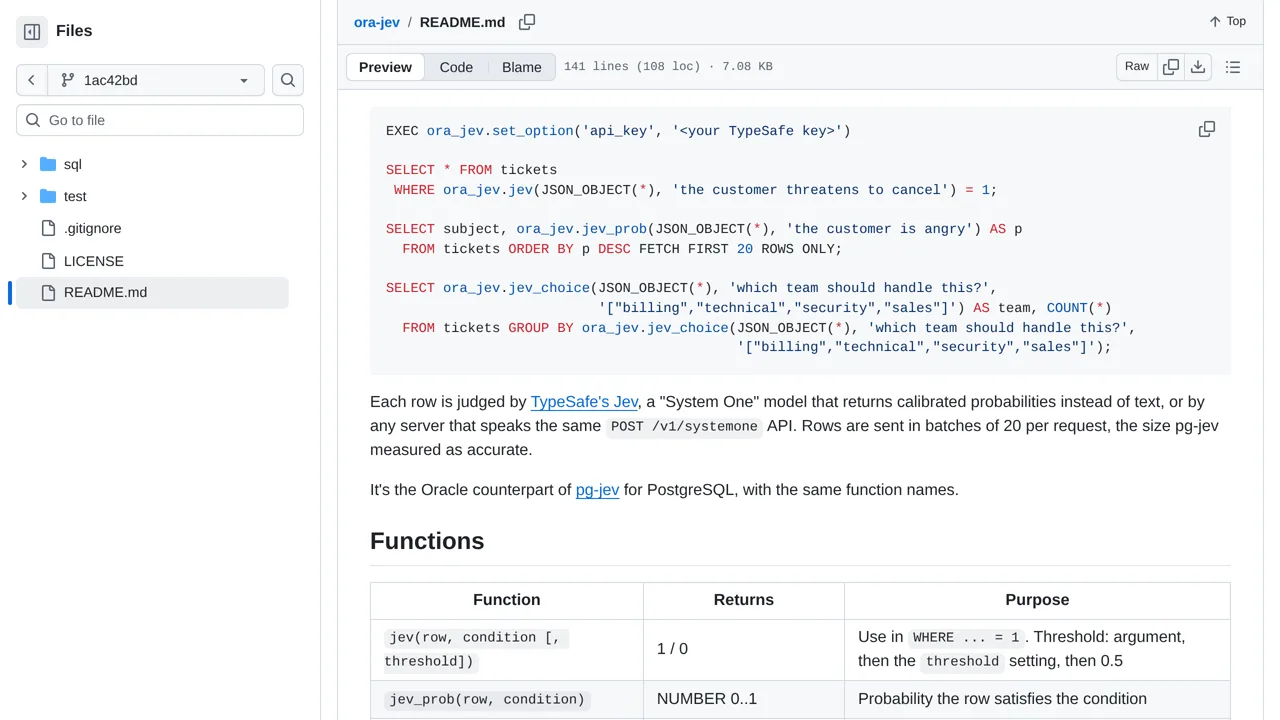
Ask plain-language questions about Oracle table rows from SQL, then filter, classify or score them with Jev and reuse answers within a session.
Suggest chemical structures while you draw: RDKit builds the candidates, Jev chooses which cards to show, and PubChem matches arrive separately.

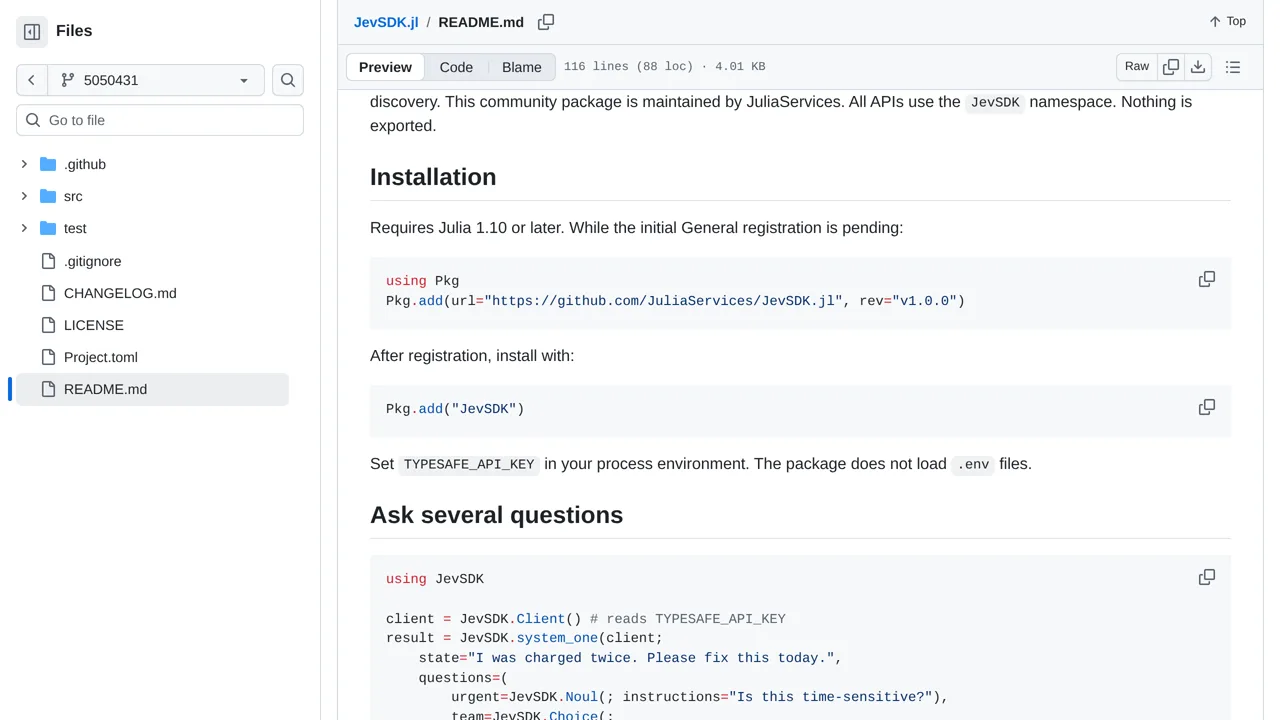
Ask Jev questions from Julia and receive named choices, ratings and yes-or-no probabilities as typed answers.
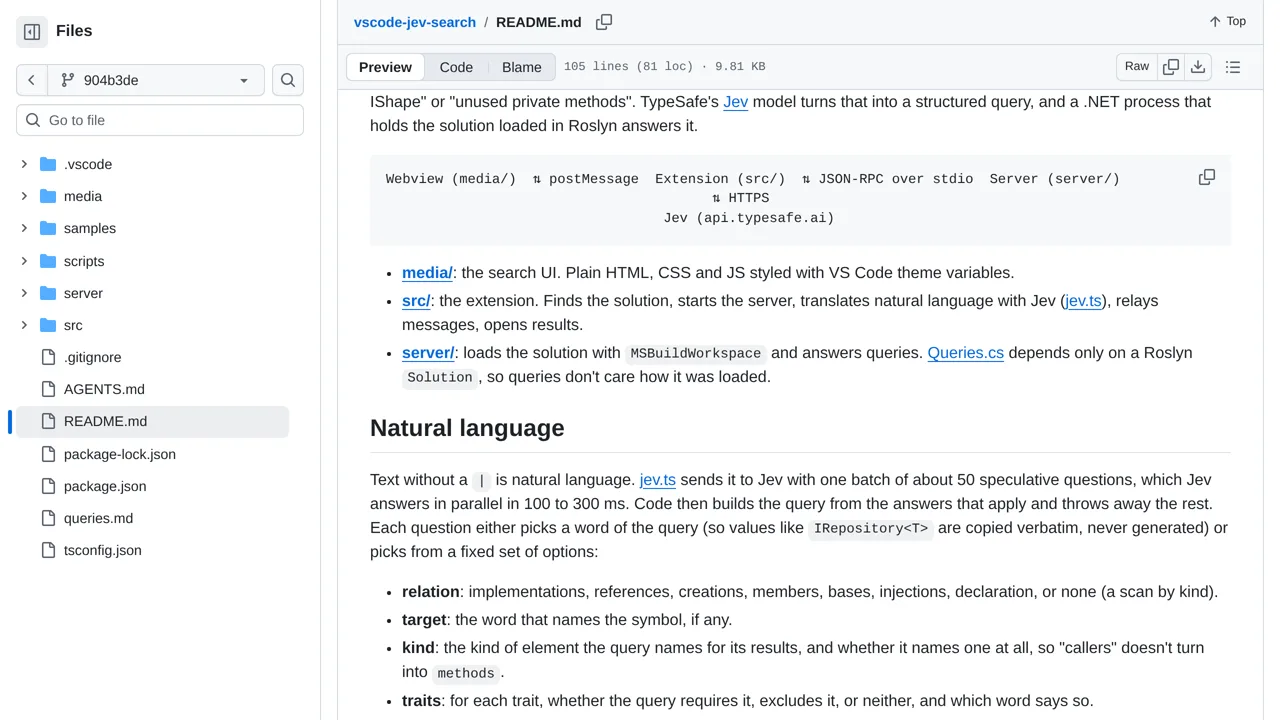
Find C# symbols in VS Code by describing them in English; Jev translates the request and a local code-analysis server finds matches.
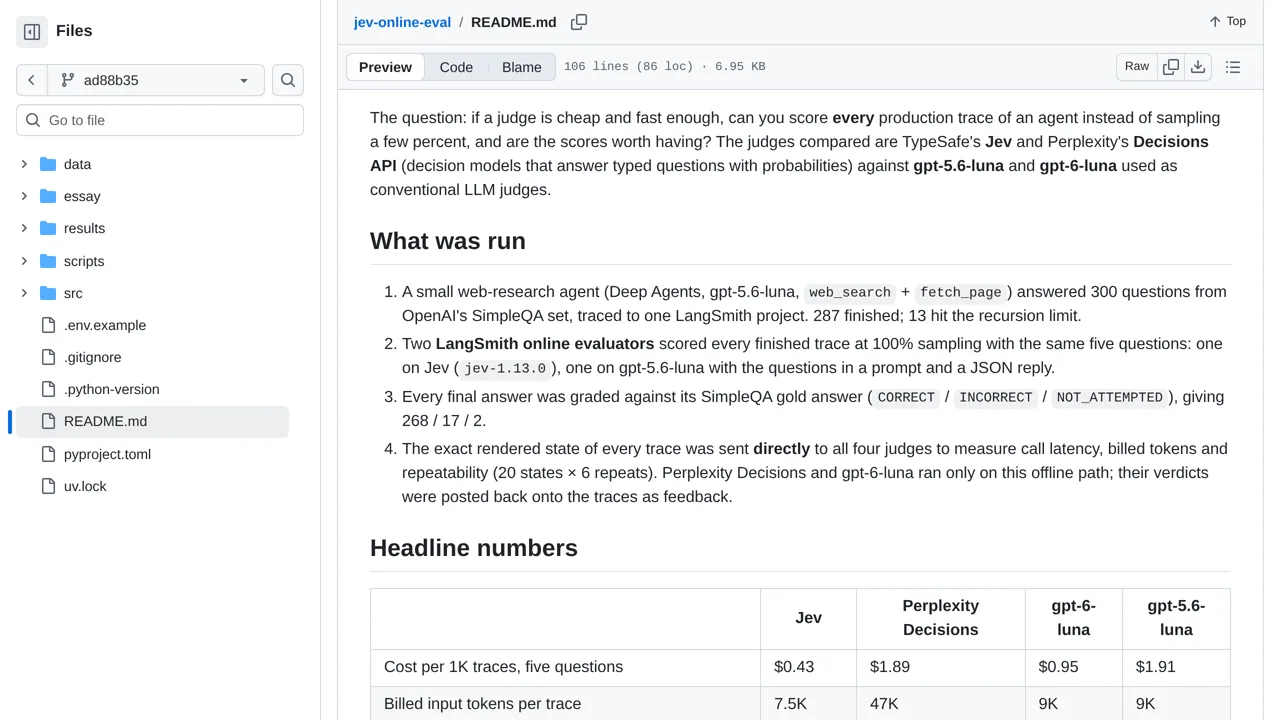
Compare Jev and other judges on a web-research agent’s answers, separating direct-call speed from the wait for scores in LangSmith.
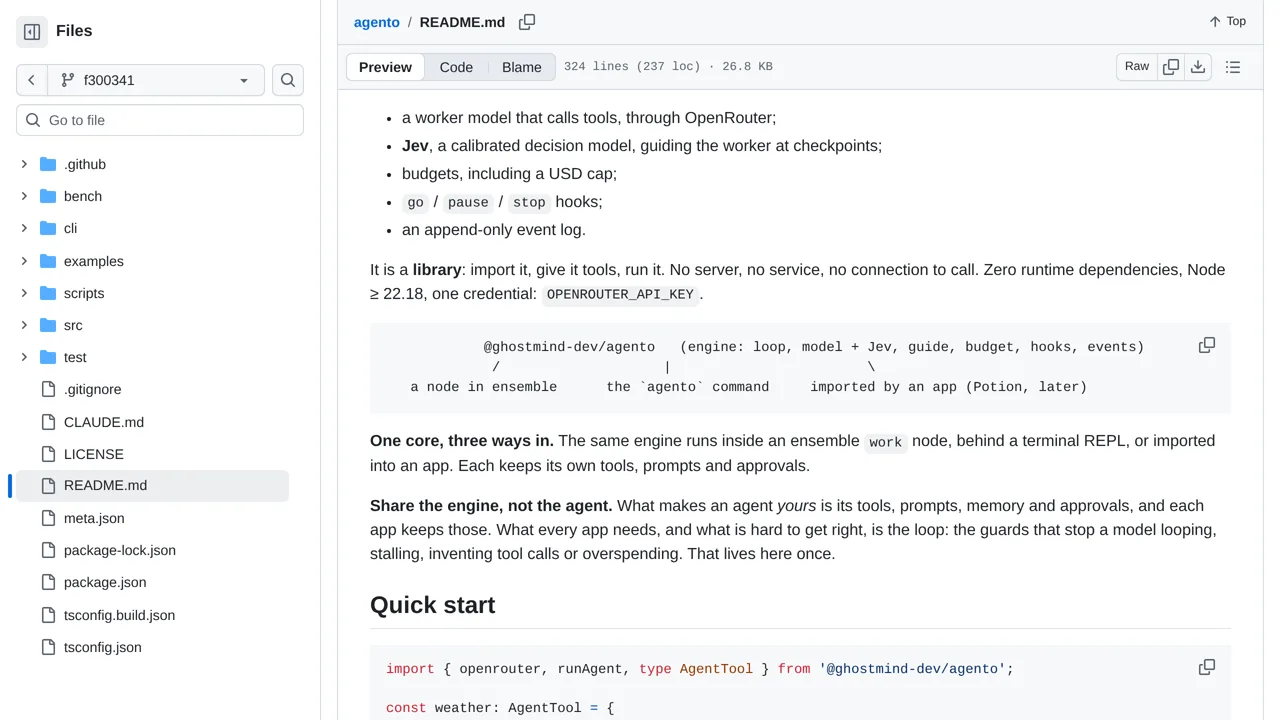
Build a tool-using assistant with a writing model and Jev checkpoints that suggest when to reconsider a result, change or answer.
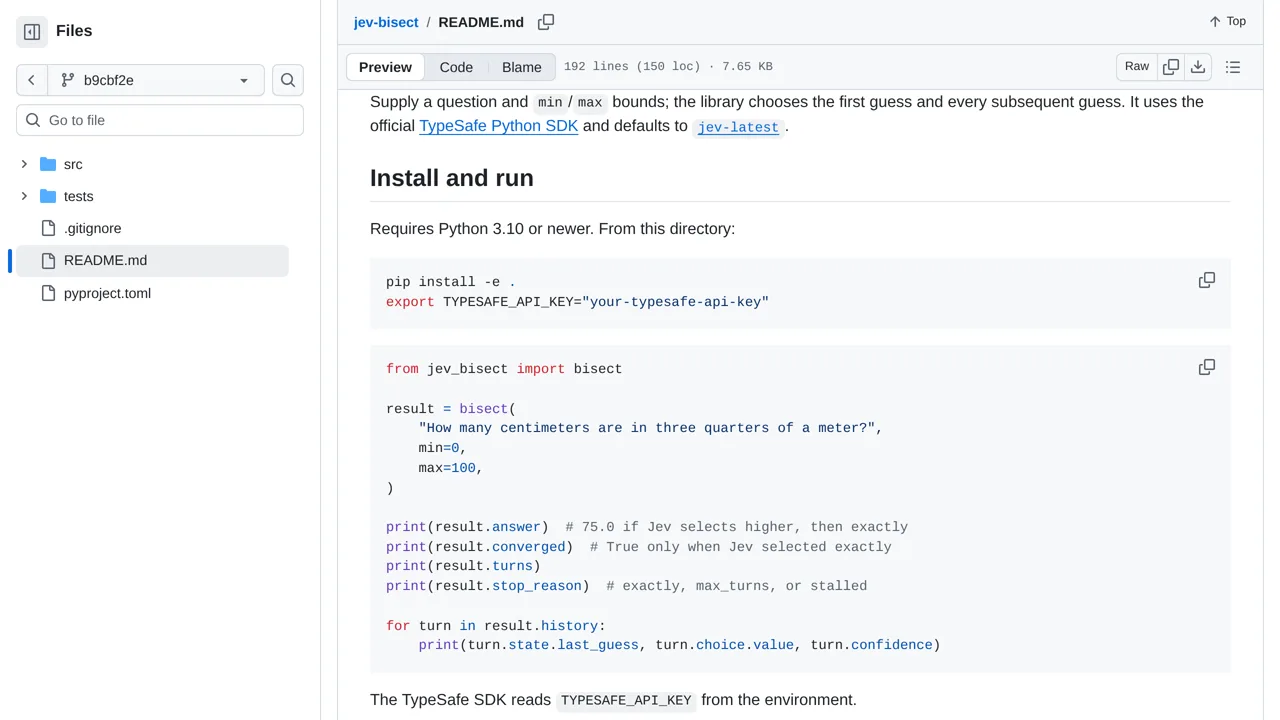
Explore numeric guessing with Jev choosing higher, lower or exactly while Python narrows the interval around each guess.
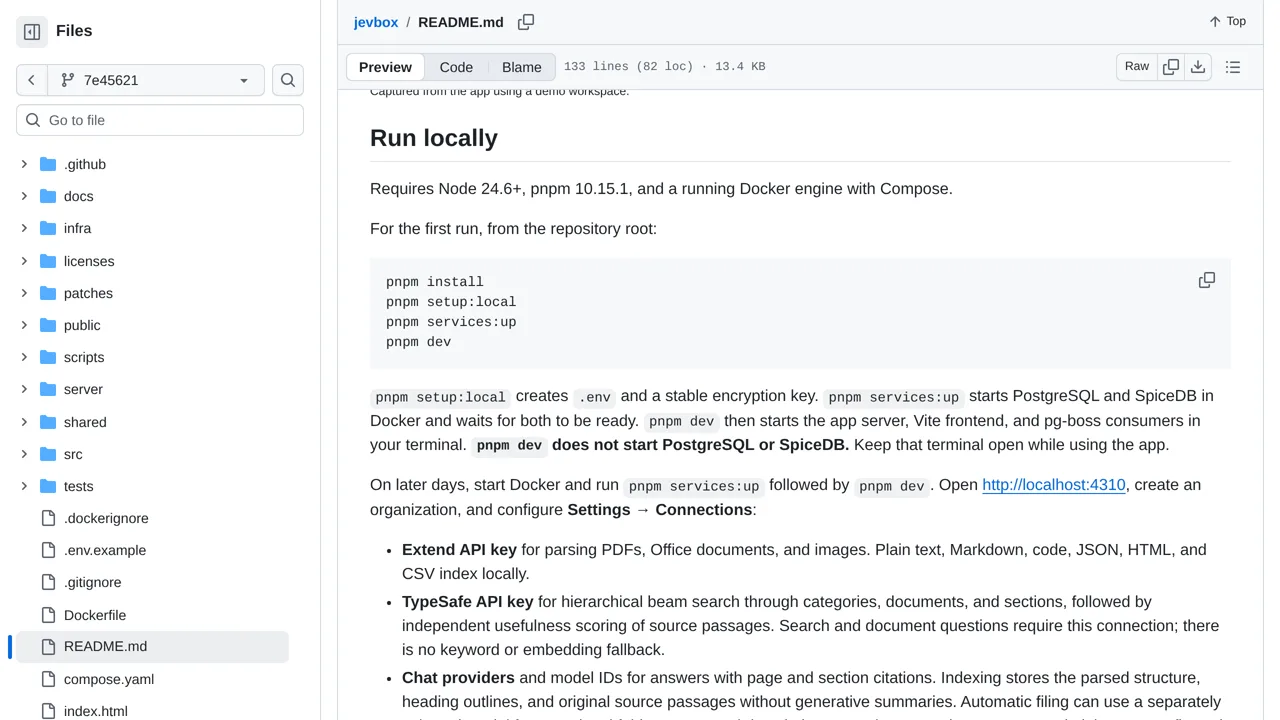
Browse a shared document library, search its folders with Jev and follow citations from answers written by a separate chat model.
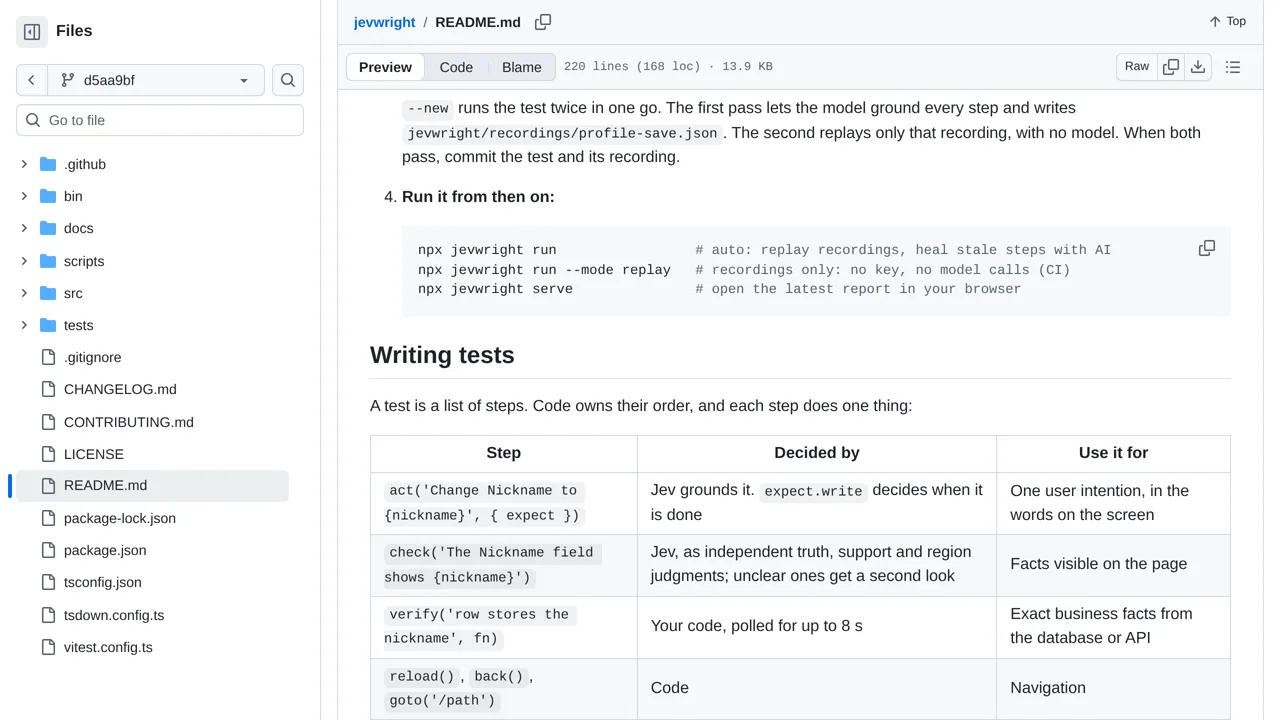
Write browser tests as user steps, let Jev find the controls and save those paths for later model-free replay.
Route user messages, retrieved text and tool output toward allow, review or block using Jev risk signals and a local policy.
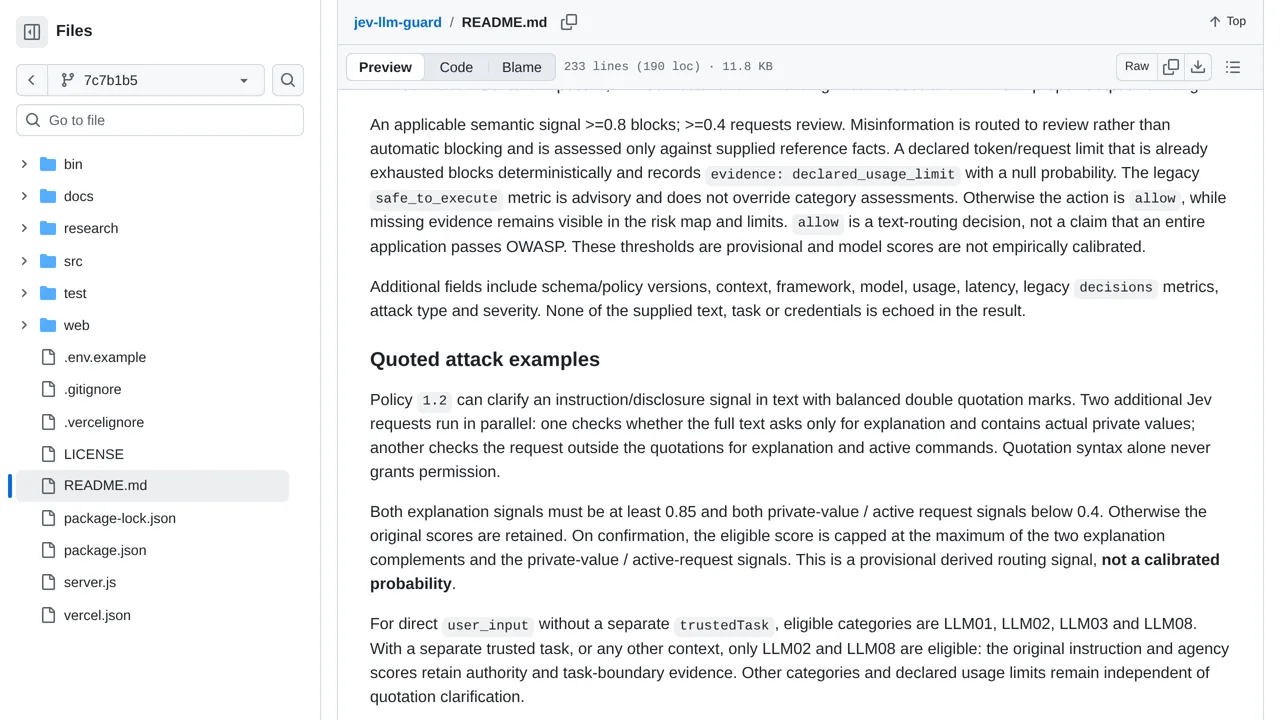
Read a one-day Jev evaluation that publishes its predictions, test code and response logs, including findings that went against expectations.
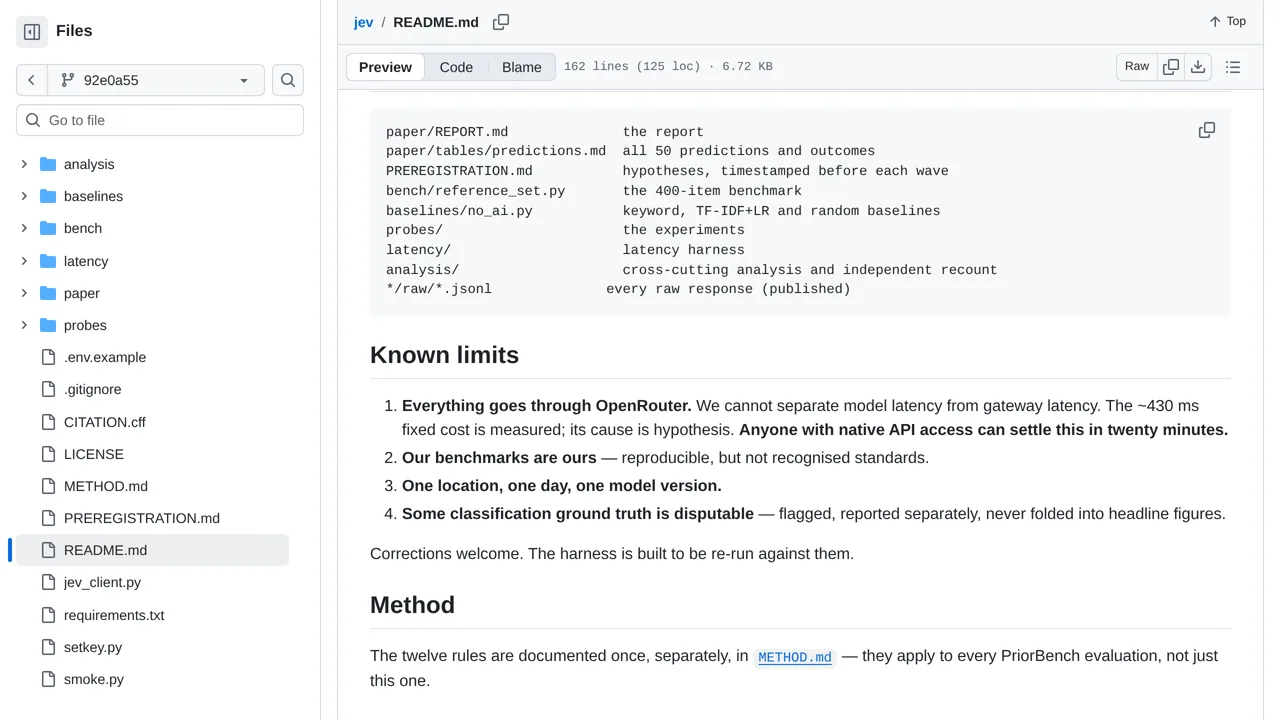
Use a self-hosted GLiFormer model behind a Jev-shaped API, with published comparisons showing where its answers differ from hosted Jev.
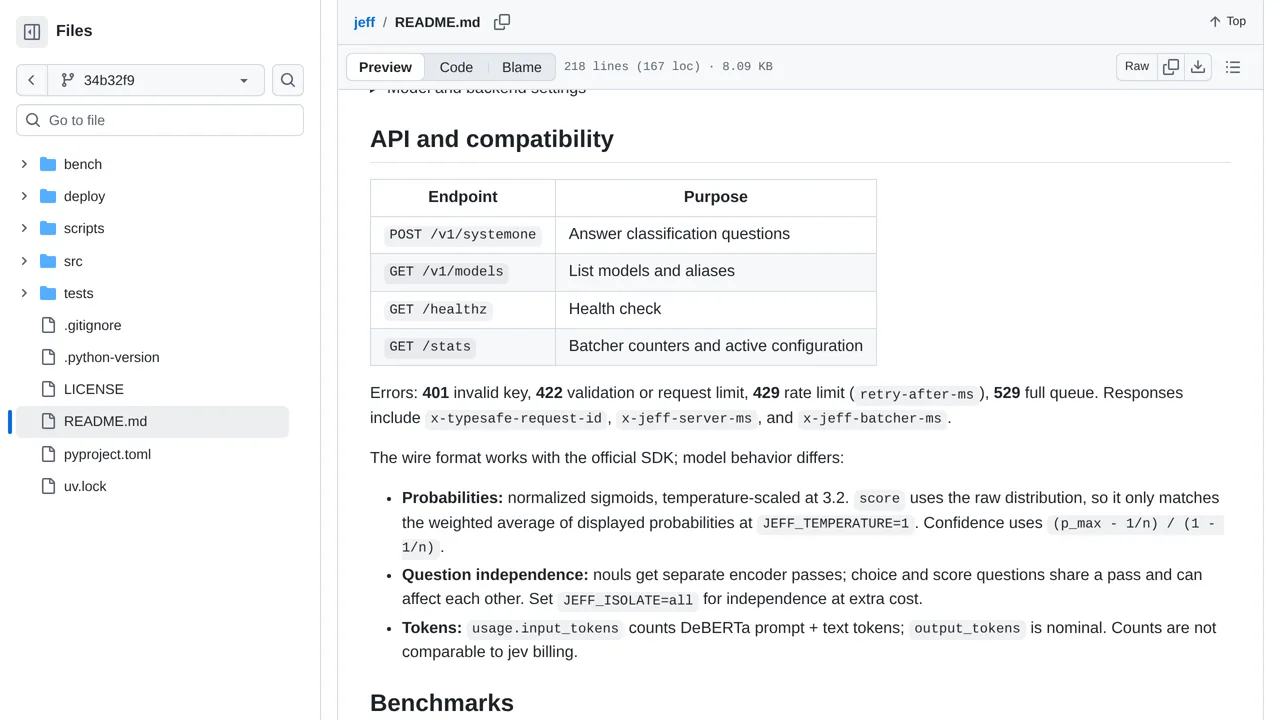
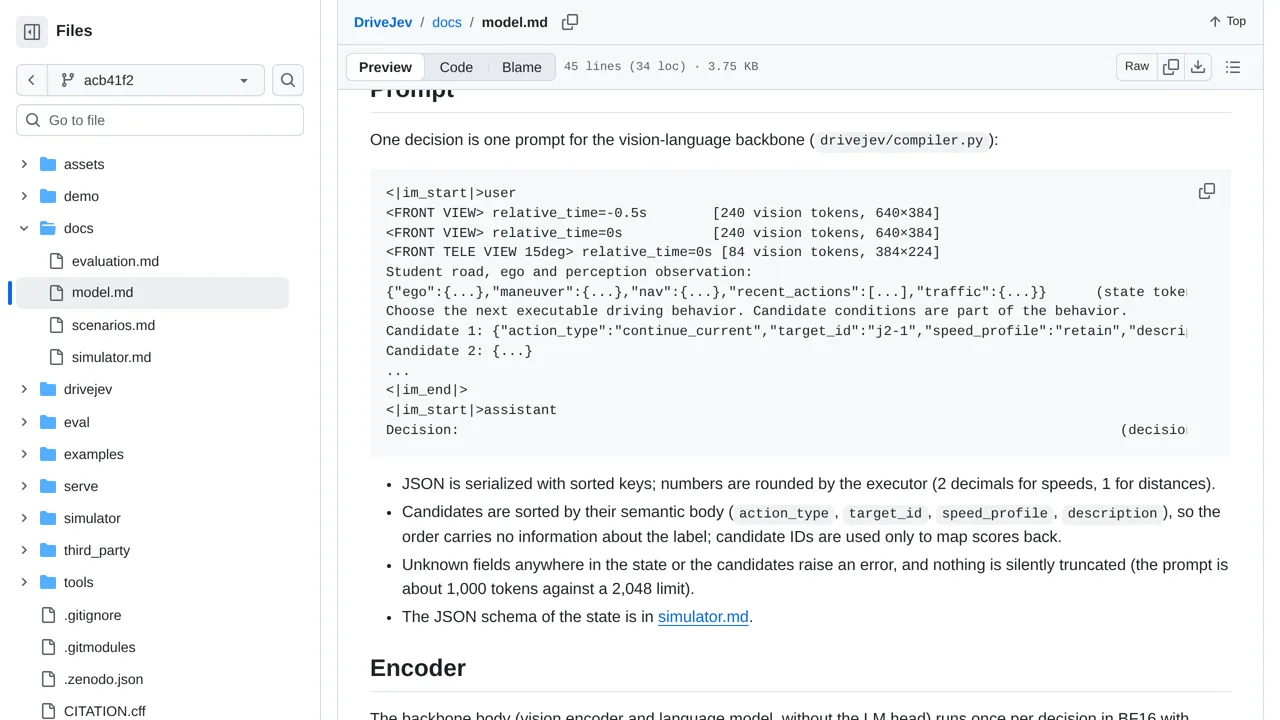
An independent visual driving model chooses among available behaviors in JevPilot, leaving local control code to turn each choice into steering and speed.
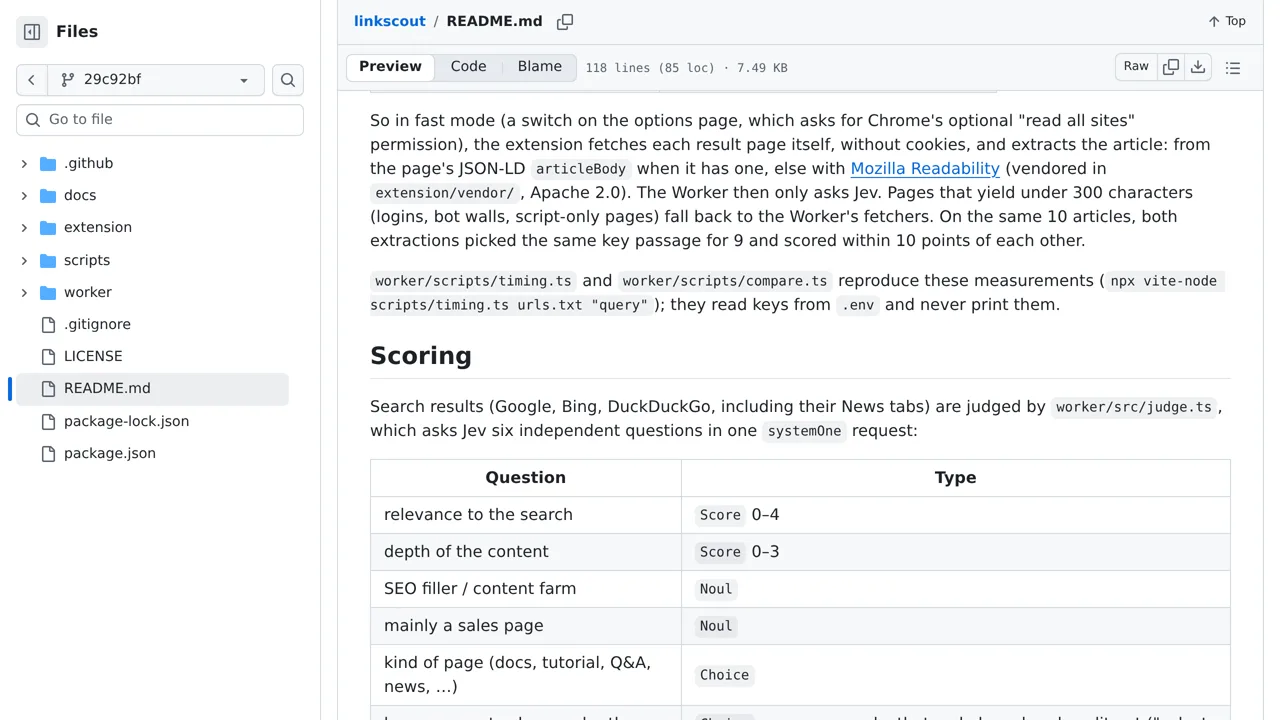
LinkScout ranks search results before you open them, adding relevance scores, page-type badges and a passage picked from each article.
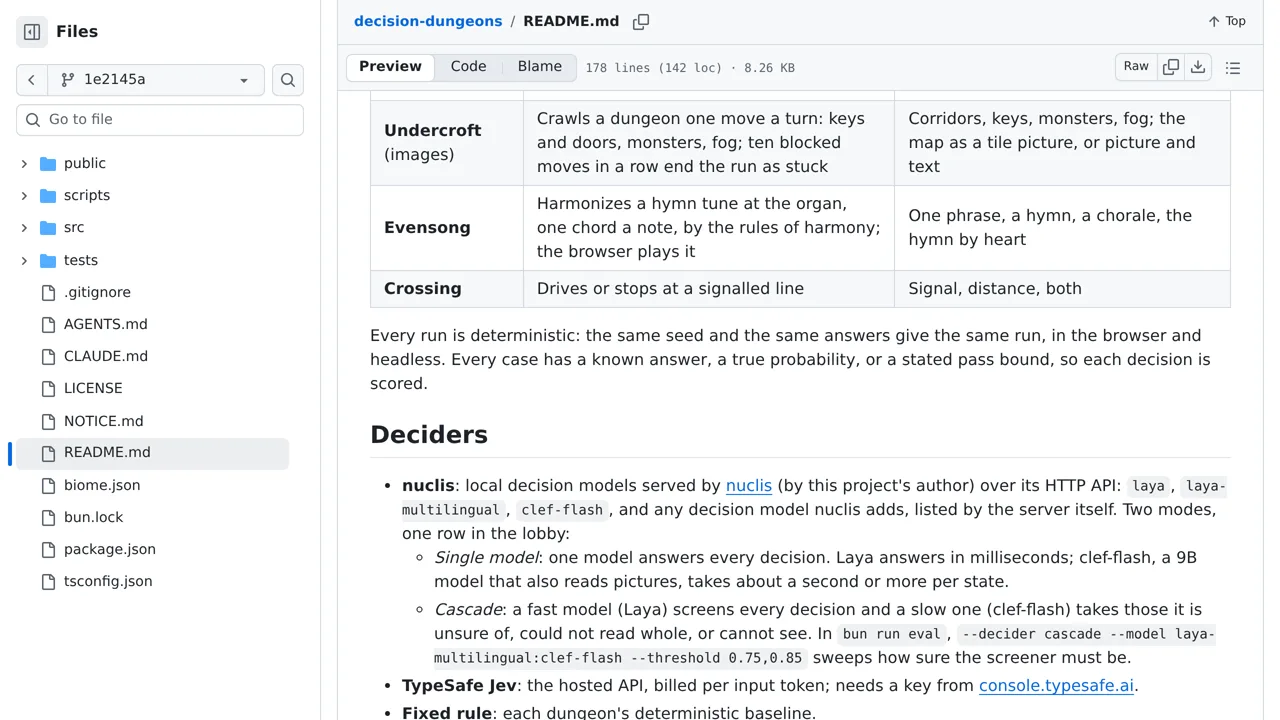
Compare decision models in simulated driving, airport and support-desk worlds, watching their choices or collecting results from the command line.
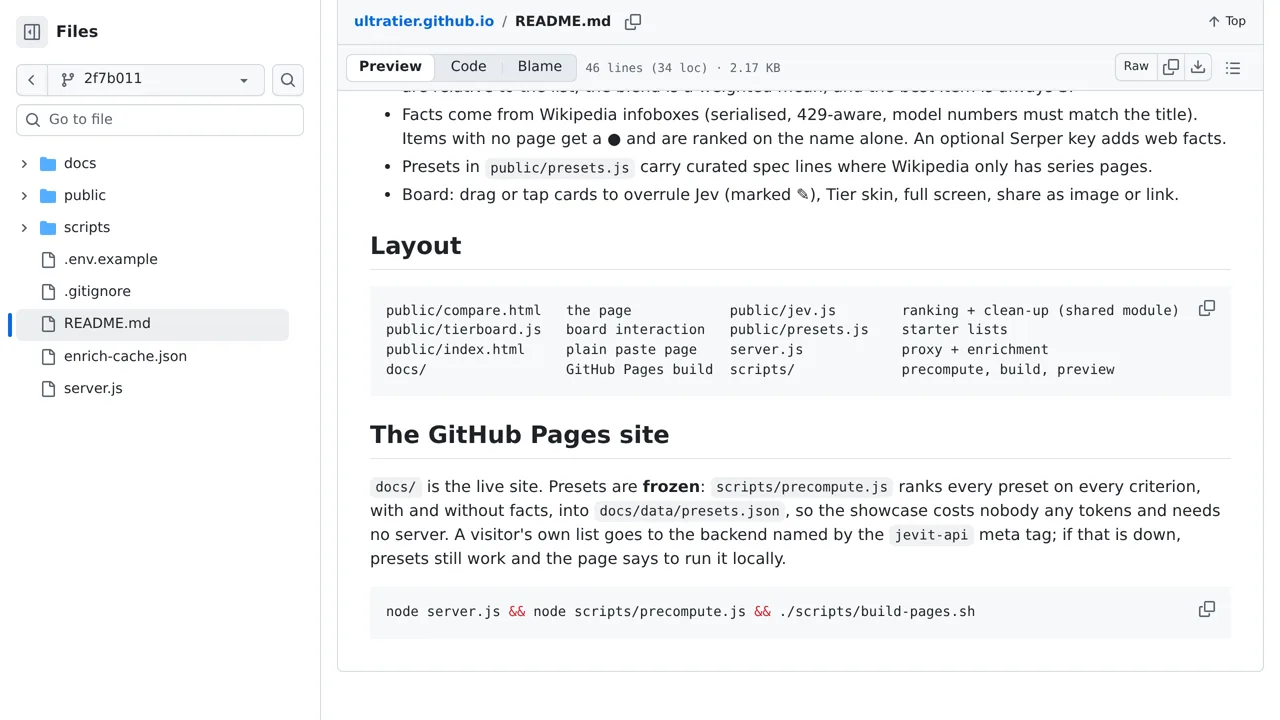
Ultratier turns a list into a weighted tier board, letting you compare rankings with supplied facts against rankings from names alone.
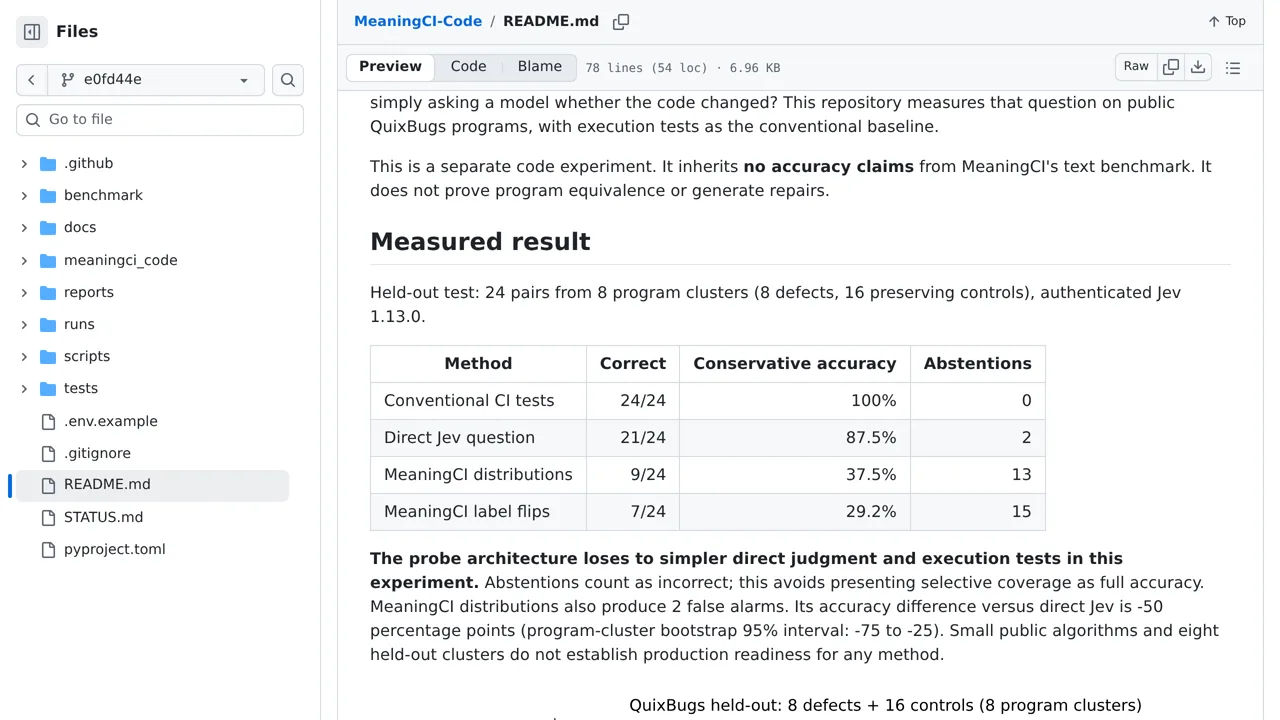
A study of bugs in small programs finds that comparing Jev's answer probabilities works worse than direct questions and execution tests.
Audit where Jev disagrees with existing yes-or-no rules, then use human checks to explore separate thresholds for each answer.
Give QAJev a visitor's goal and explicit checks; Jev chooses browser actions while the QA harness decides whether the page met your expectations.
A local proxy and dashboard that keeps Jev answers alongside the question versions, usage estimates and review labels that produced them.
NXTG.AI compares Jev's probabilities with Qwen and Claude on contract questions and internal routing tasks, then tests adding retrieved context.
Jev, briefly
A chat model generates text token by token and hopes you parse it. Jev never generates a word. Your code sends the state of the world plus typed questions; Jev returns every answer in one parallel pass — typed values with calibrated probabilities and a confidence score your code can trust. About 70–500 ms end to end, $0.042 per million input tokens, output free. Trained with what TypeSafe calls Reinforcement Learning for Calibrated Decisions.
You define the options. Jev returns the chosen option, a probability for every option, and a confidence. The workhorse of routing, agents, and games — the answer space is always legal, so there is nothing to parse and nothing to hallucinate.
You describe ordered levels — say trivial / normal / critical. Jev returns the level, the probability of each, and a confidence. Scores turn fuzzy judgment (“how severe is this log line?”) into a number-free decision your code can branch on.
You assert a statement; Jev returns the probability that it is true — a noul. Moderation, verification, guardrails, “does this diff actually fix the bug?”: one question, one calibrated probability.
Official material lives at typesafe.ai and docs.typesafe.ai. JevMade is an independent community registry — not affiliated with or endorsed by TypeSafe AI.
Recurring lessons
Games, drones, trading bots, and browser agents all converge on the same loop: serialize the state, ask one decisive question, act, repeat. Jev’s latency makes the loop feel instant — the model lives inside the control loop, not outside it.
The answer says what; the confidence says whether to act. The most reliable entries threshold on confidence to route edge cases to a slower model or a human — automation with an honest escape hatch.
Makers rarely ask Jev to pick from everything. Local tactics prune 225 gomoku moves to ~40; DOM filters turn a page into an element table; code narrows options, Jev judges within them.
A recurring split: Jev makes every decision cheaply and instantly, and a small LLM is only invoked when a human-facing string must actually be written. Decision and generation are separate budgets.
Send the link — repo, live demo, post, or video — plus a line on what it does and which primitives it uses. Every entry is verified against its primary source before it ships.
Submit your experimentSign in first so we can reply to you. Submissions are reviewed, not published automatically.