What it does
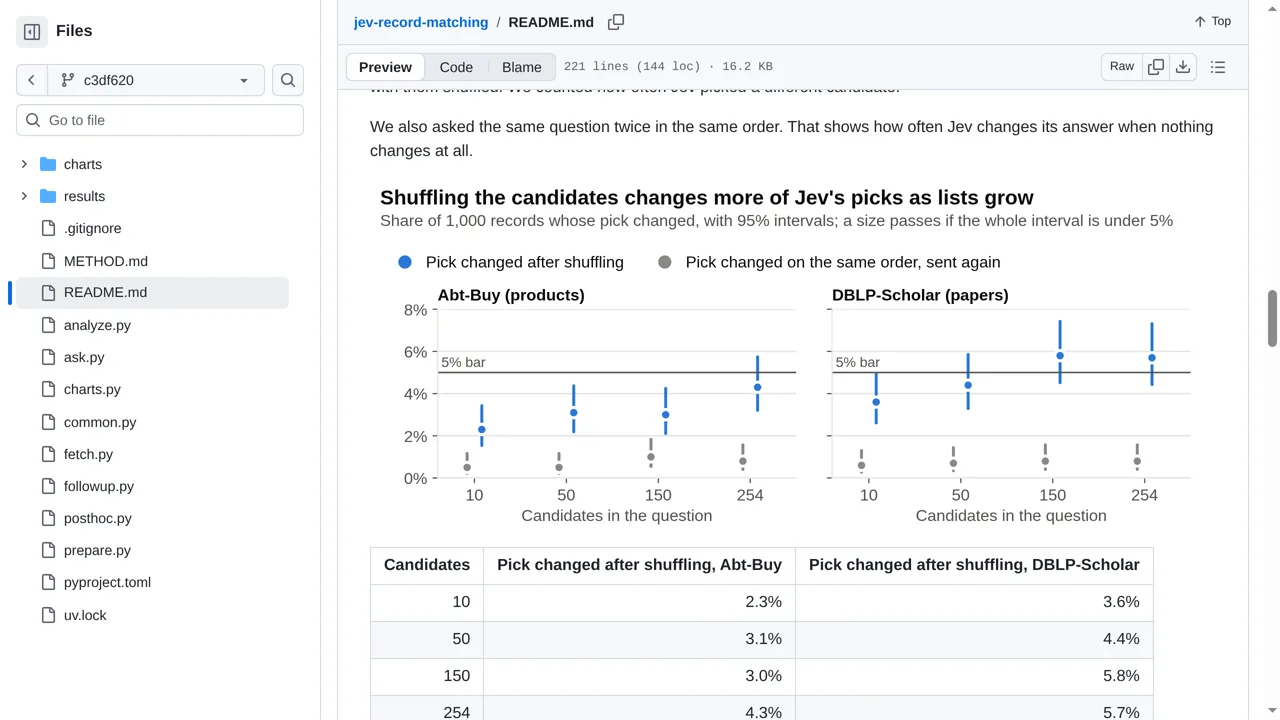
The reported tests examine missed matches and sensitivity to candidate order. Choice finds one match; pairwise questions can find several duplicates. Only summary results, not raw API answers, are published.
Benchmarks & research
Shaun Mataire compares Jev’s multiple-choice and yes-or-no questions for matching product listings and research papers.
Only you can see your notes.
Screenshot unavailable. Open the experiment ↗
The reported tests examine missed matches and sensitivity to candidate order. Choice finds one match; pairwise questions can find several duplicates. Only summary results, not raw API answers, are published.
To spot duplicates across product listings or paper archives, collect the records you need sorted. A developer can adapt this project's approach to ask the service either a yes-or-no question for each pair or a multiple-choice question from a short list of options.
Keep multiple-choice questions to ten or fewer items at a time. Longer lists or shifting item orders can cause the system to miss duplicates. If a record might match several entries at once, have your developer check pairs individually instead of using multiple-choice.