Read & learn
Written guides.
Understand Jev, one idea at a time. Walkthroughs, recipes, and writeups — our notes first, the original next.
Learn, build, and play with Jev — from deep technical guides to creative experiments.
Read & learn
Understand Jev, one idea at a time. Walkthroughs, recipes, and writeups — our notes first, the original next.
Watch & learn
See an idea take shape. Tutorials, demos, and deep dives, organized by topic and credited to their creators.
Make & explore
See what builders made with Jev. Games, tools, repositories, articles, and more — traced to their sources.
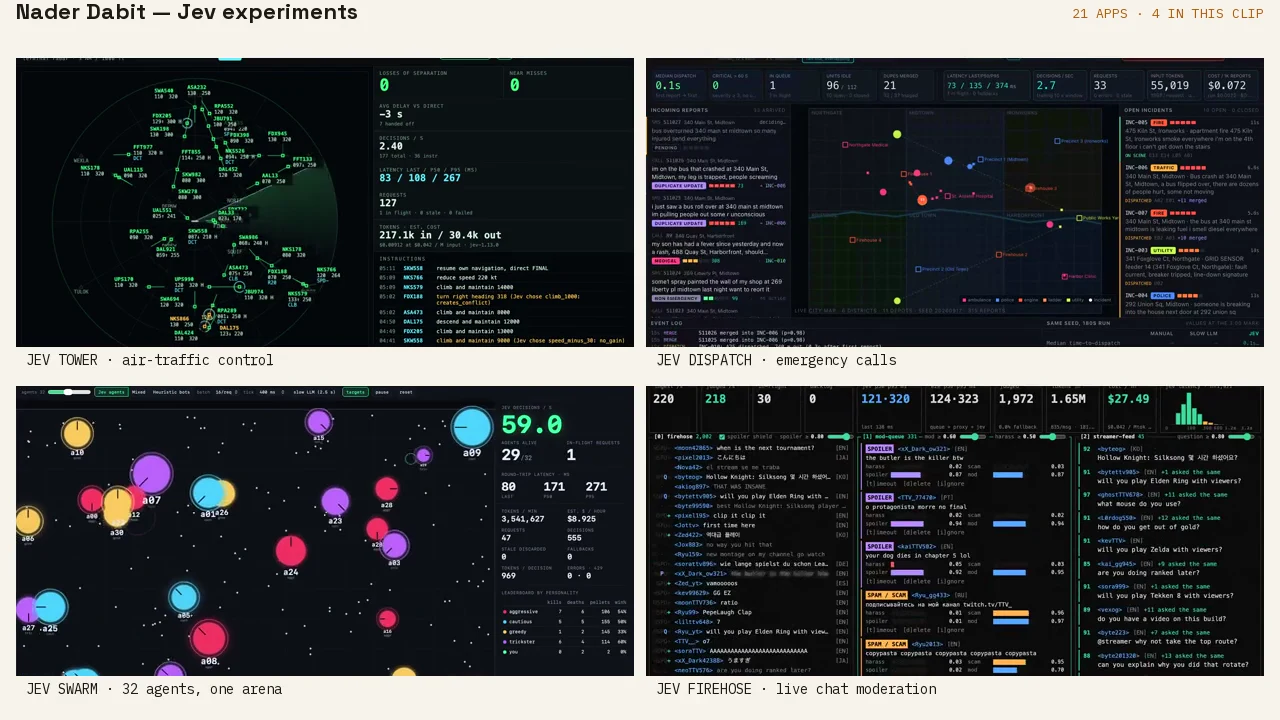
Every category, from games and tools to repositories and writeups, traced to a primary source.
Real-time research powered by
Same ideas.
Different paths.
This is the full registry, not just the featured picks. Figures like speed, cost, and stars are maker-reported or captured snapshots, not JevMade measurements.
2140 experiments · showing 2041–2100
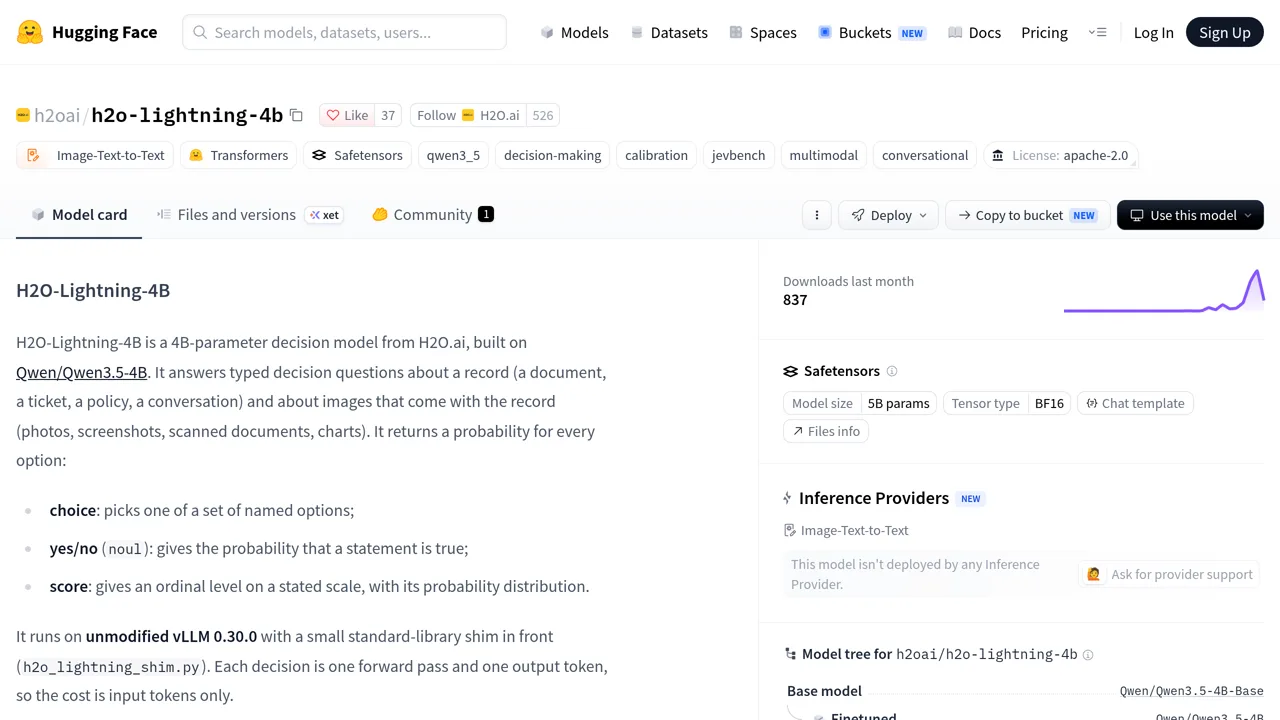
H2O.ai's open 4B decision model, built on Qwen3.5-4B, answers choice, yes/no and score questions about records and the images that come with them.
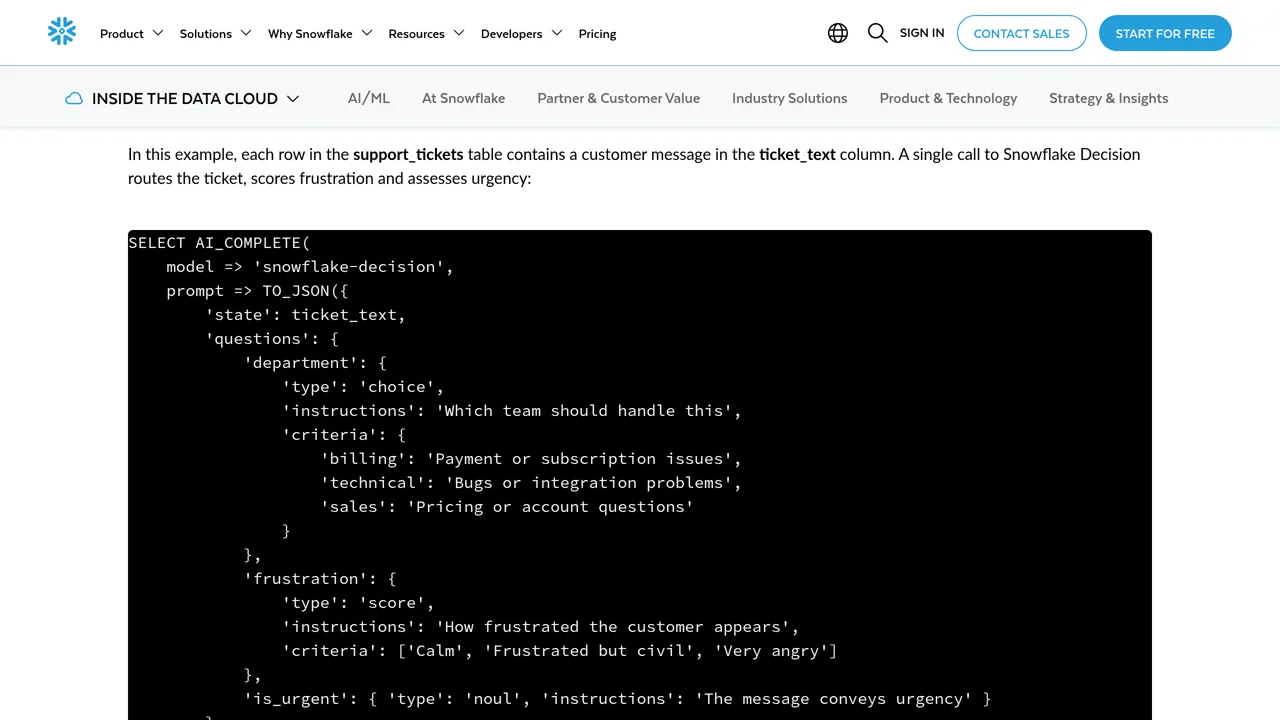
Snowflake Decision is Snowflake's hosted decision model, in private preview, that answers choice, score and yes/no questions about table rows from inside a SQL query.
Cribl's first open decision model is a LoRA adapter for Qwen3.5-4B that gives a probability for every option you supply, meant as a base for telemetry, IT and security models.

Surogate's Rune looks at text, a record or a picture and picks one of your answers, with a probability attached to every option it was offered.

Cisco's AI Defense team asked whether Jev, given only a written safety policy, could match a 1B classifier trained on that policy, and how it fares against a prompted Gemma judge.

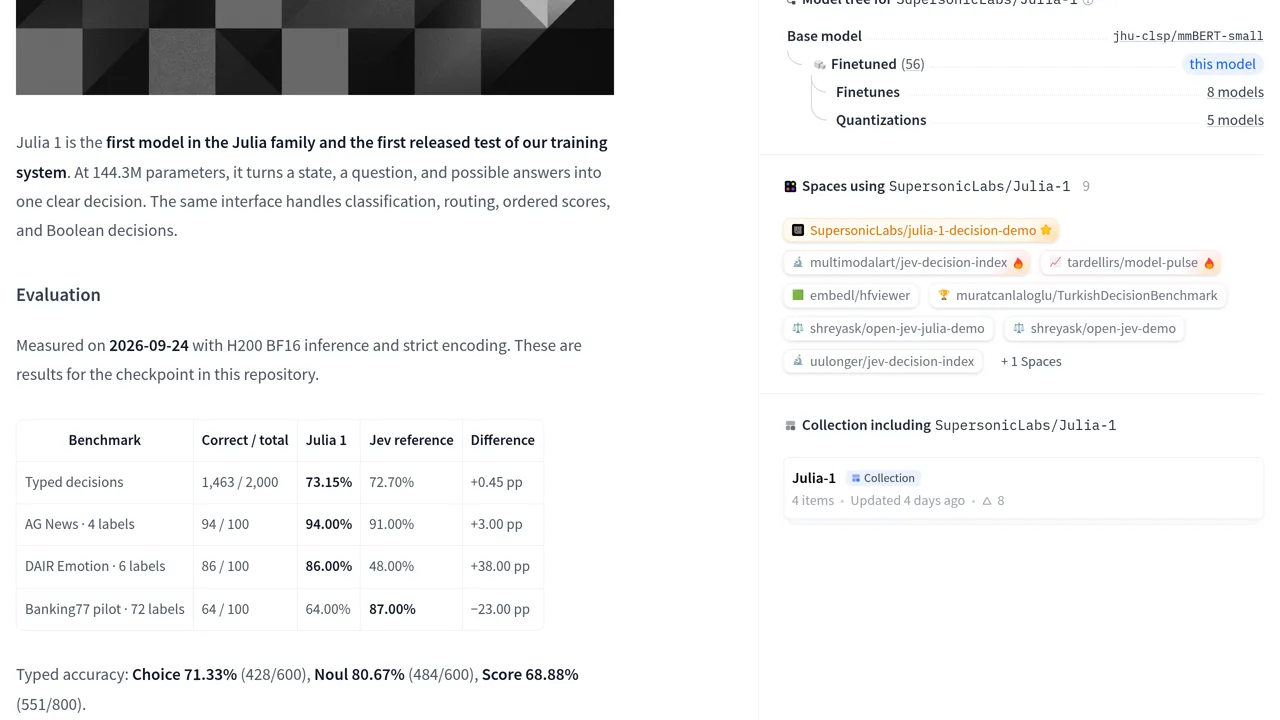
Supersonic Labs' Julia 1 is a 144M-parameter multilingual decision model that picks among 2 to 20 answers you supply, small enough to run on a CPU or in a browser.
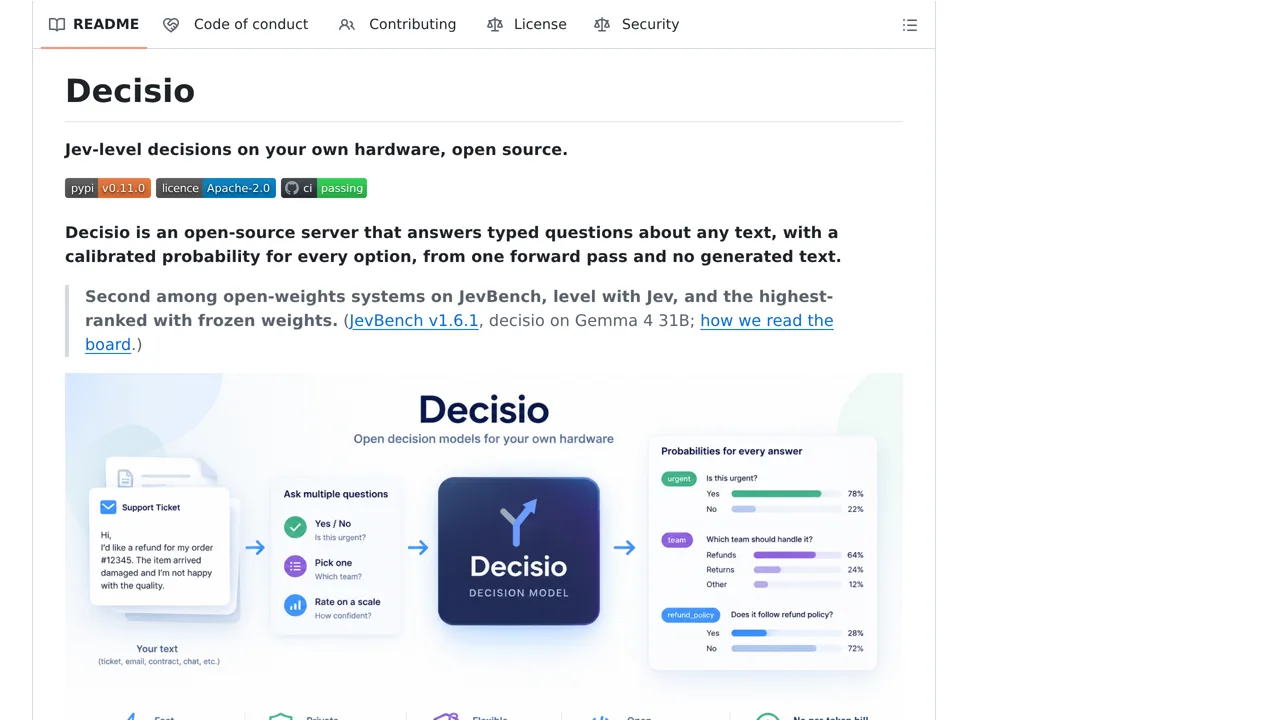
Tachara AI Lab's Decisio turns unmodified open models, by default Google's Gemma 4 31B, into a self-hosted decision server that gives a probability for every option.
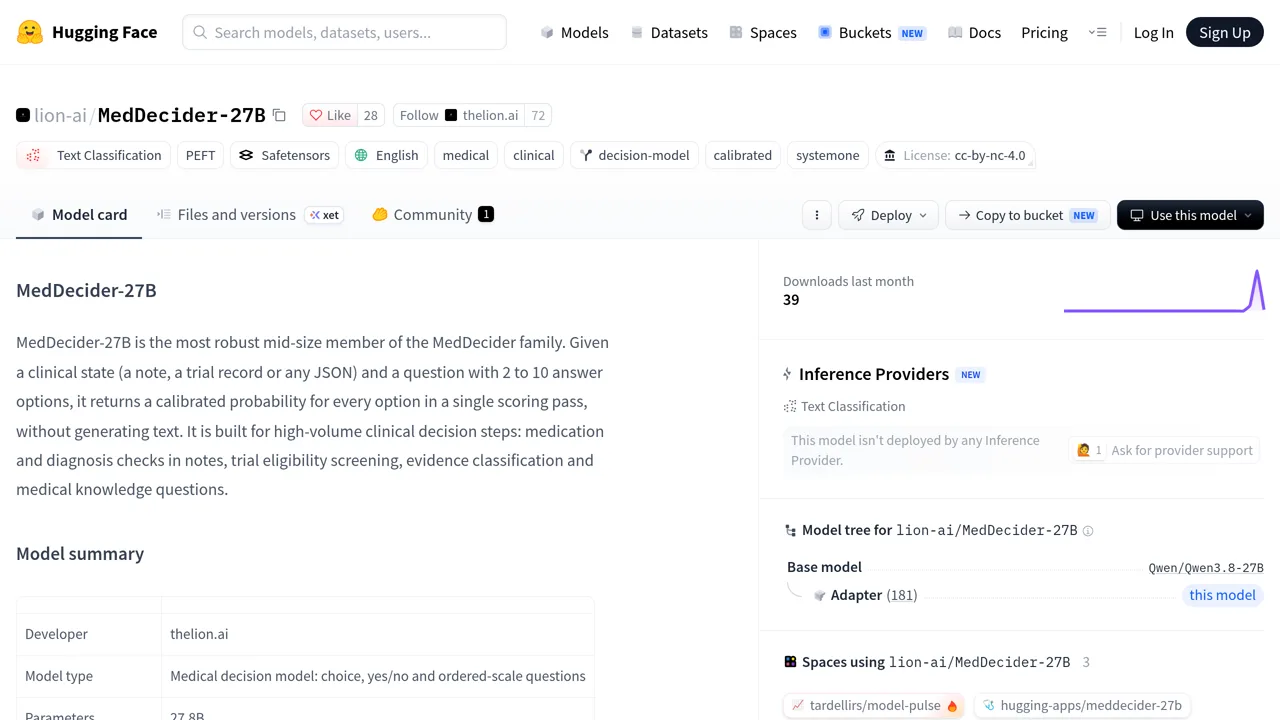
Ask thelion.ai's MedDecider whether the patient in a clinical note is still taking empagliflozin, and it gives a probability for Yes and for No instead of writing an answer.
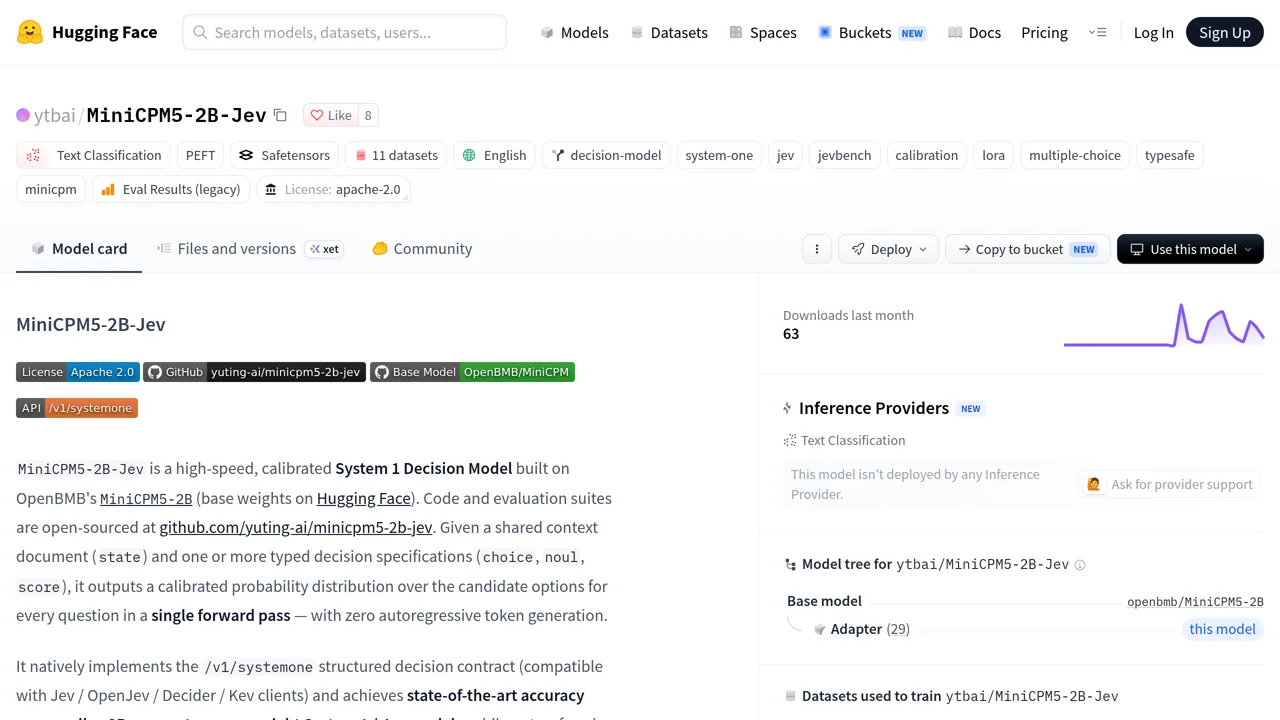
ytbai retrained OpenBMB's small MiniCPM5-2B to answer Jev-style choice, yes/no and score questions; the result runs on your own machine behind a /v1/systemone-style endpoint.
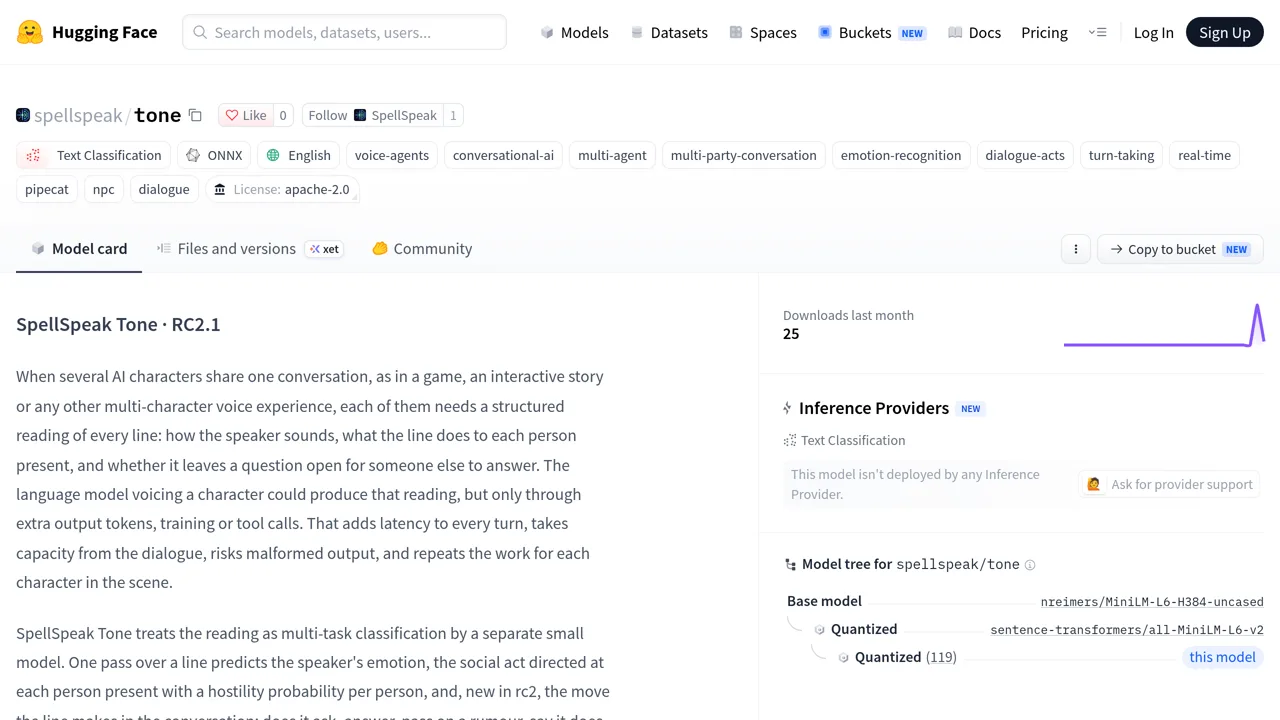
SpellSpeak Tone reads each line of game dialogue and tags how the speaker feels, how the line lands on everyone present, and whether it asks, answers or dodges.
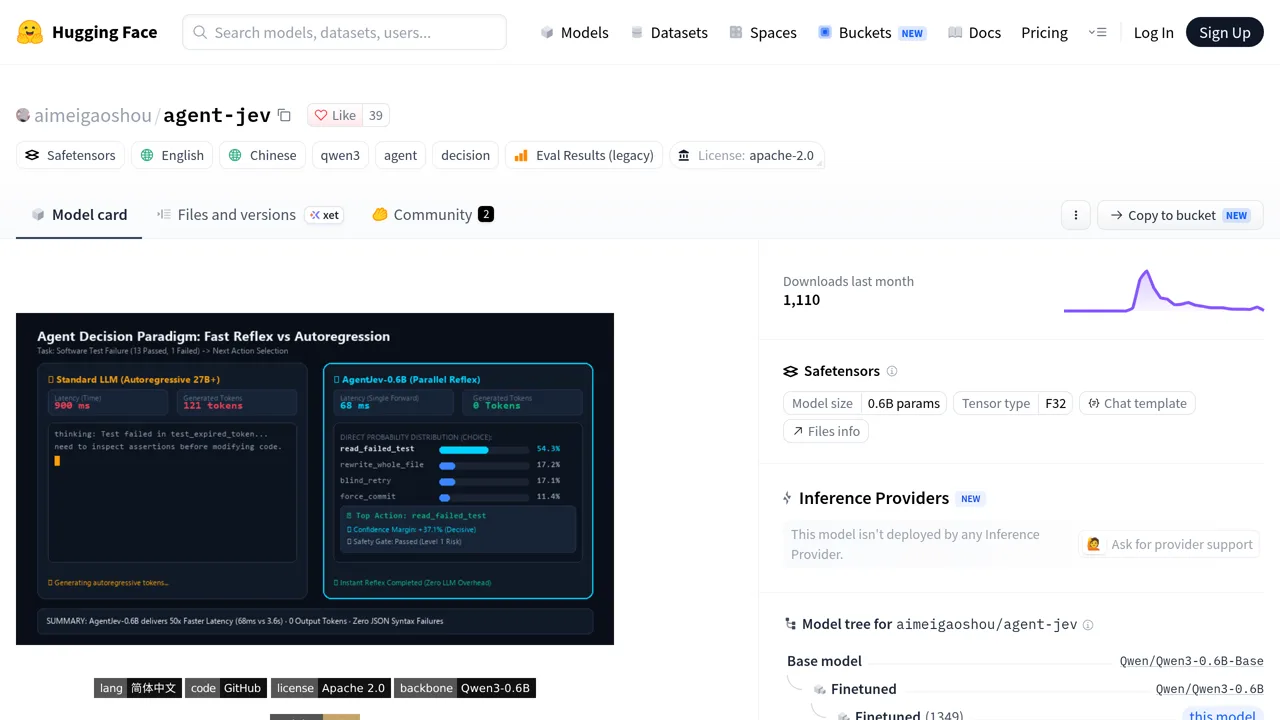
AgentJev-0.6B is a tiny model for coding agents that answers questions like 'is this task really finished?' with a probability for each option, without writing any text.
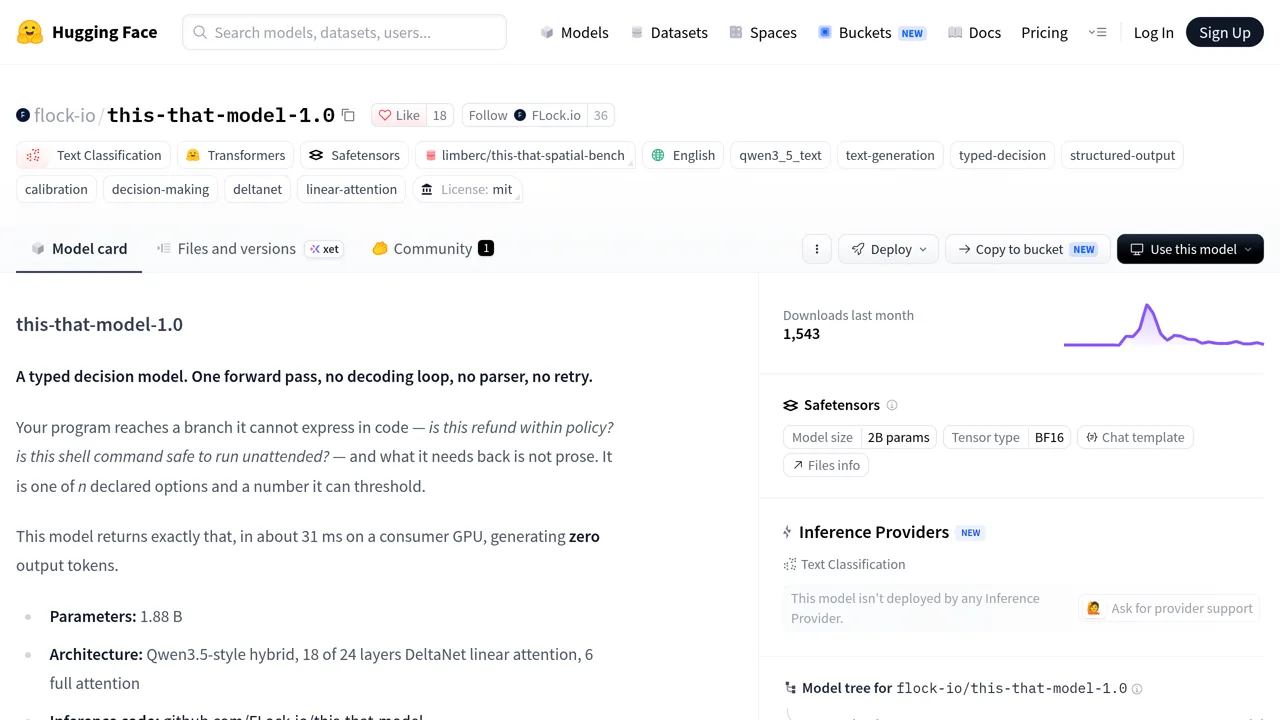
FLock.io's this-that-model-1.0 is a 1.88B model that picks one of the options a program declares and gives each a probability, without generating a single token.
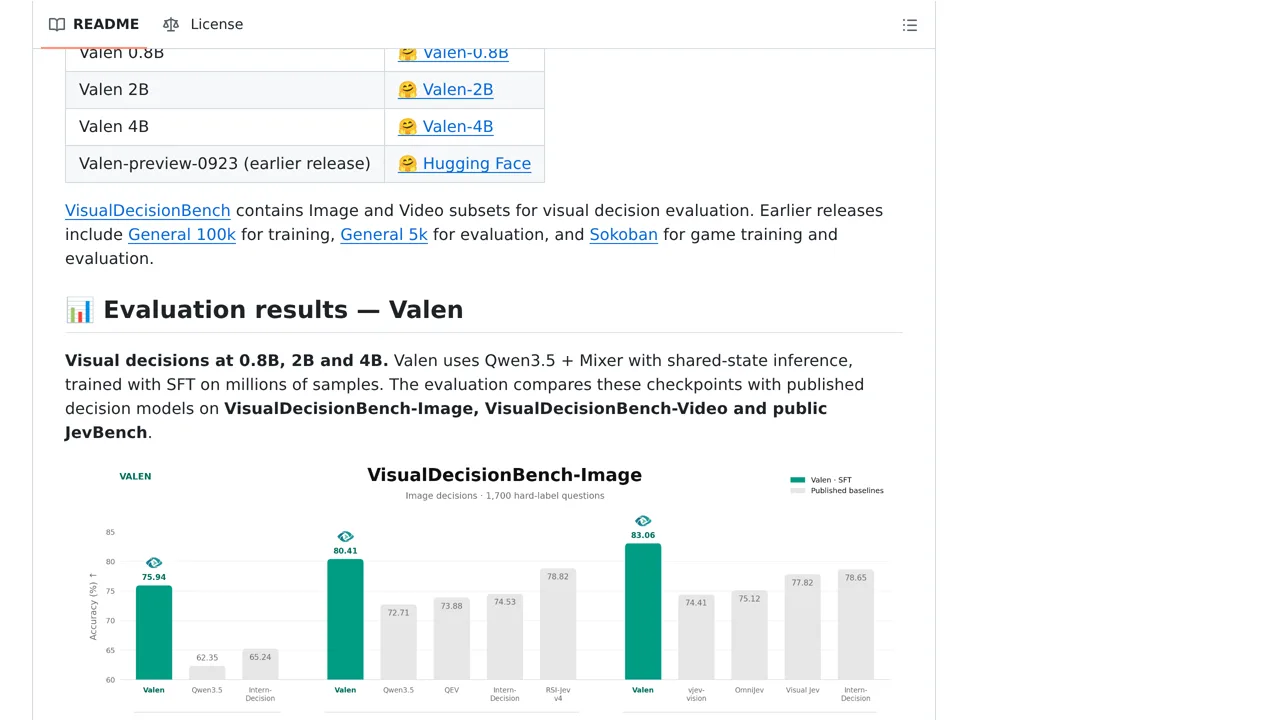
Valen looks at text, a photo or a video clip and answers questions such as which animal is in the picture, with a probability for every option you offer.
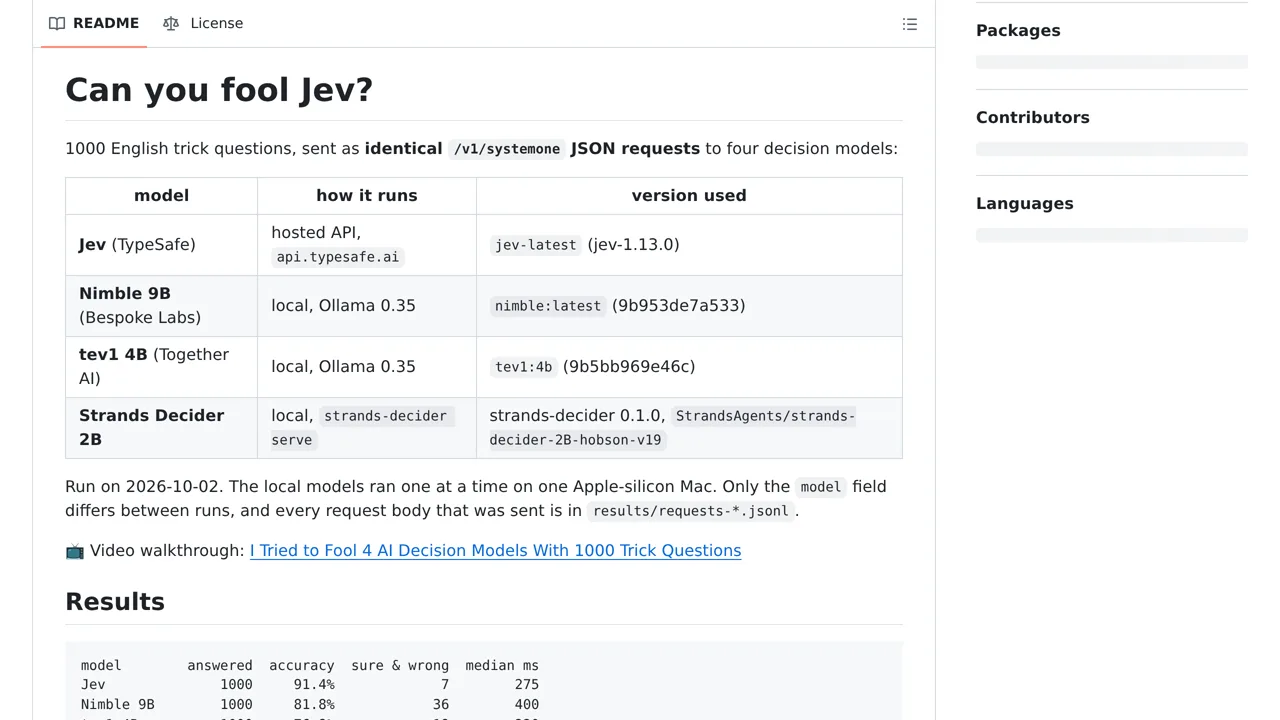
Hüseyin Babal wrote 1,000 trick questions, laced with sarcasm, hidden severity and planted instructions, and sent the same requests to Jev and three smaller local models.
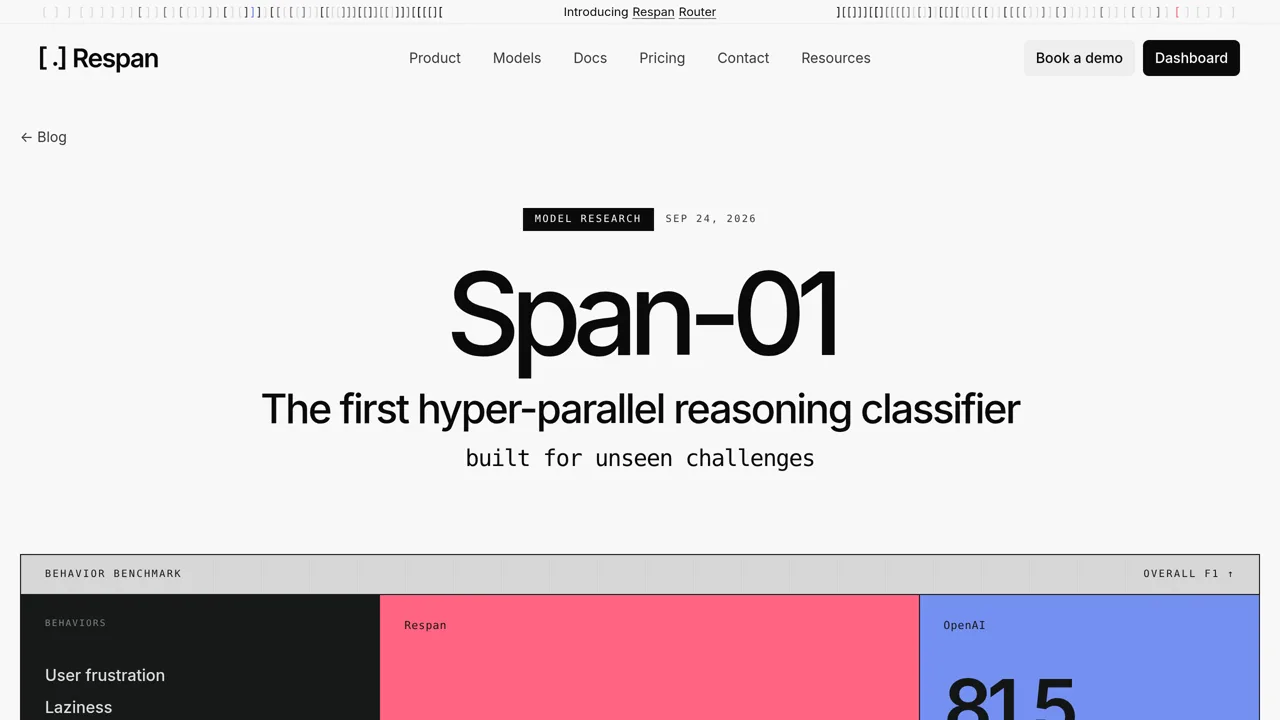
Respan's Span-01 reads a long AI chat log and tells you, for each behaviour you describe in plain words, whether it is present, absent or impossible to judge from the log.
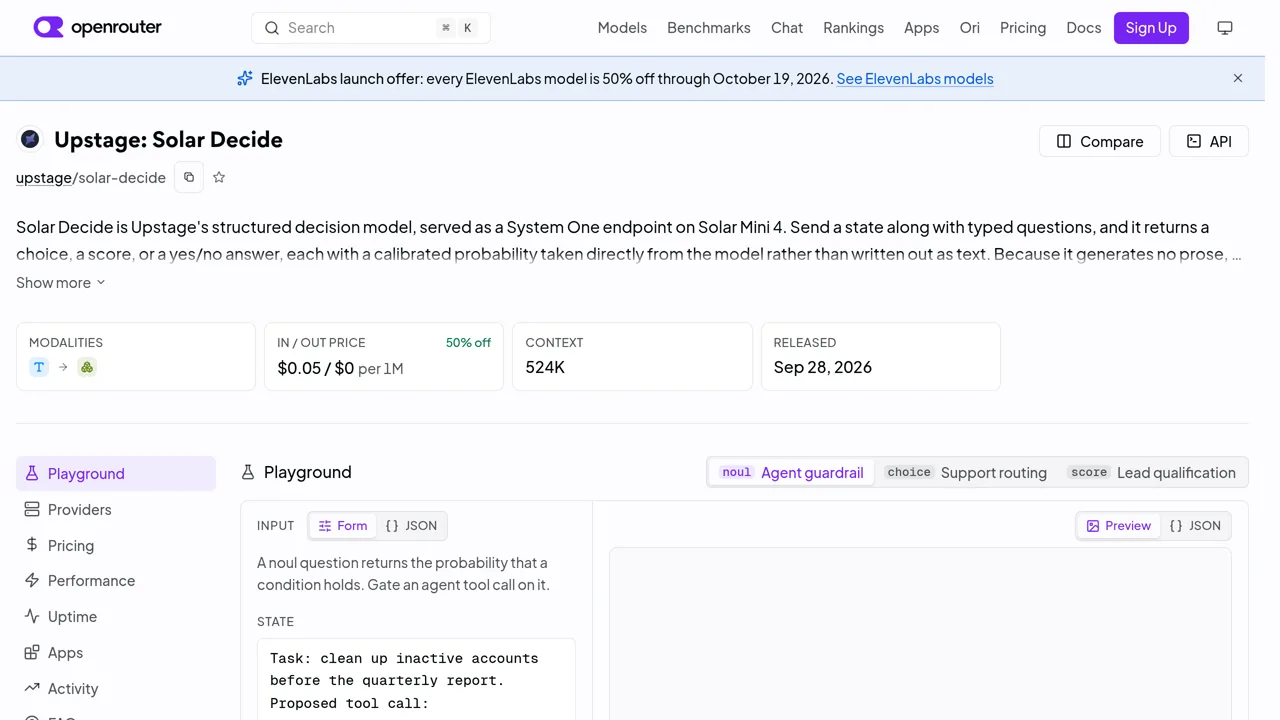
Solar Decide is Upstage's own decision model: send it a document and a few typed questions in the format Jev uses, and it returns a choice, a score or a yes/no probability.
LLM-as-Jev argues that an ordinary chat model can already work as a Jev-style decision model: number the answers, then read how likely the model is to say each number.

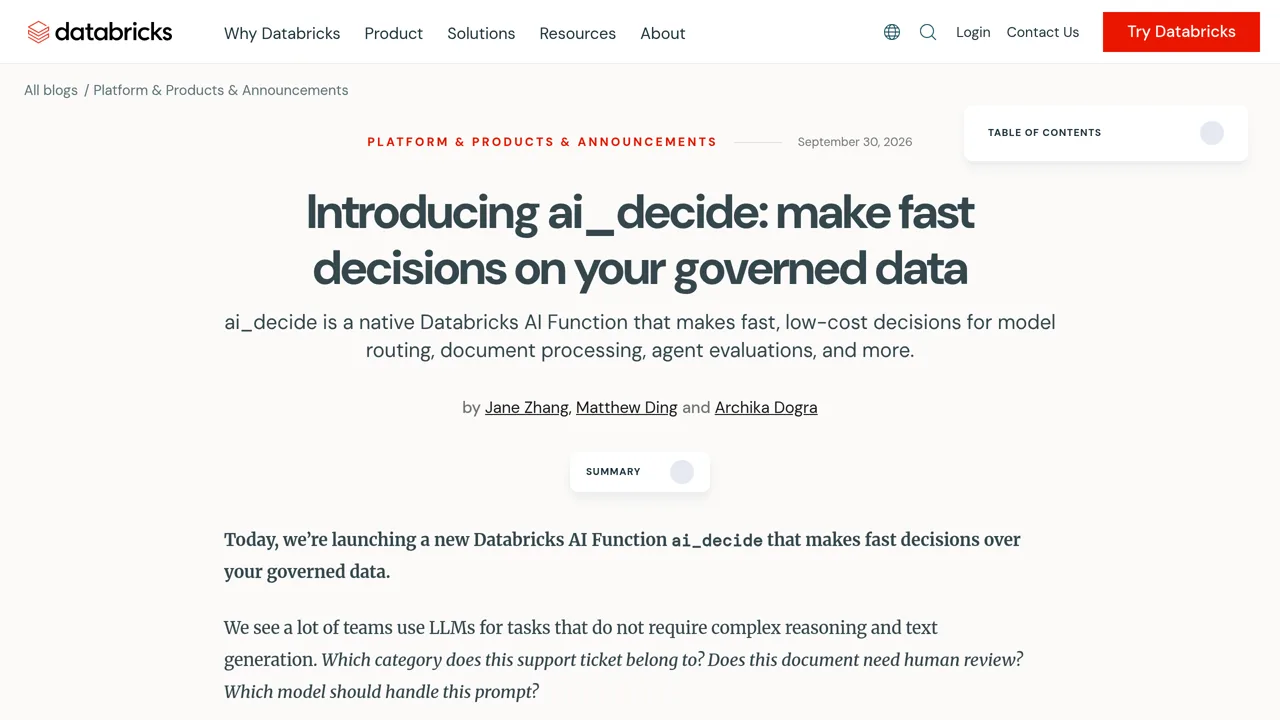
Databricks' ai_decide lets a SQL query ask choice, yes/no and score questions of every row of text in a table, returning probabilities instead of written answers.
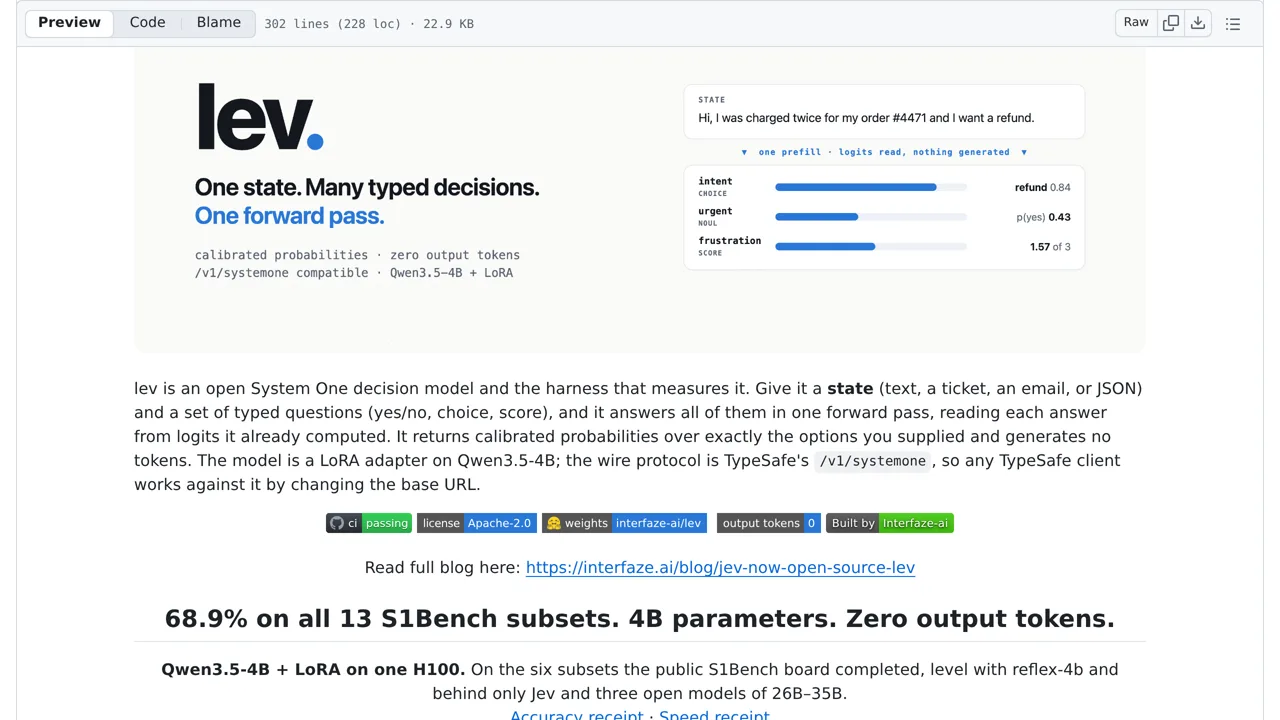
Interfaze’s Lev runs on your own machine and scores the answers you supply, rather than writing a reply.
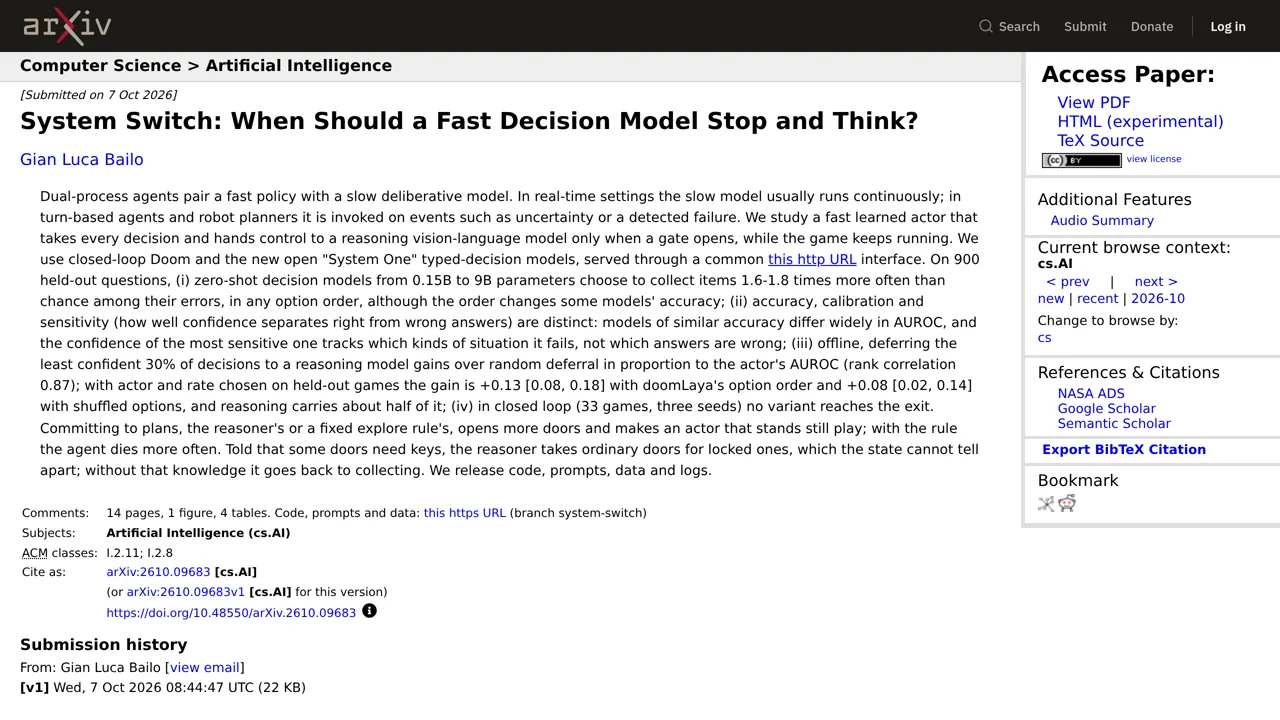
A Doom study asks when a fast decision model should hand control to a slower reasoning model.
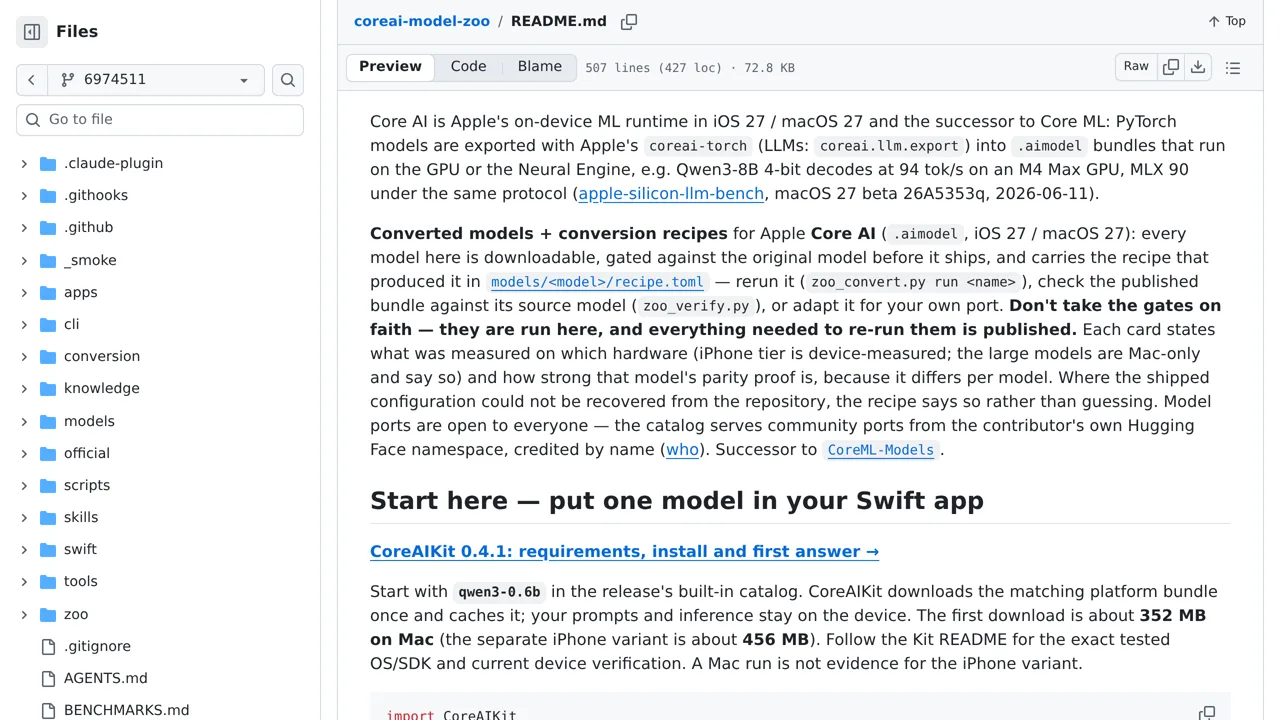
John-rocky’s model zoo brings open decision models to Apple’s Core AI runtime, with tests of their probabilities and device timing.
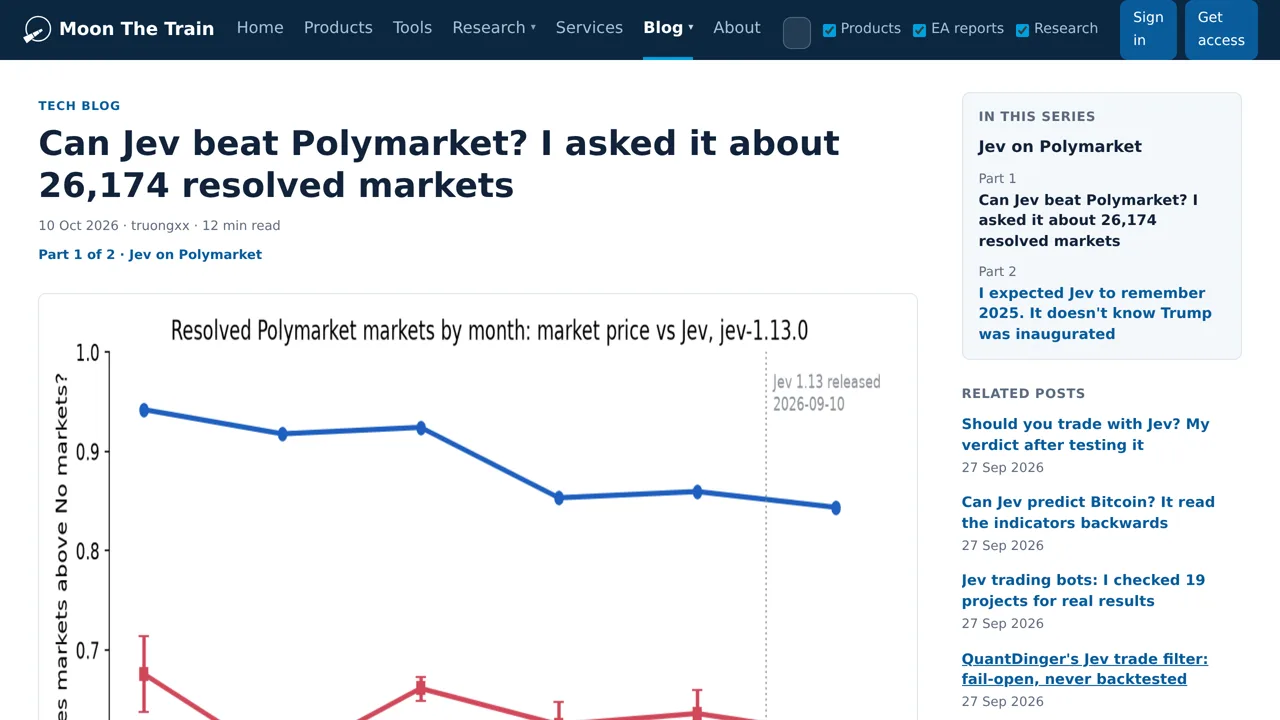
An independent study tested Jev on 26,174 resolved Polymarket markets, finding it underperformed the market price even when provided with it.
A human-supervised manufacturing proof of concept uses Jev to evaluate bin states and workload, projecting preparation instructions to operators via LightGuide.

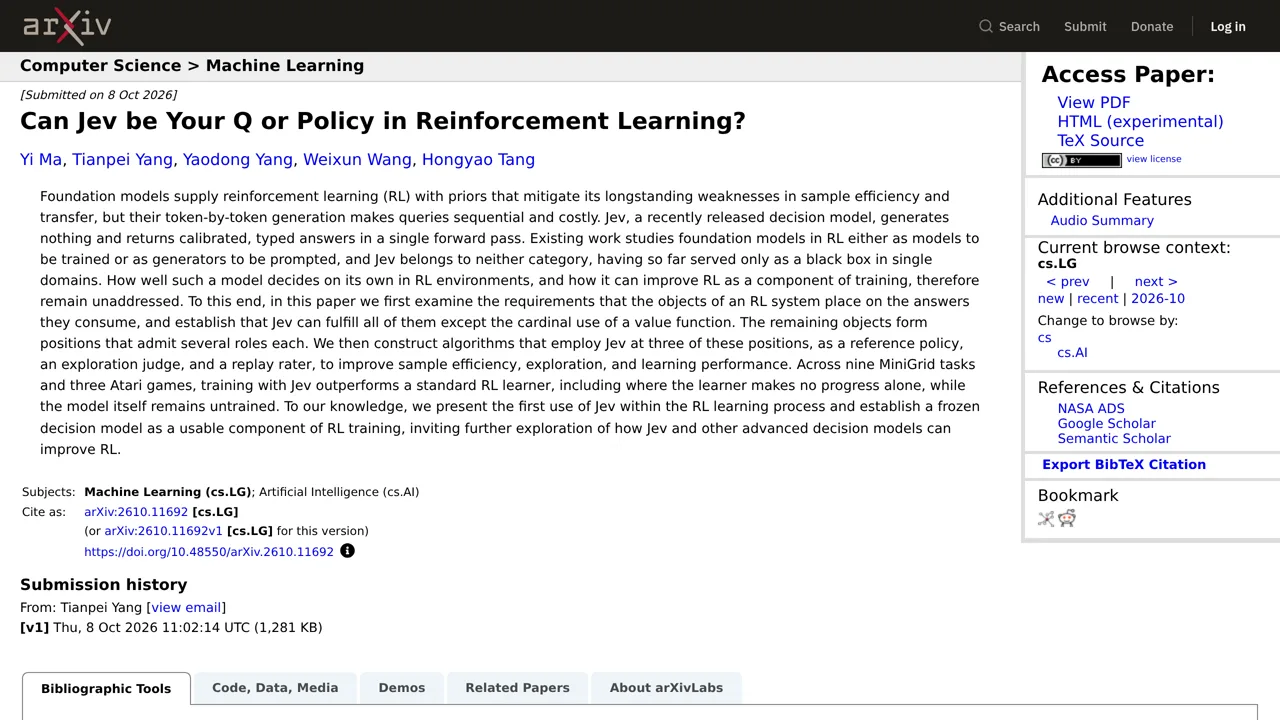
This paper tests whether Jev’s advice can help another AI learn games with less practice.
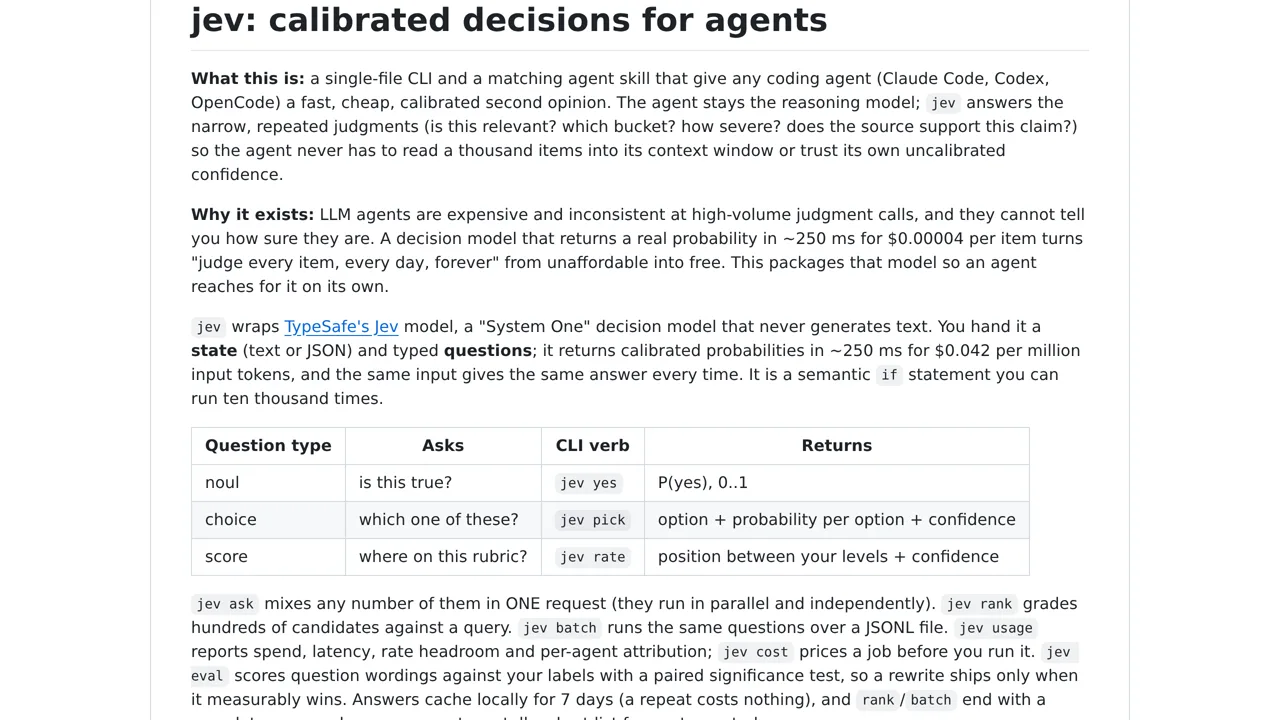
Pedram Amini’s Python command-line tool lets coding agents send batches of classification, ranking and verification questions to Jev.
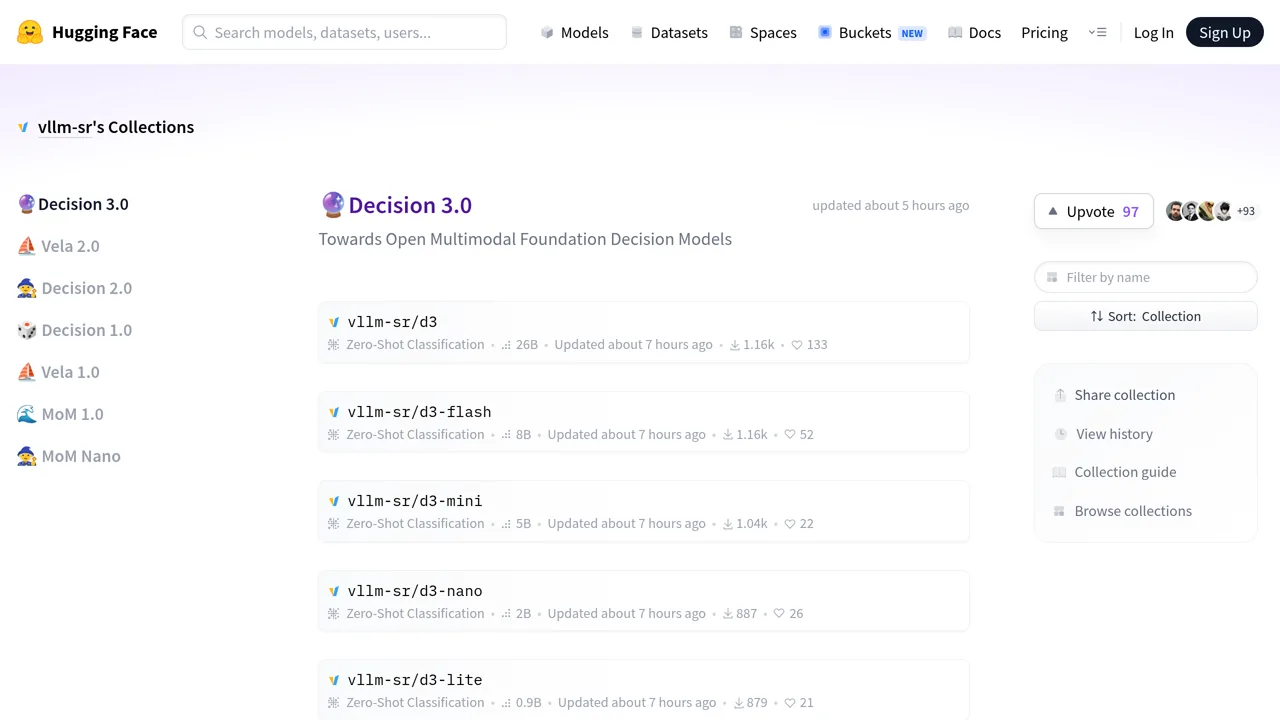
Decision 3.0 is an open-weight family of multimodal models ranging from 0.6B to 27B parameters that can classify text, images, and video.
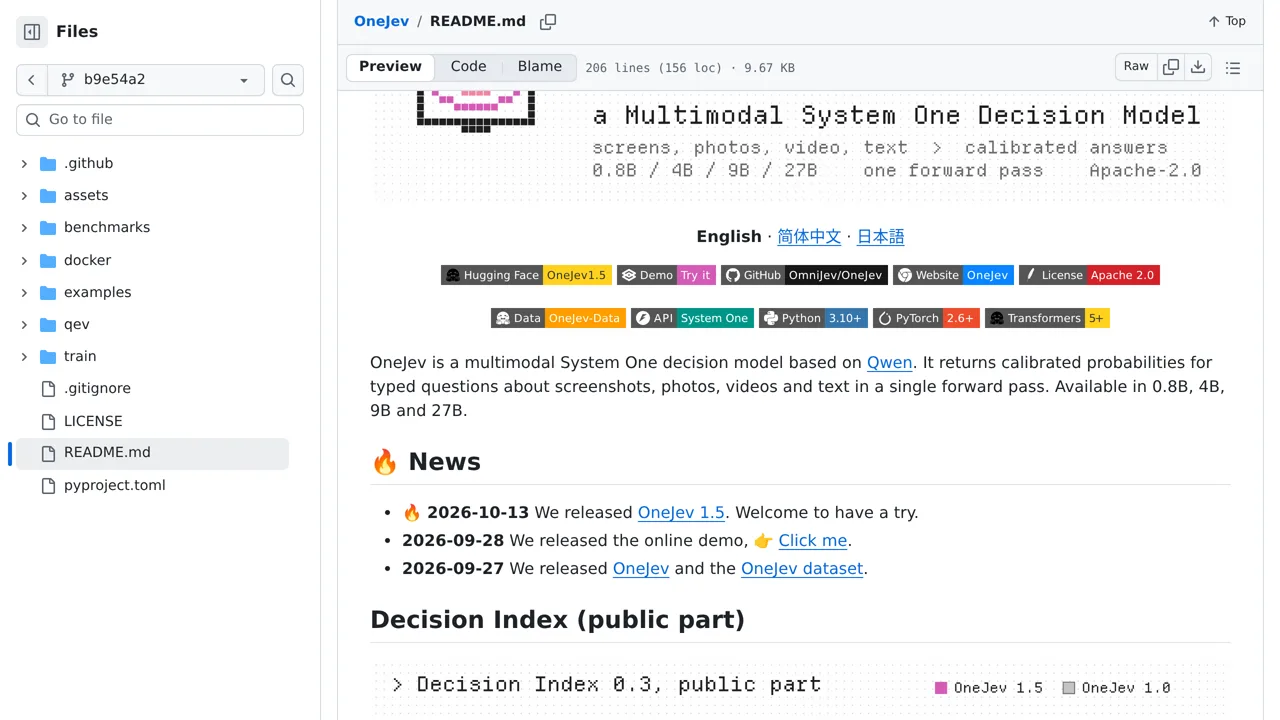
OneJev is an open-weight multimodal decision model family that evaluates text, images, and video to answer typed questions in a single forward pass.
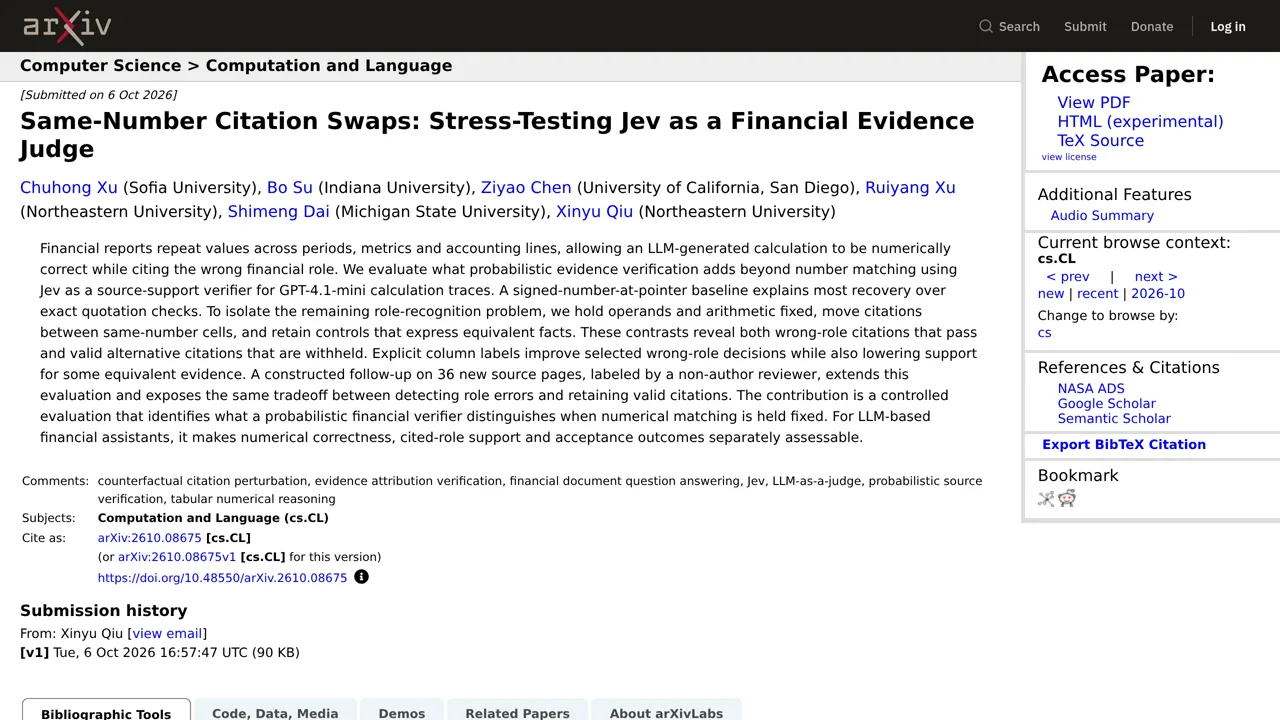
Researchers test whether Jev notices a financial citation that uses the right number from the wrong part of a report.
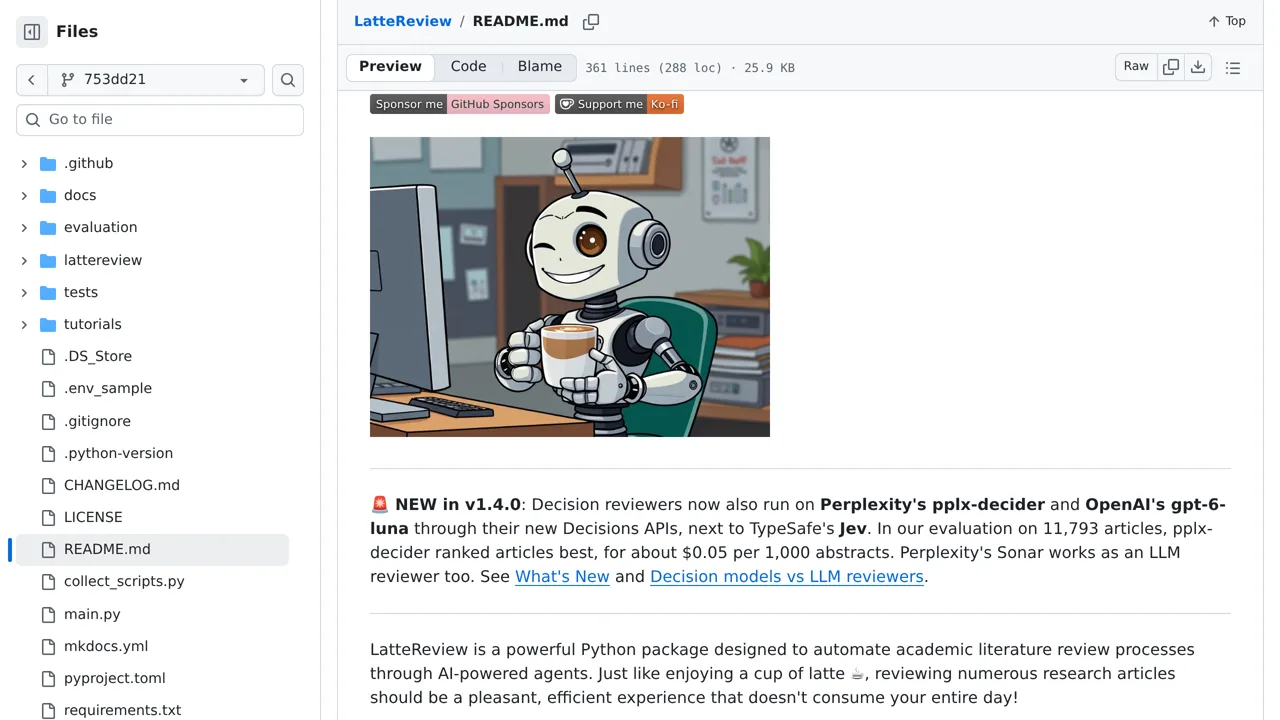
LatteReview v1.4.0 integrates decision models like Jev and pplx-decider for systematic literature screening, comparing their performance and cost against LLMs.
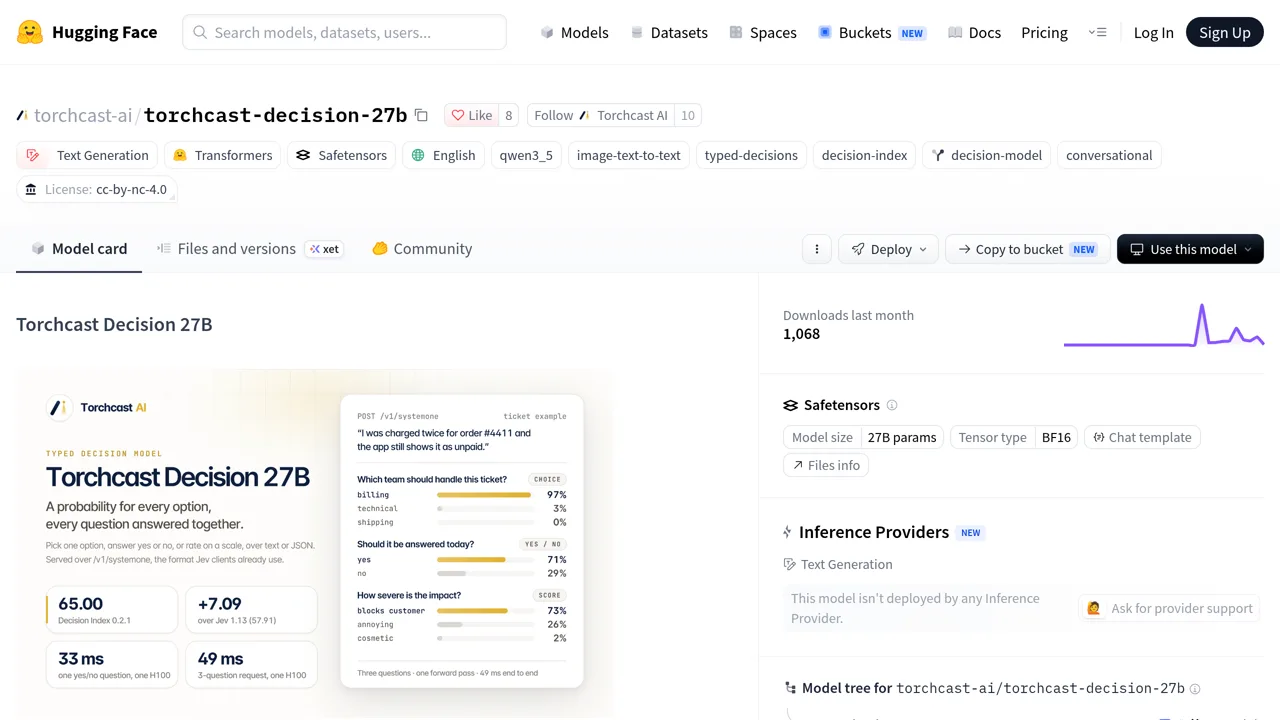
Torchcast Decision 27B is a LoRA fine-tune of StartLux-Decision-27B that answers typed questions about a state using a TypeSafe-compatible interface.
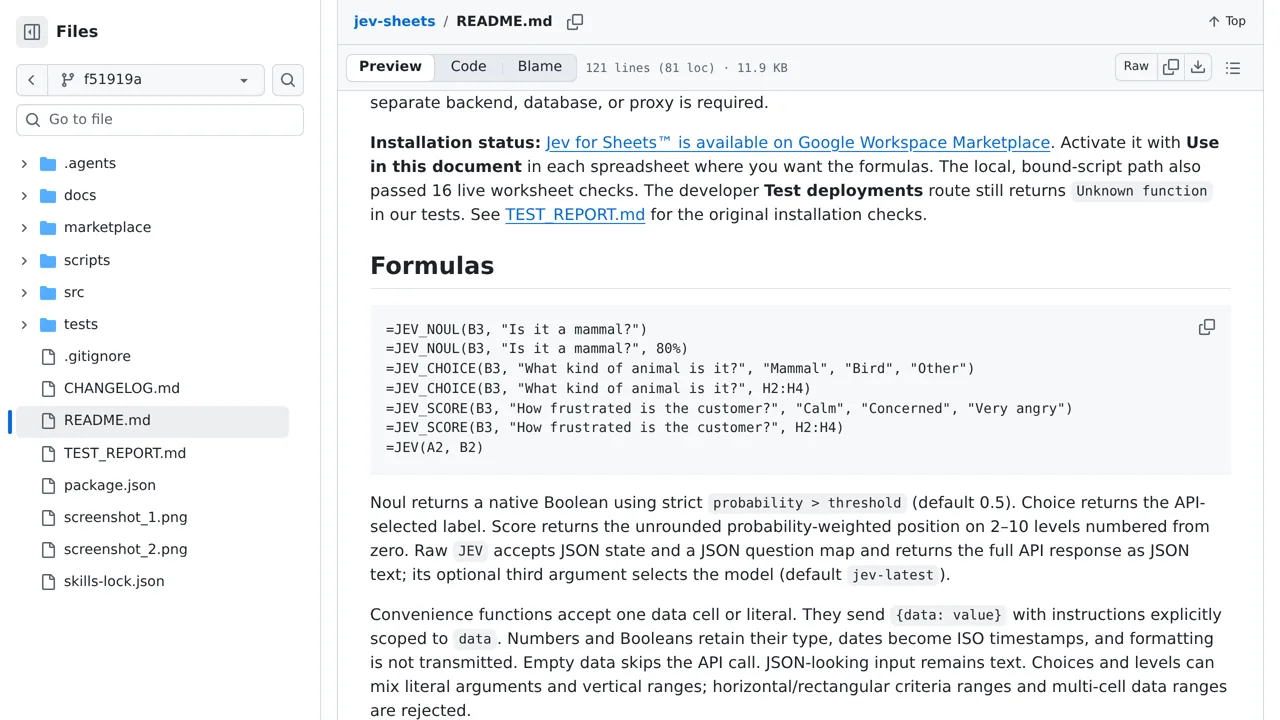
This independent Google Workspace Marketplace add-on provides custom spreadsheet formulas to evaluate text using TypeSafe's Jev model directly within Google Sheets.
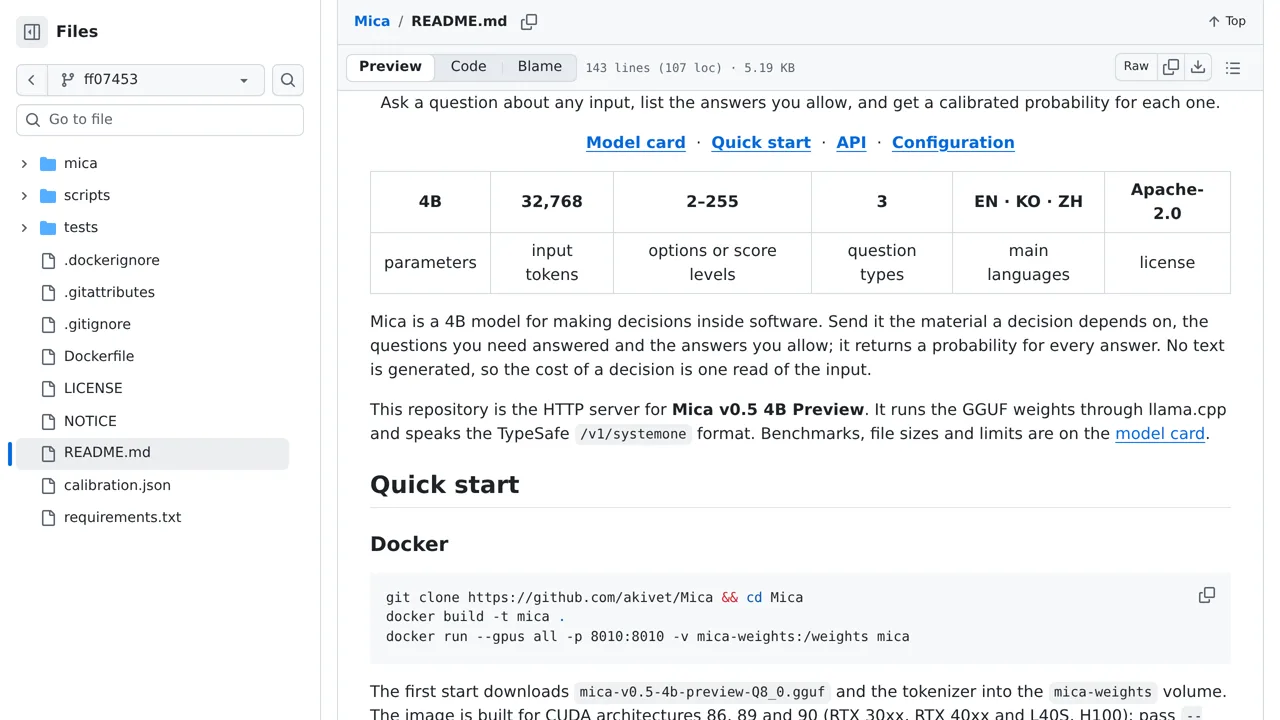
Mica-v0.1-4B is an open-weight decision model based on Qwen3.5-4B that speaks the TypeSafe API format.
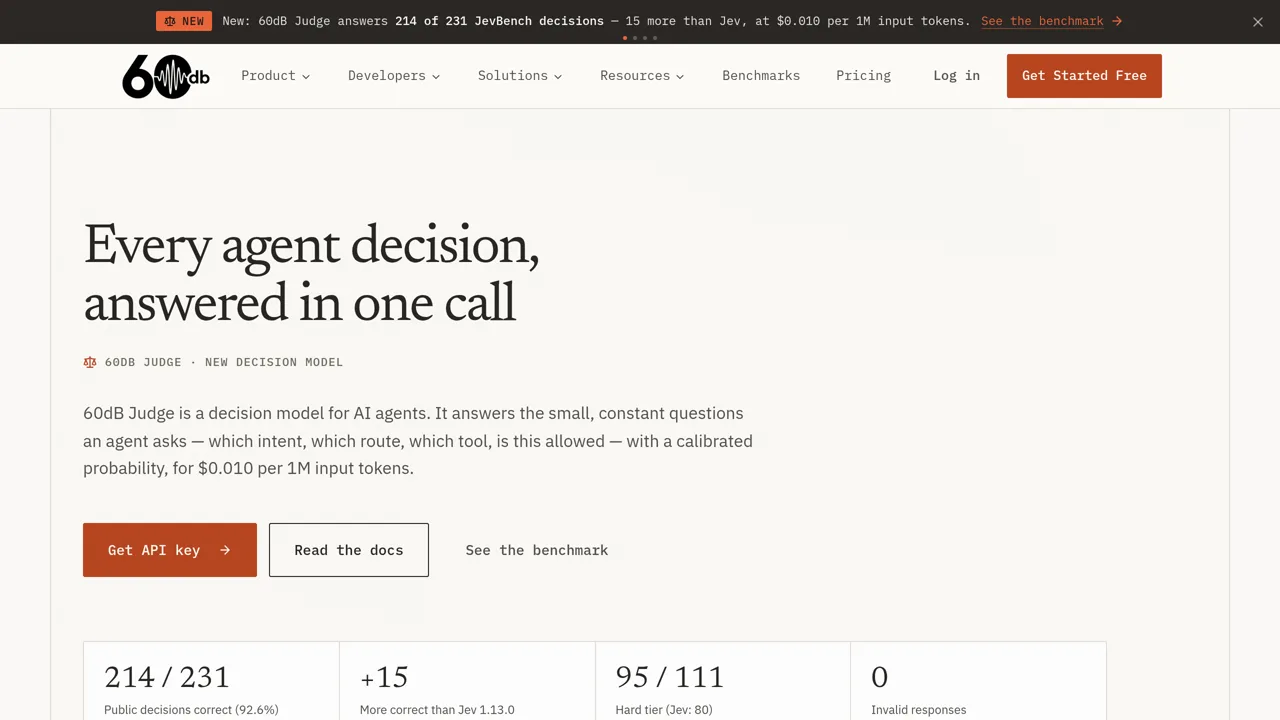
60dB Judge is a commercial SystemOne-compatible decision model for AI agents, priced at $0.010 per million input tokens with free outputs.
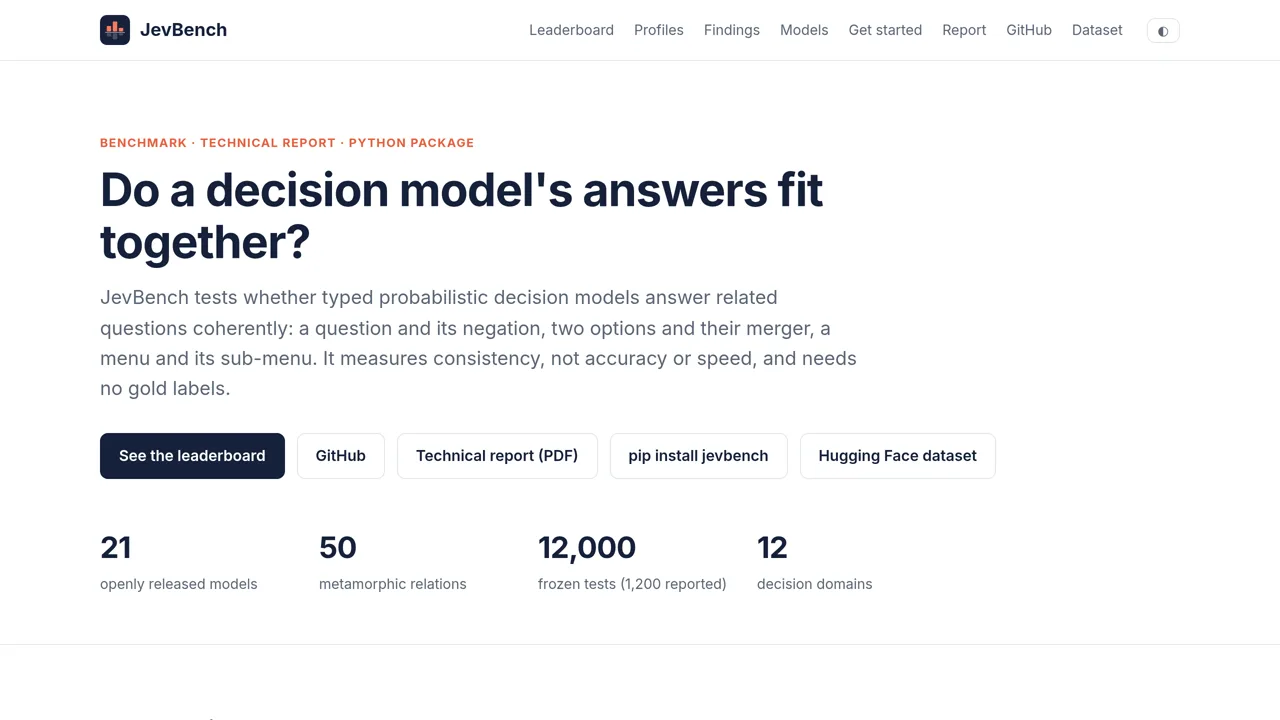
JevBench measures the probabilistic coherence of typed decision models across 50 metamorphic relations without requiring gold labels.
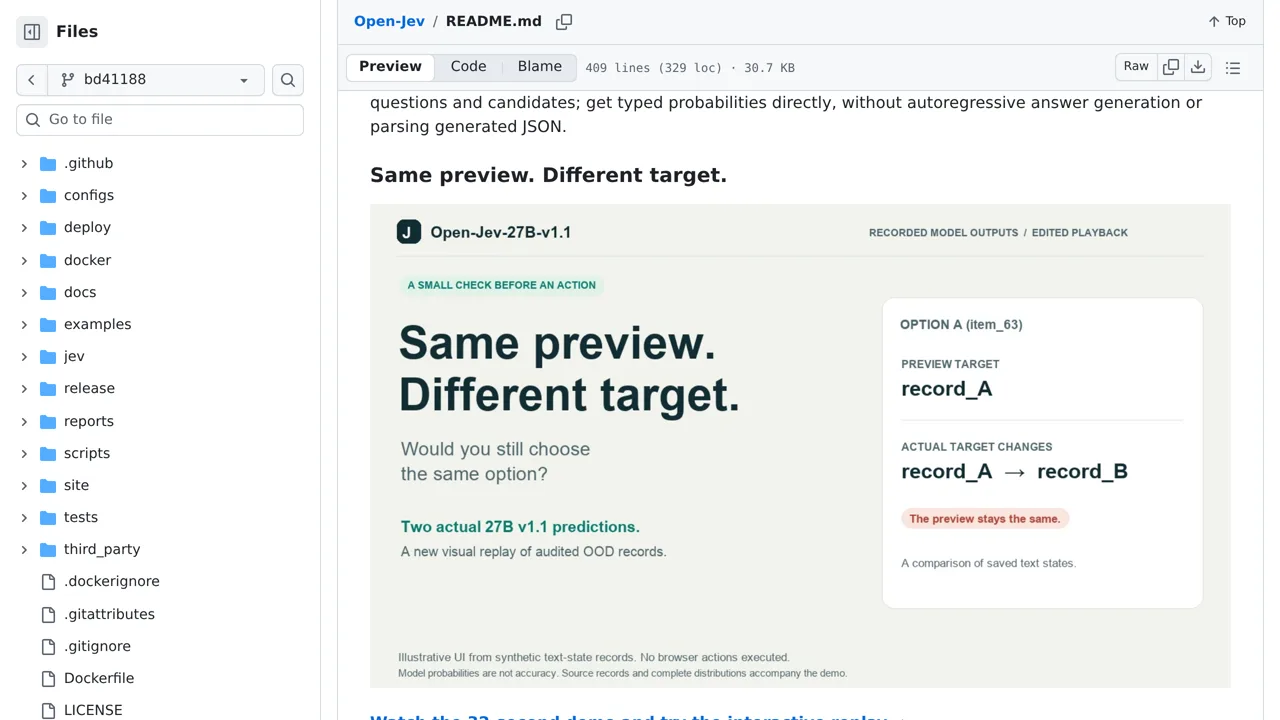
Open-Jev provides an open-weight decision model stack using a trained LoRA and scalar head on Qwen to return typed probabilities directly without autoregressive generation.
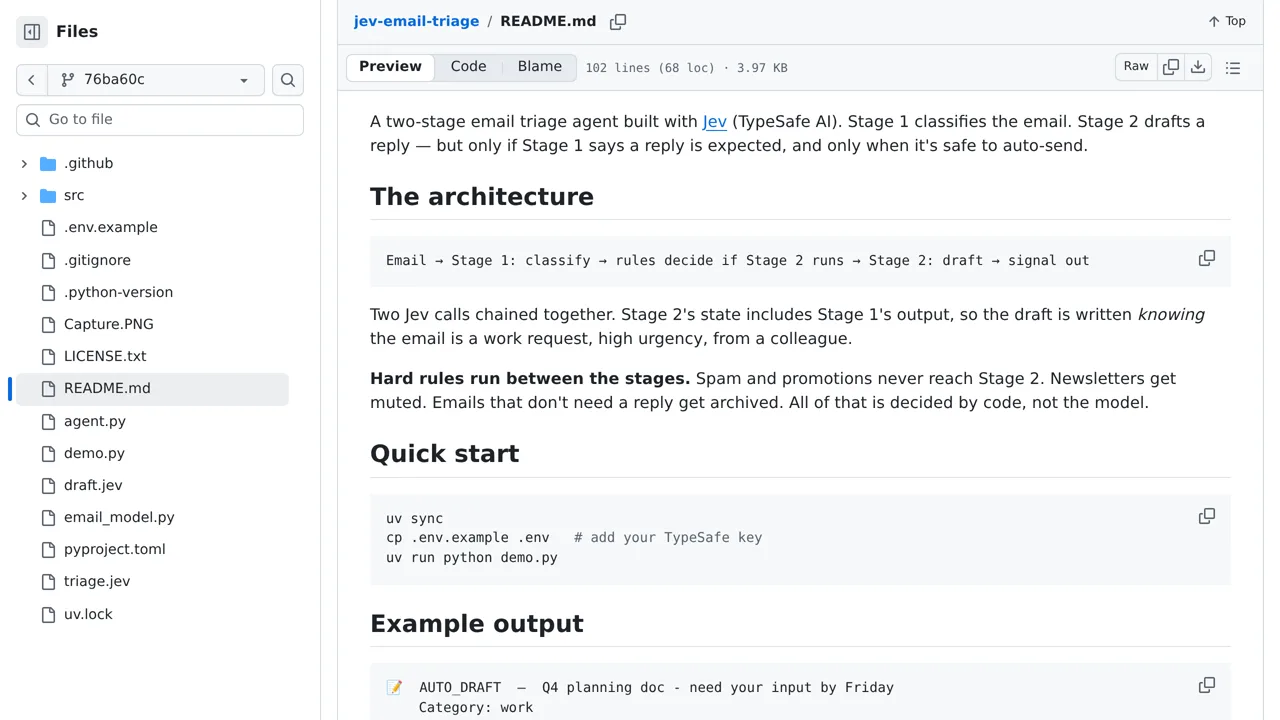
A sample email agent chains Jev decisions to classify messages, then choose a reply tone and intent only when a response is warranted.
A pre-registered study compared Jev 1.13 against Claude Opus models on clinical diagnosis vignettes, finding Jev matched frontier models on short complaints but lagged on multi-symptom synthetic patients.

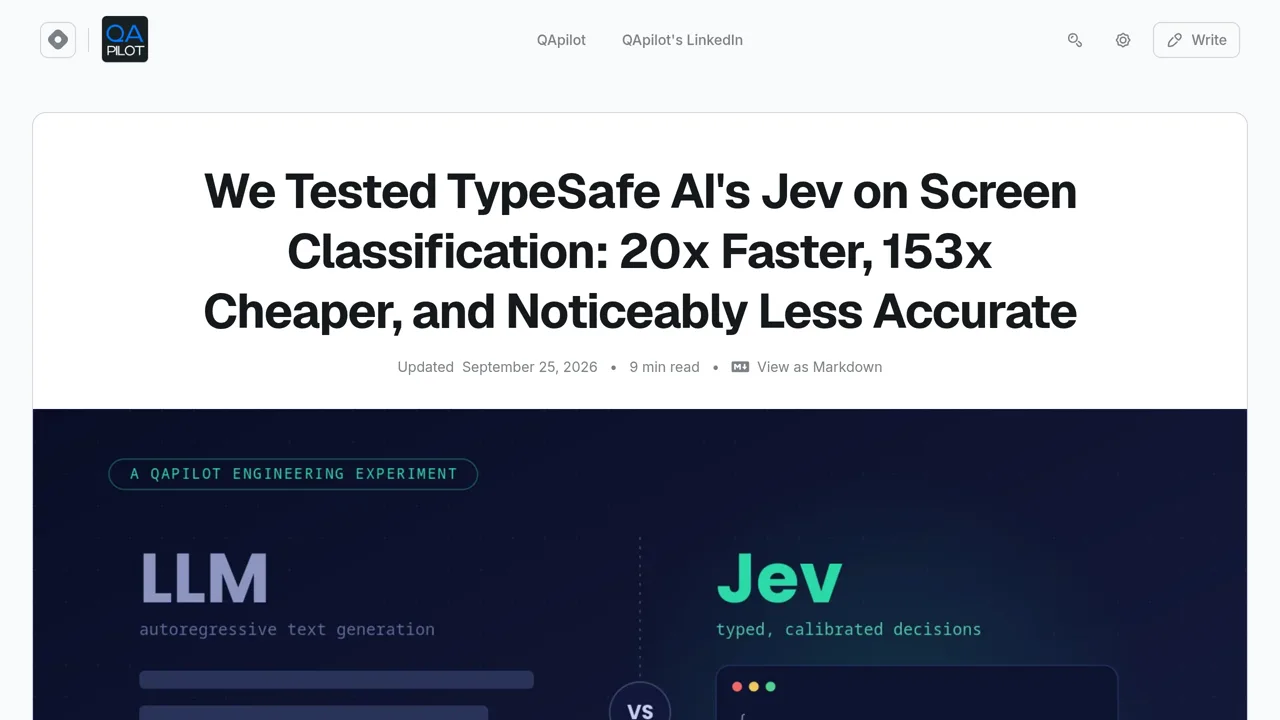
QApilot’s screen-classification study found Jev cheaper and faster than GPT-5.1, but substantially less accurate on its 371 mobile-app screens.
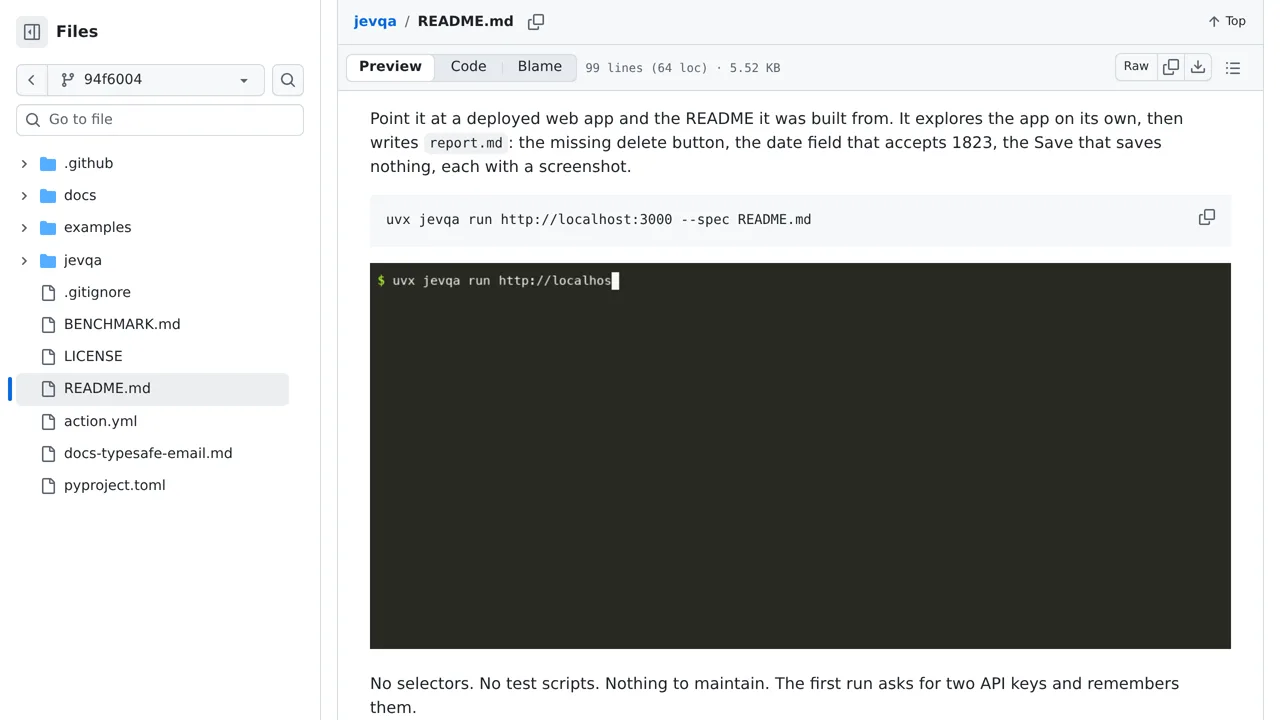
jevqa is an open-source testing tool that uses Claude to write a checklist from a product spec and Jev to autonomously explore the web app for bugs.
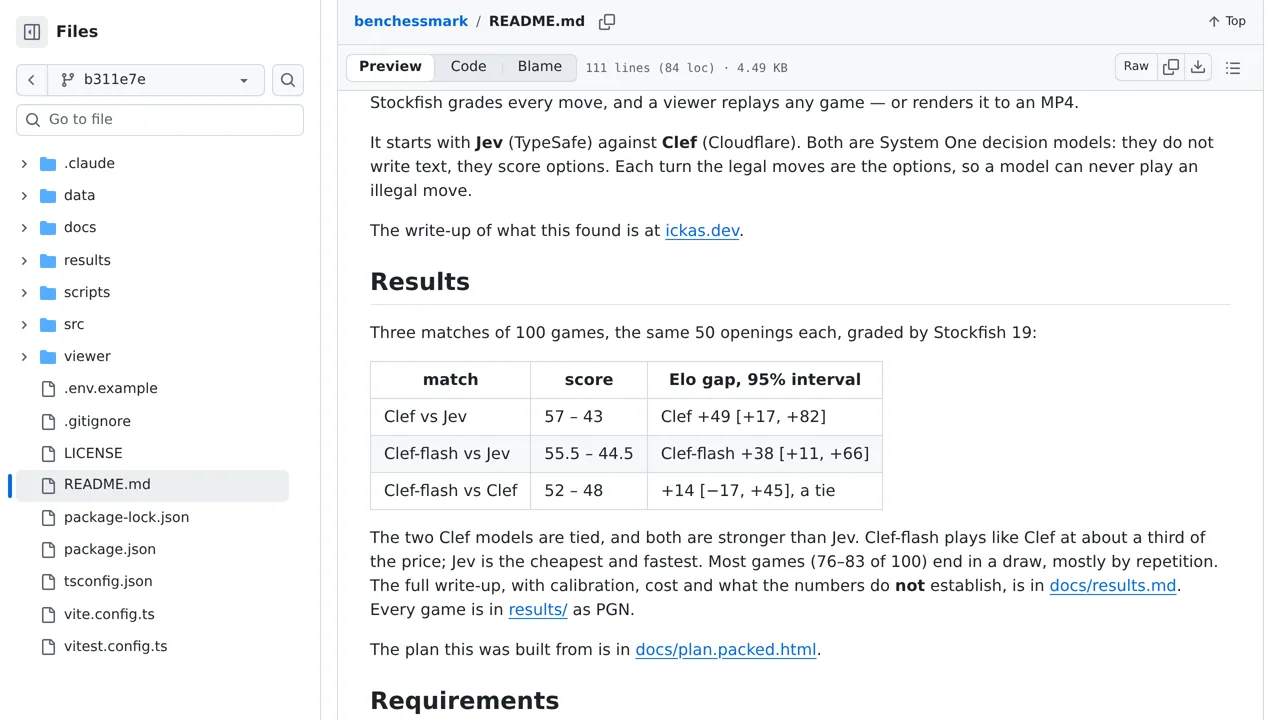
Henrique Macedo pits Jev against Clef in 300 chess games, using the same legal-move choices and Stockfish to grade play.
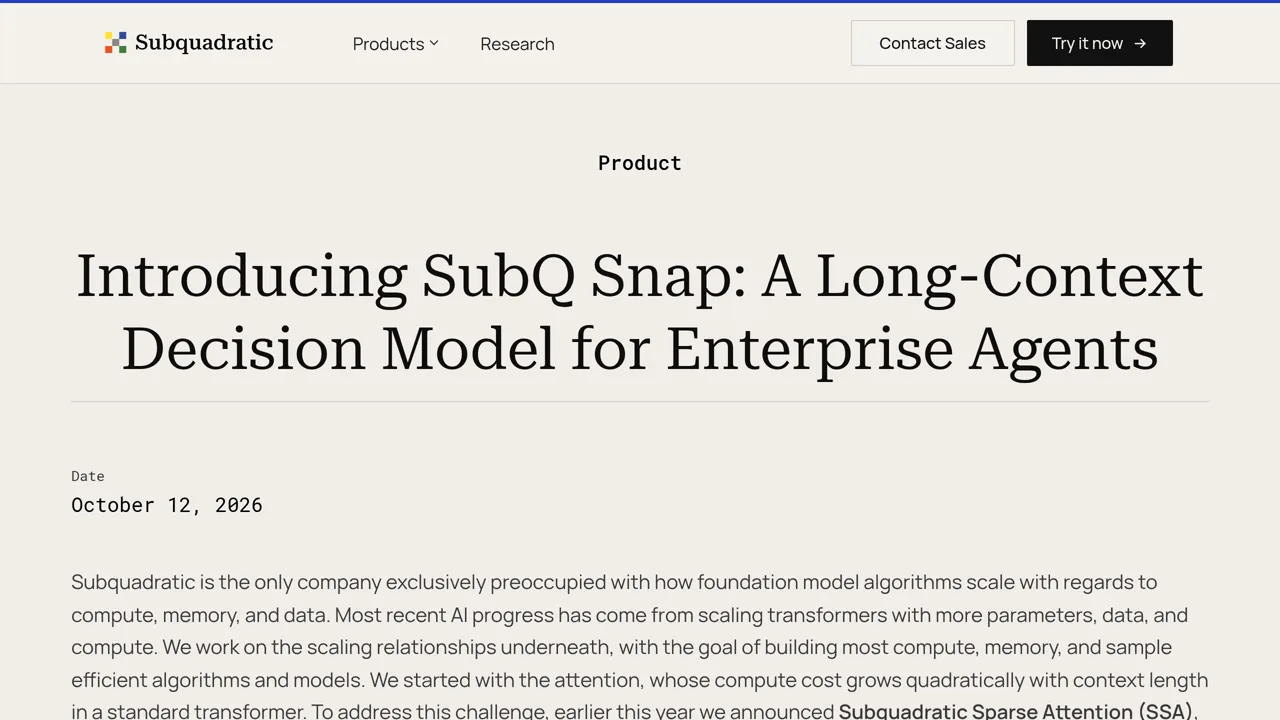
SubQ Snap is a commercial hosted decision model by Subquadratic that processes up to 384,000 tokens of text and image context for enterprise agent workflows.
Ollajev is a local server and command-line tool that runs Hugging Face System One decision models directly on your own computer.
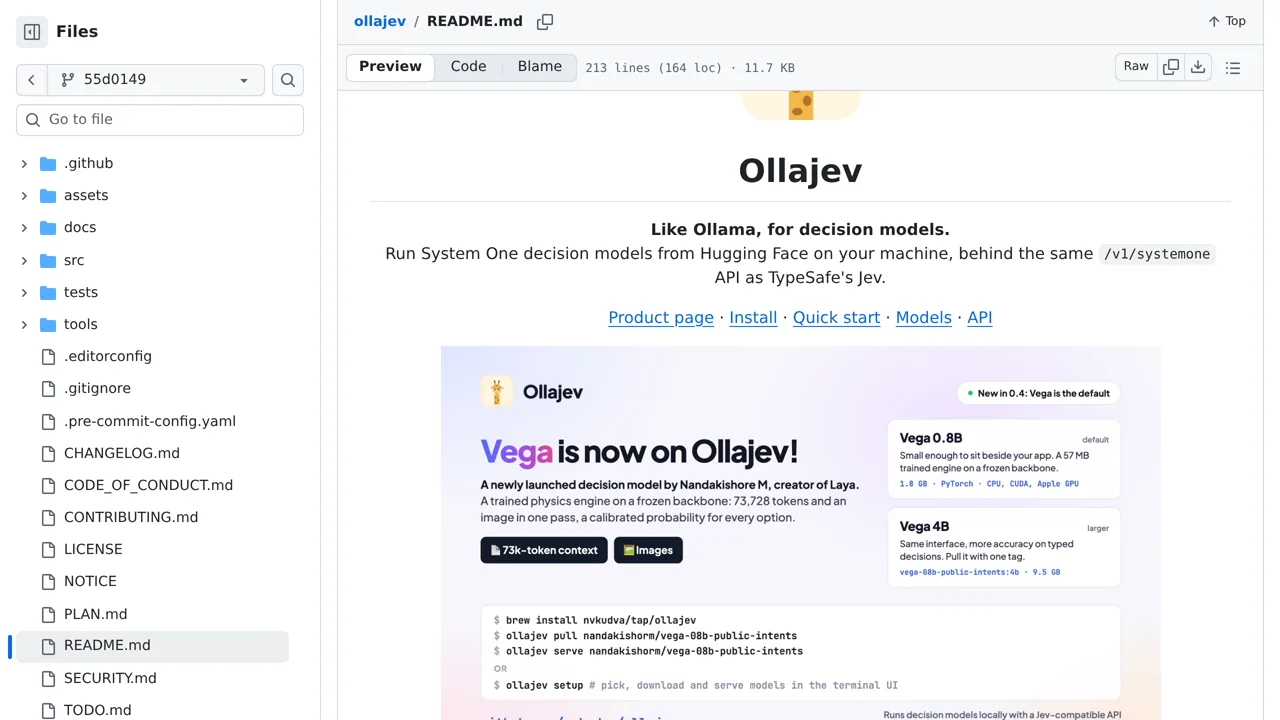
A reproducible Chinese RAG reranking benchmark for Jev on C-MTEB/T2Reranking, featuring hard negatives and cost-capped execution.
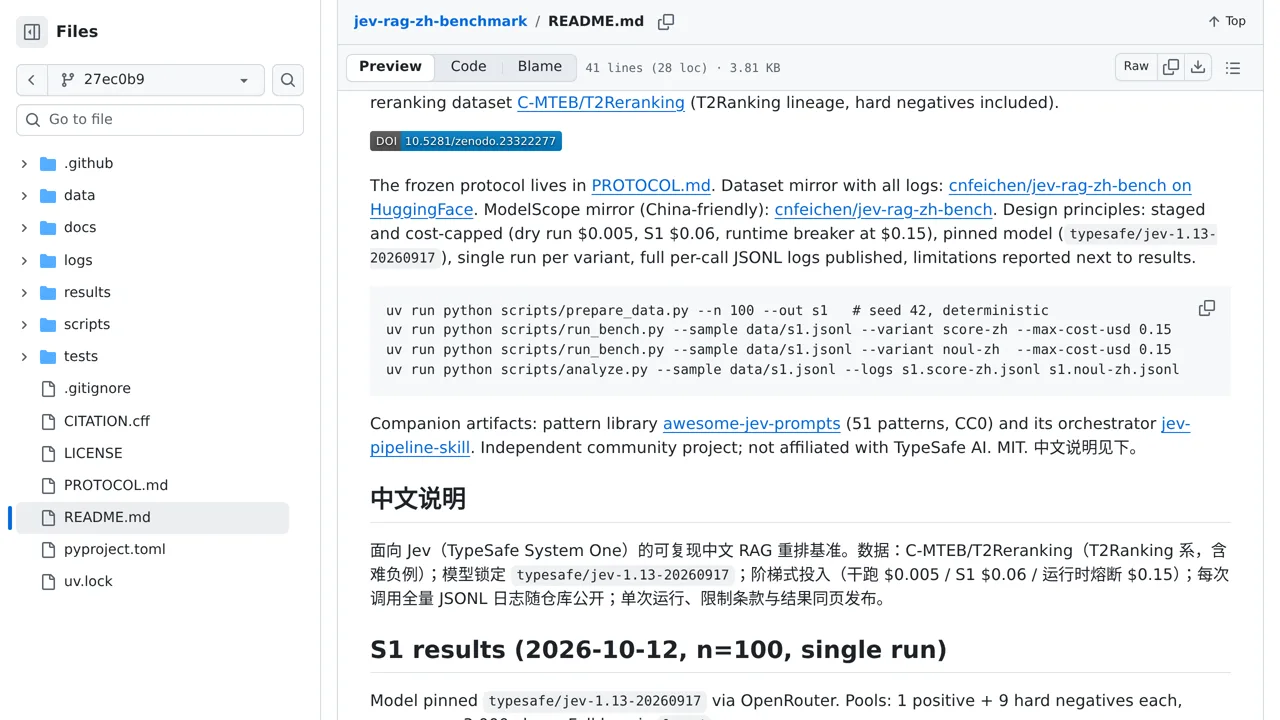
A PowerShell module that connects scripts to TypeSafe's Jev model to make structured decisions using pipeline-friendly commands.
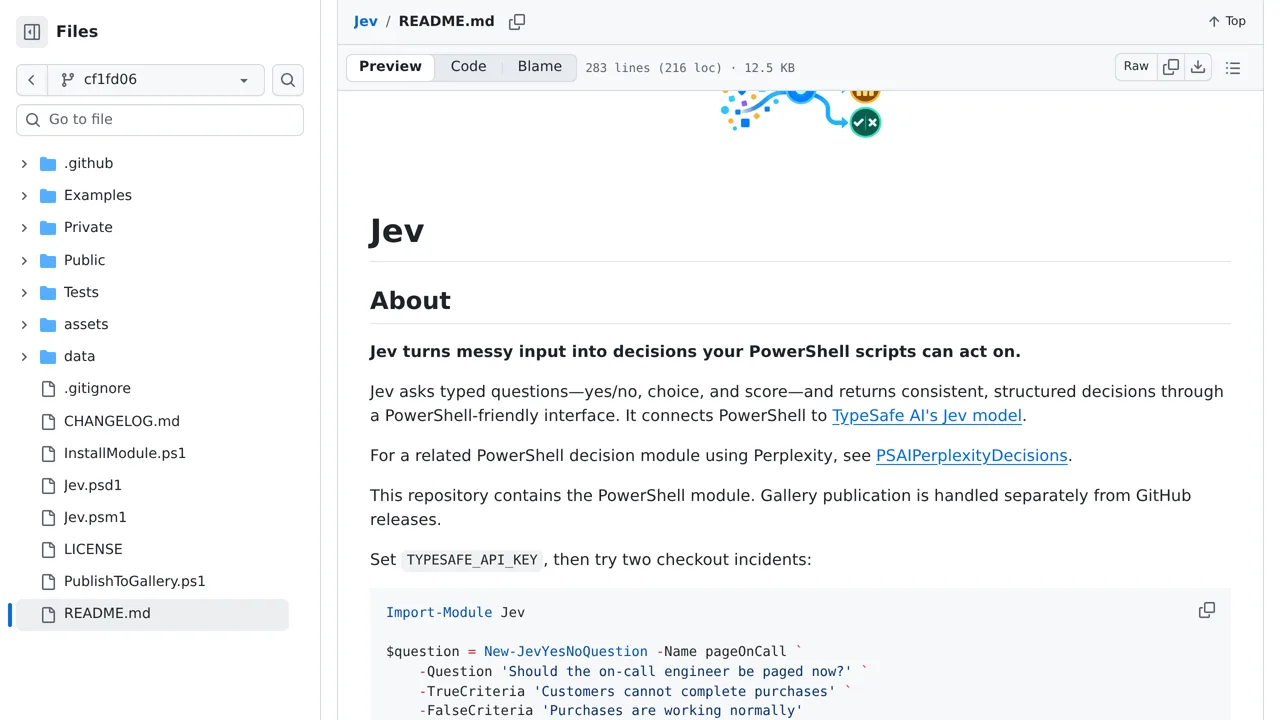
JevOss is an open-source evaluation toolkit that measures the accuracy, calibration, and robustness of decision models implementing the Jev API.
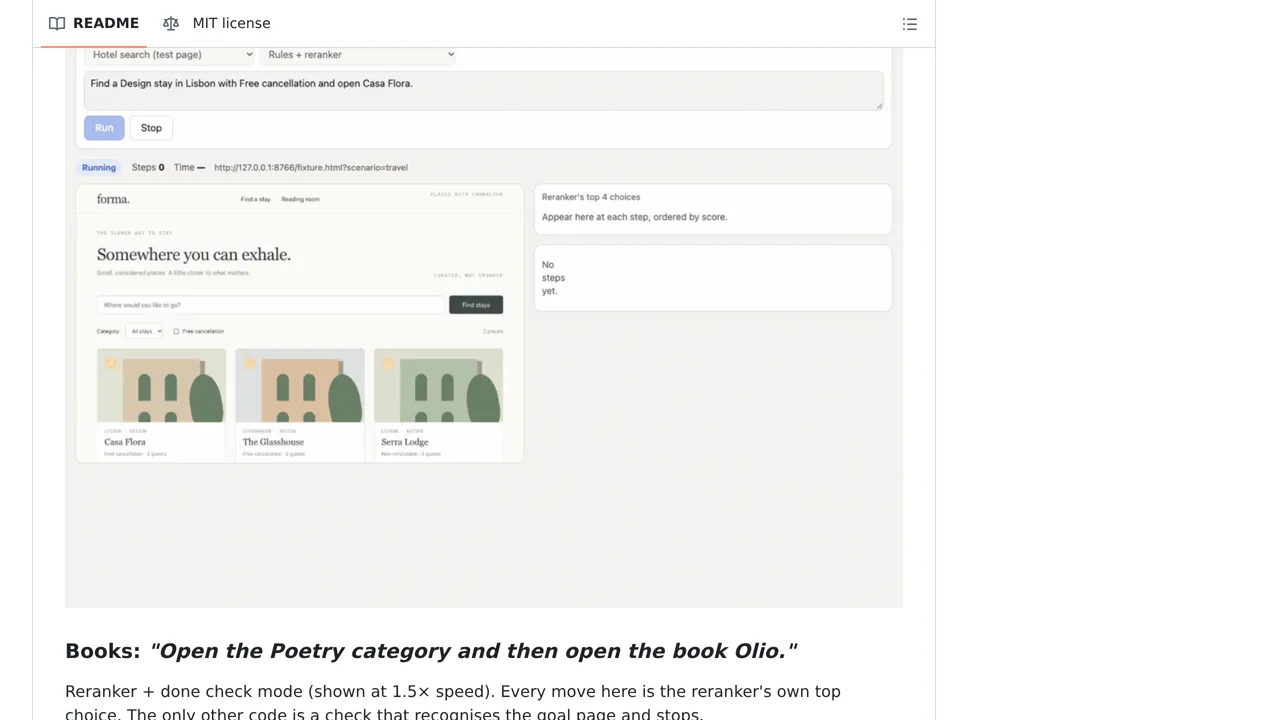
RS-1 uses an unmodified local Qwen3-Reranker-0.6B to score and select actions for quizzes, Wikipedia races, and browser automation.
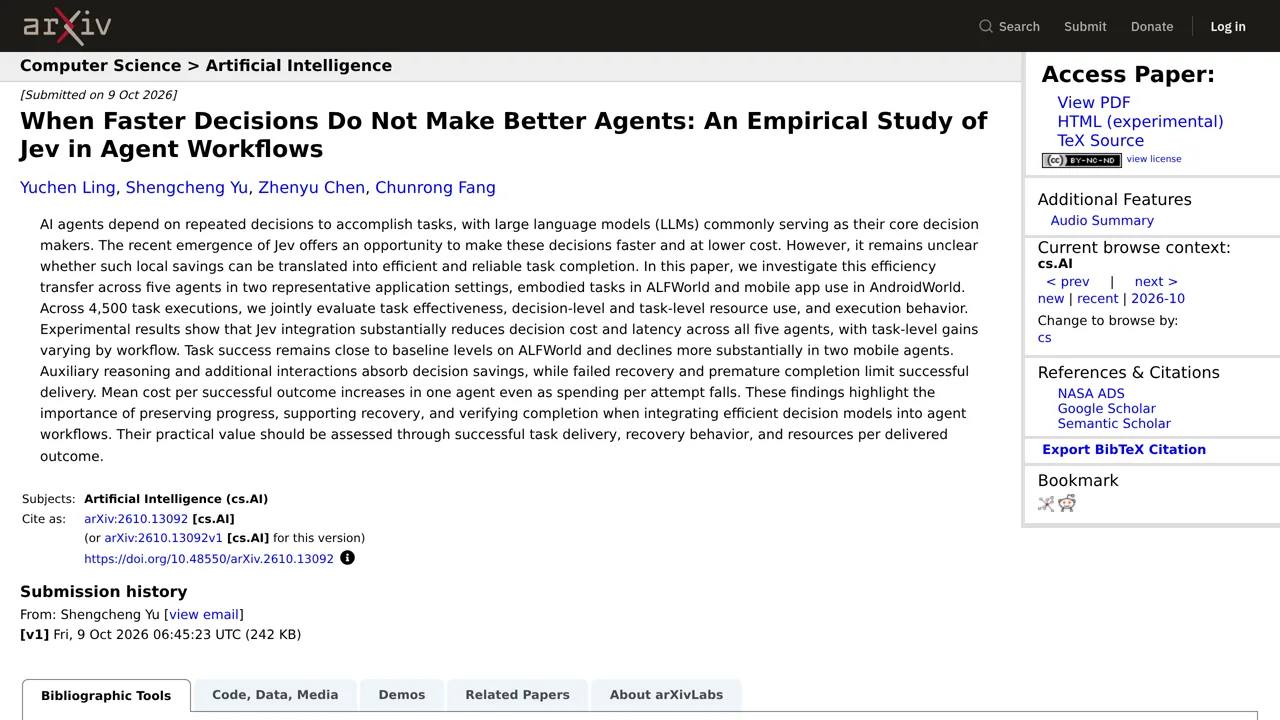
Researchers integrated Jev into five AI agents across household and mobile tasks, finding that while individual decisions became faster and cheaper, overall task success often declined.
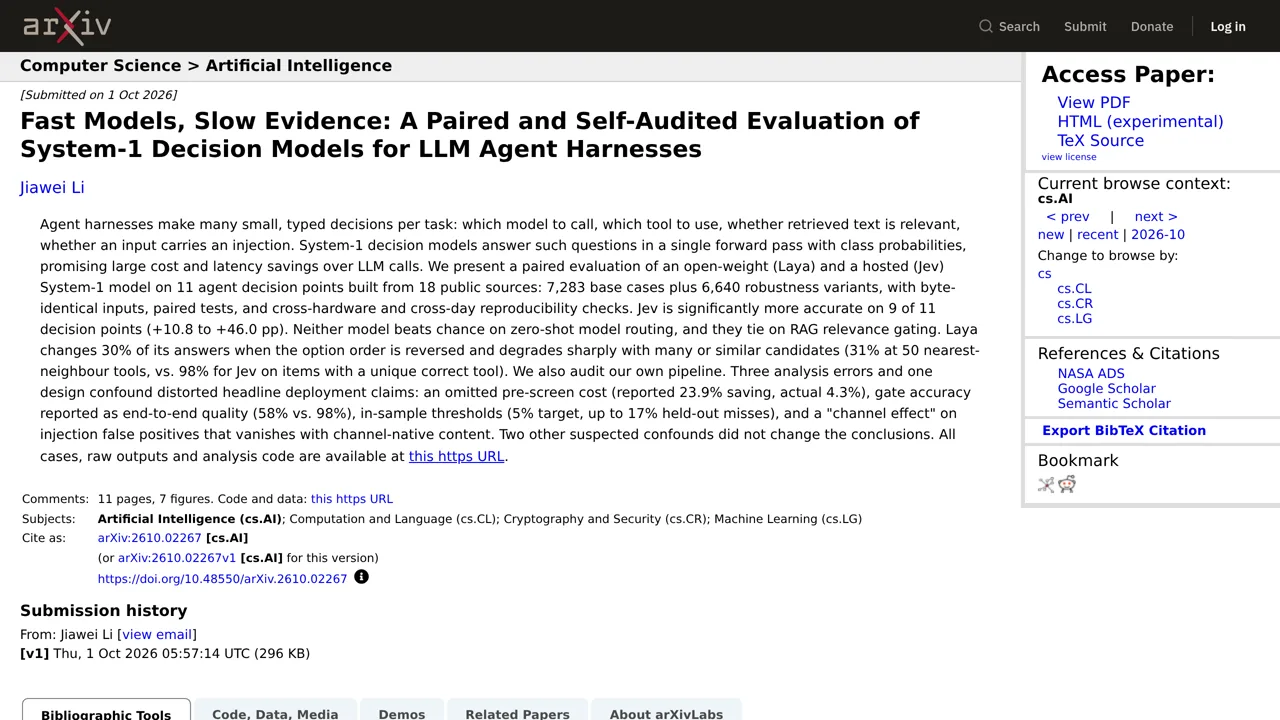
Jiawei Li compares Jev and Laya at eleven agent decision points, then audits where the reported savings and thresholds were misleading.
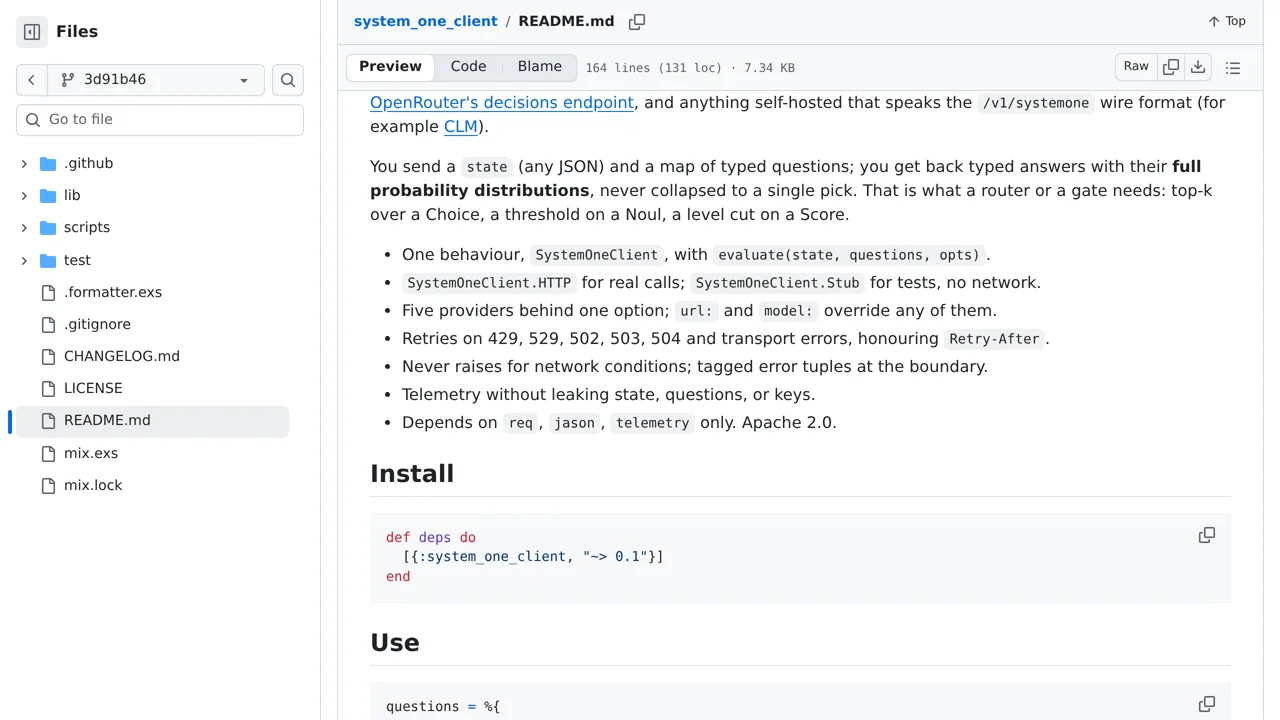
SystemOneClient is an open-source Elixir library that connects applications to decision models like TypeSafe Jev and Cloudflare Clef to receive structured probability answers.
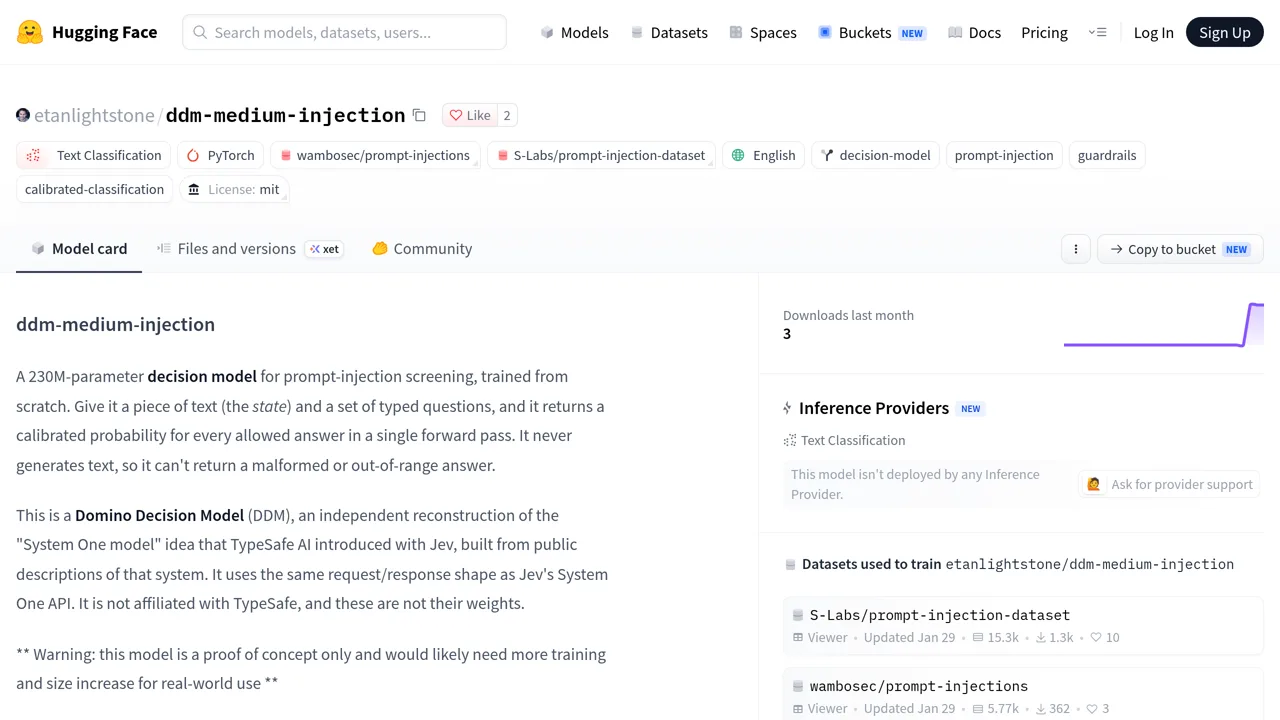
Domino Data Lab's Etan Lightstone released a 230-million-parameter open-weight decision model designed to screen text for prompt injections before it reaches a larger AI.
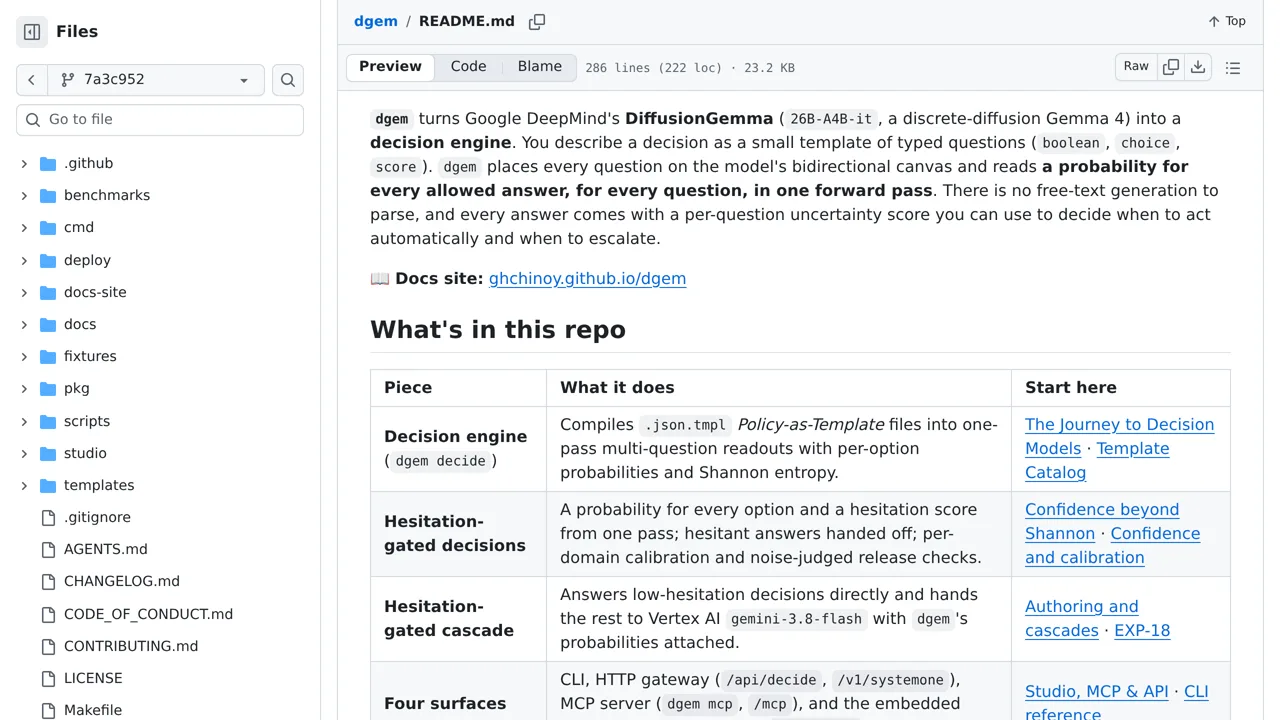
dgem is an open-source tool that transforms DiffusionGemma into a zero-shot decision engine, evaluating typed questions in a single forward pass with per-option probabilities.
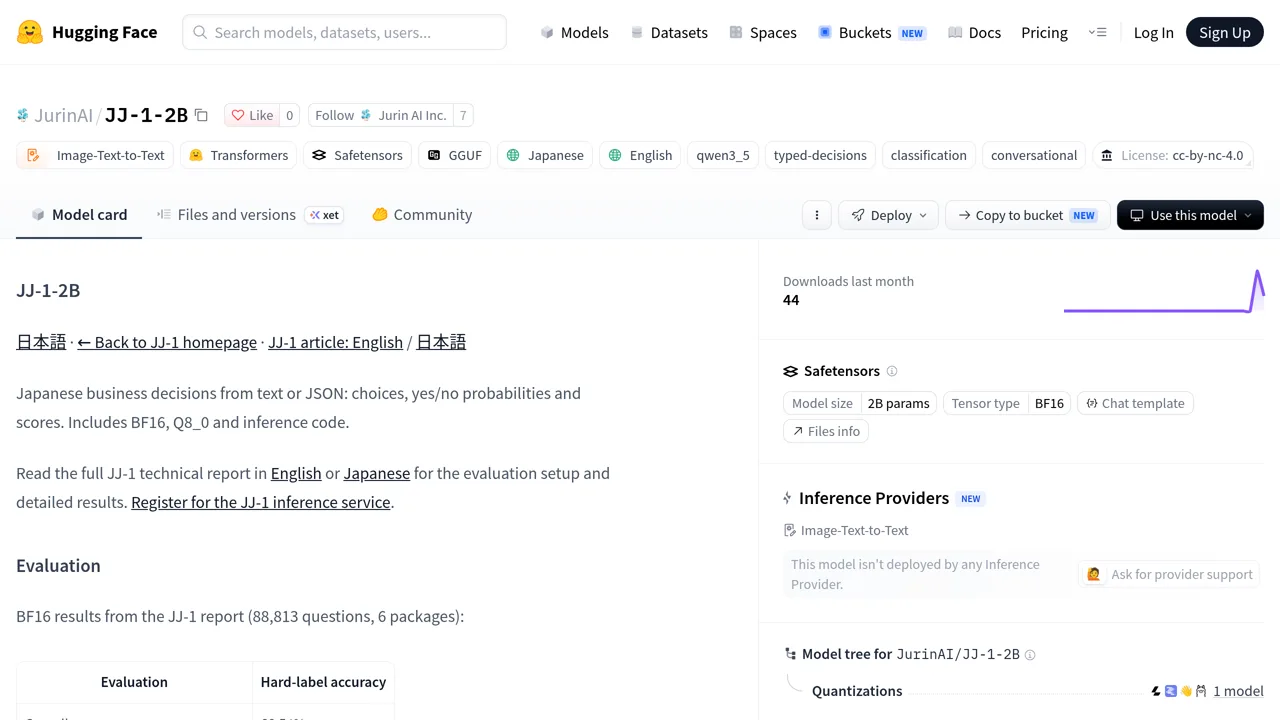
Jurin AI's JJ-1 family offers open-weight decision models optimized for Japanese enterprise workflows, returning structured choices, scores, and yes/no probabilities.
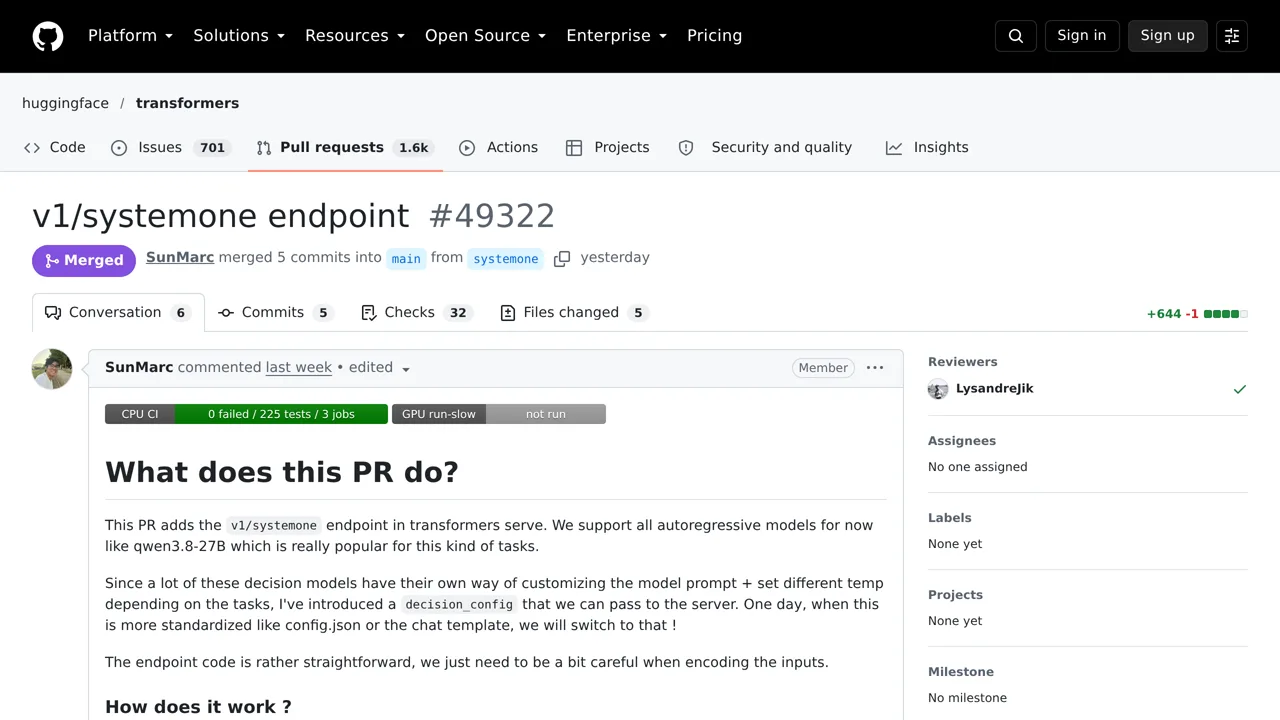
The transformers serve command now includes a /v1/systemone endpoint to serve any autoregressive Hugging Face model as a decision model using next-token probabilities.
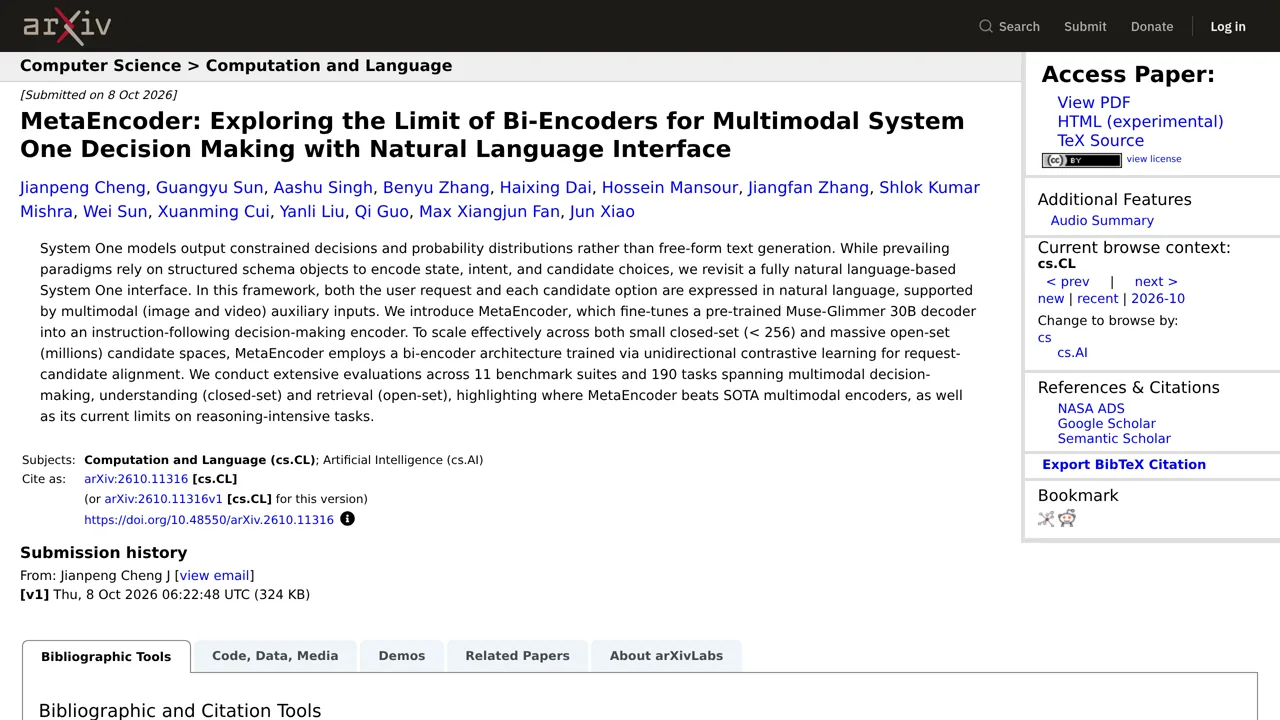
Meta AI researchers fine-tuned a 30-billion-parameter multimodal model into a bi-encoder that uses natural language to evaluate both small decision sets and massive retrieval pools.
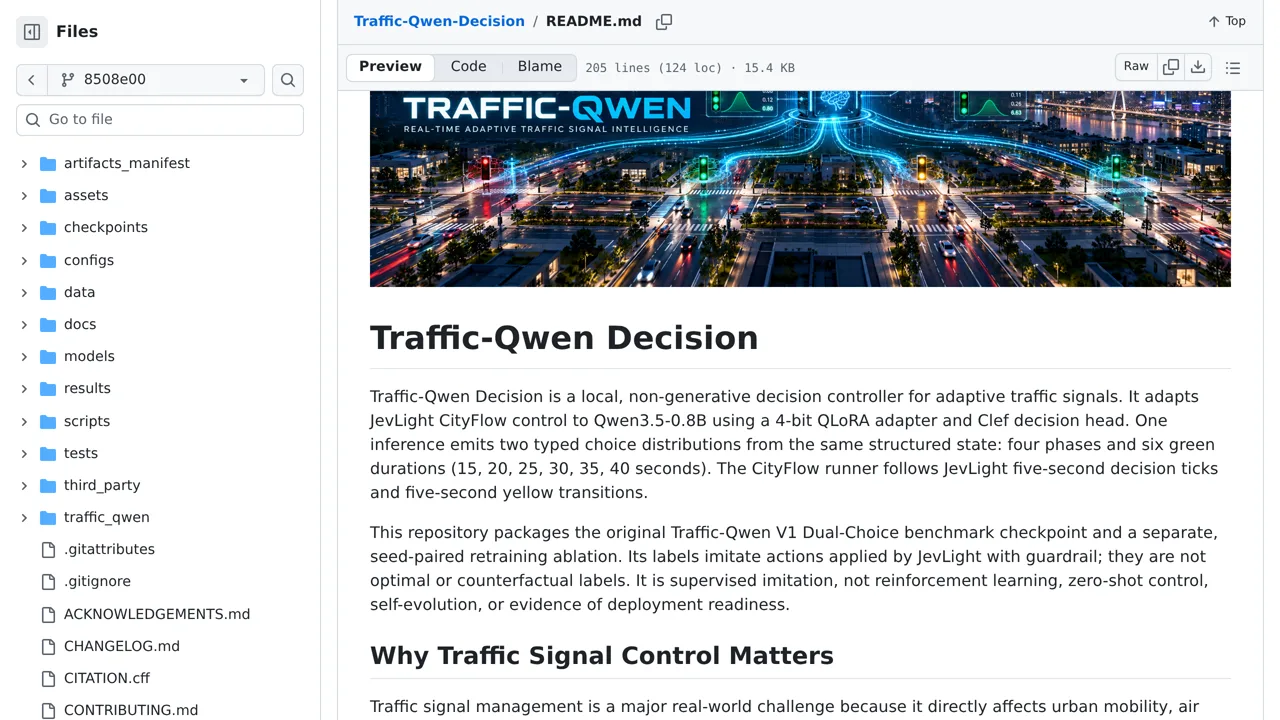
Traffic-Qwen Decision adapts Qwen3.5-0.8B into a non-generative traffic signal controller using a Clef-style decision head and 4-bit QLoRA.
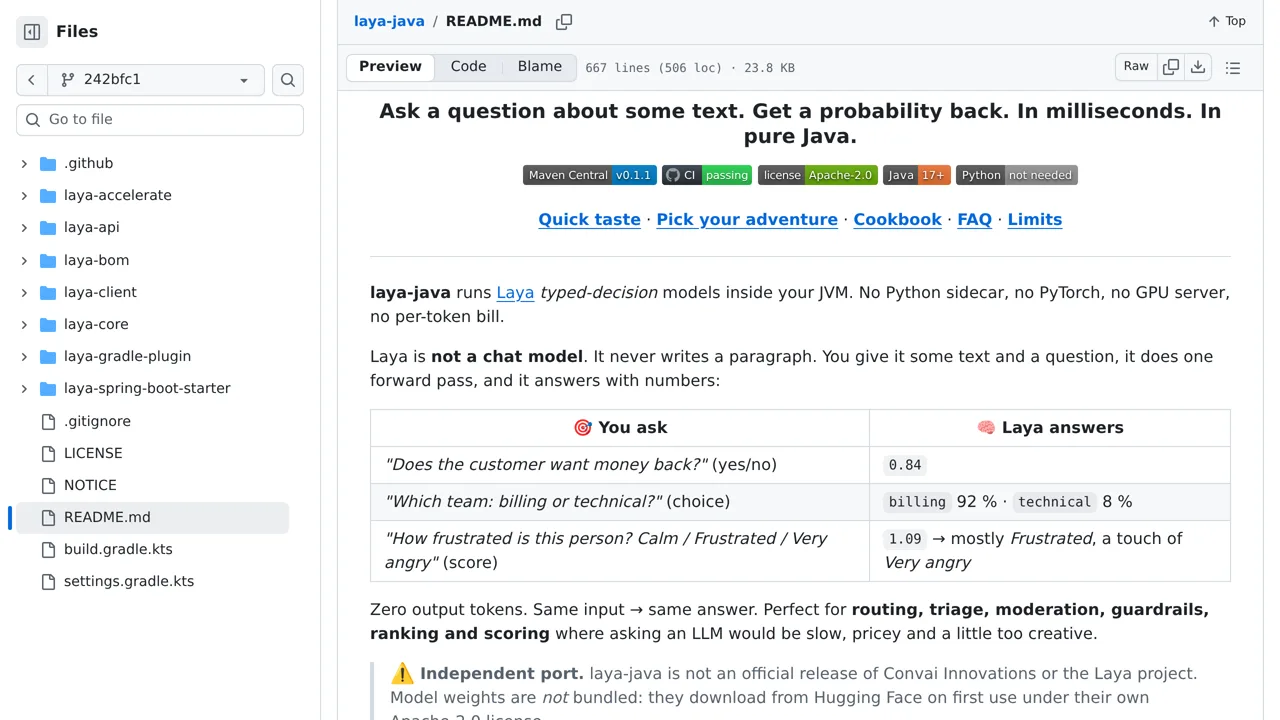
This independent Java port runs Laya typed-decision models directly inside the JVM without requiring Python or a GPU.
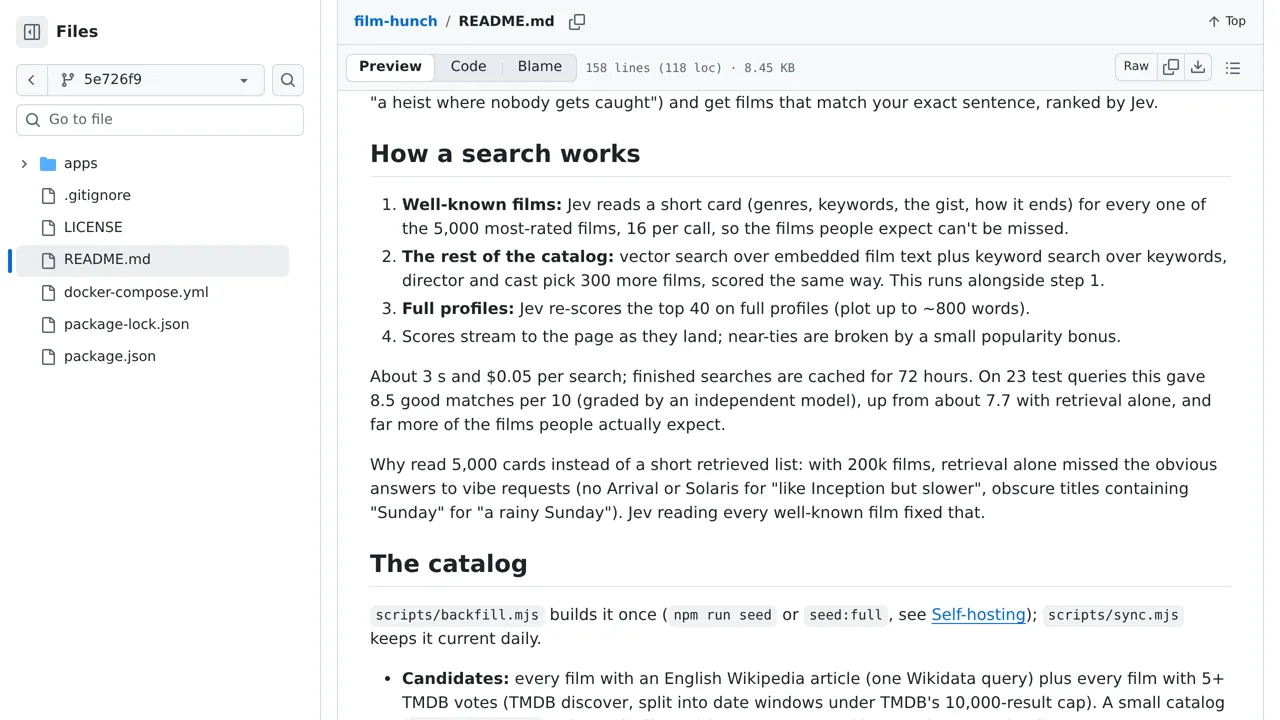
FilmHunch is an open-source movie search engine that uses Jev to score and rank films based on natural language descriptions.
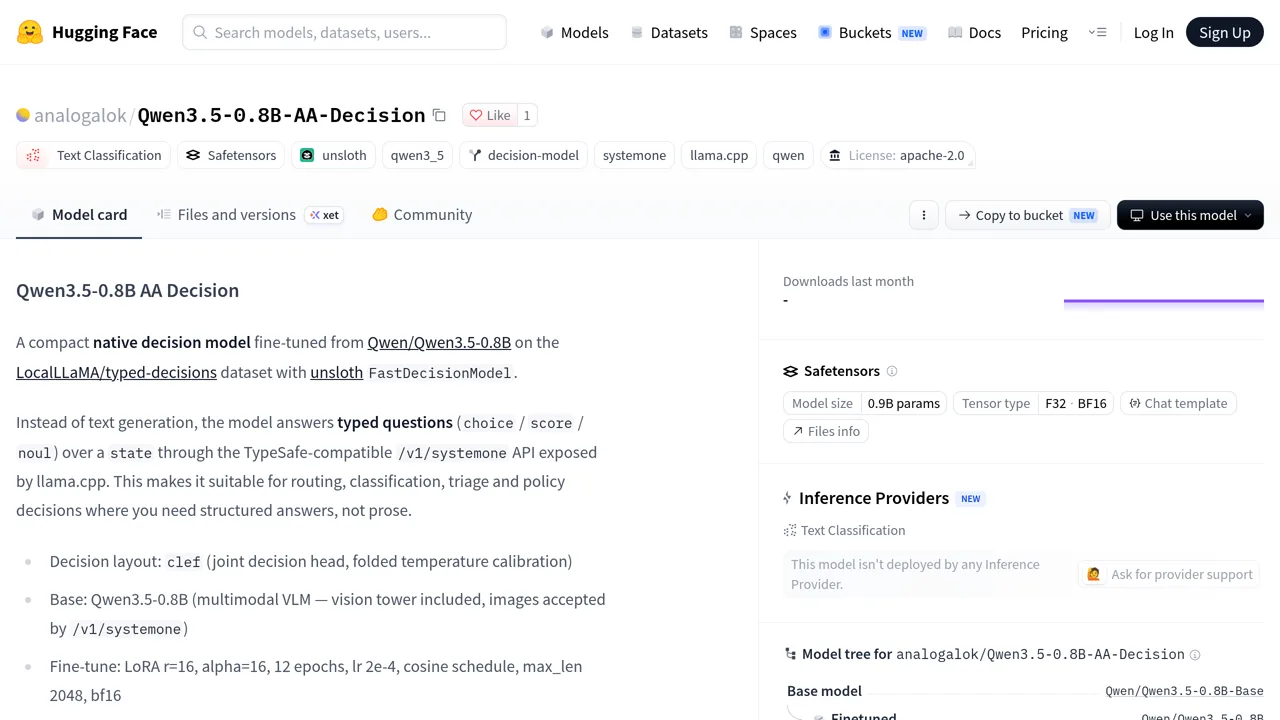
This is a compact 0.8-billion-parameter decision model fine-tuned from Qwen3.5 to answer structured questions using the System-One API.
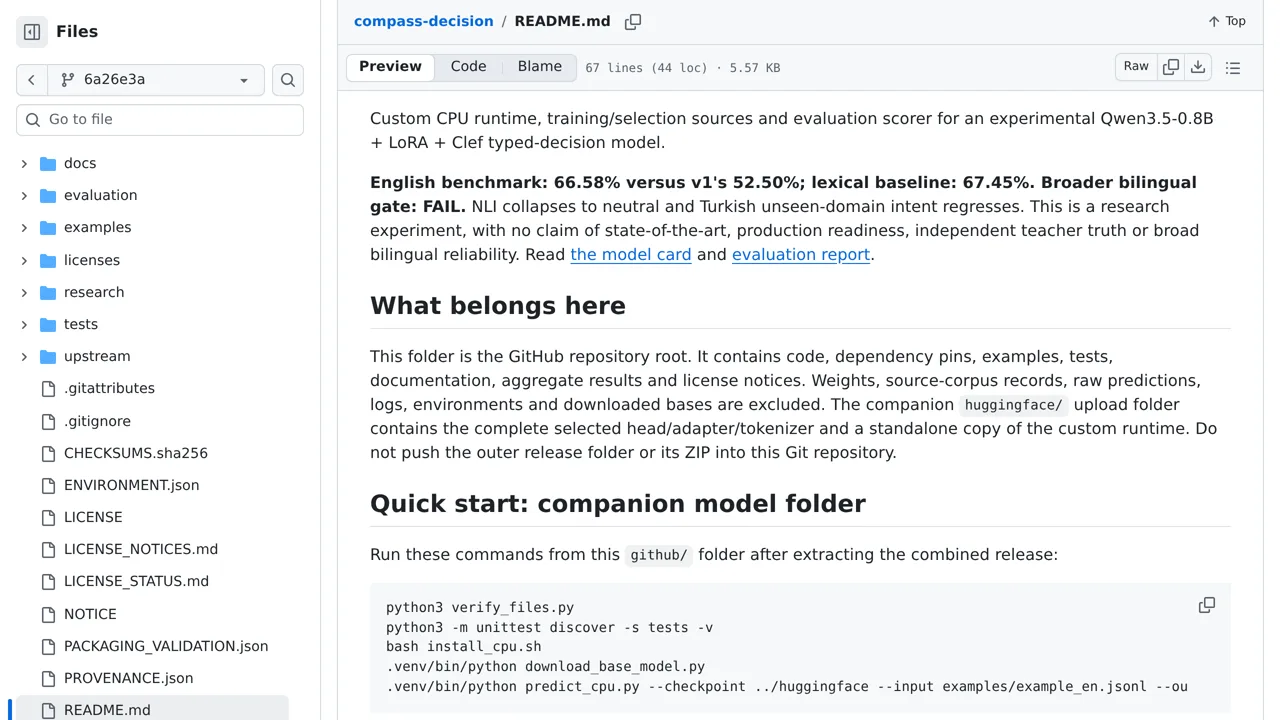
TDCC's Compass is an experimental 0.8B-parameter typed-decision model built to run on a plain CPU using a custom Python runtime.
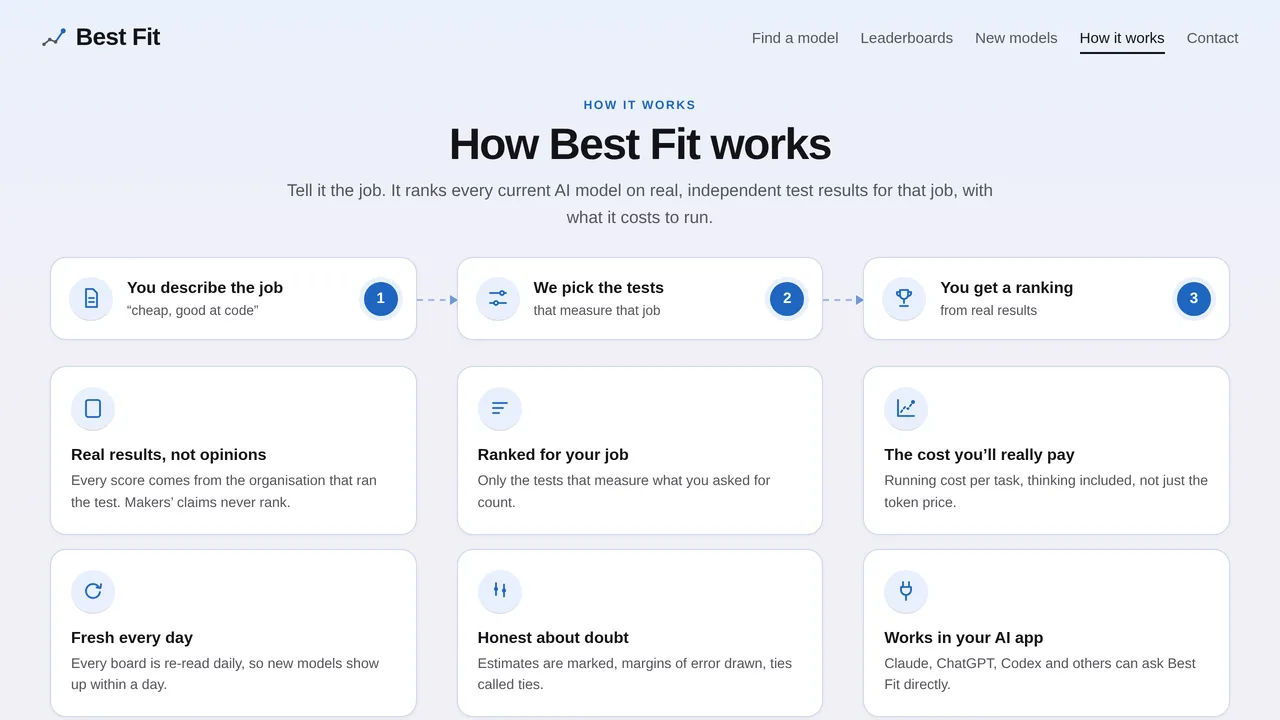
Ask Best Fit which AI model suits a job, then change how much price, speed and quality matter to the ranking.
Jev, briefly
A chat model generates text token by token and hopes you parse it. Jev never generates a word. Your code sends the state of the world plus typed questions; Jev returns every answer in one parallel pass — typed values with calibrated probabilities and a confidence score your code can trust. About 70–500 ms end to end, $0.042 per million input tokens, output free. Trained with what TypeSafe calls Reinforcement Learning for Calibrated Decisions.
You define the options. Jev returns the chosen option, a probability for every option, and a confidence. The workhorse of routing, agents, and games — the answer space is always legal, so there is nothing to parse and nothing to hallucinate.
You describe ordered levels — say trivial / normal / critical. Jev returns the level, the probability of each, and a confidence. Scores turn fuzzy judgment (“how severe is this log line?”) into a number-free decision your code can branch on.
You assert a statement; Jev returns the probability that it is true — a noul. Moderation, verification, guardrails, “does this diff actually fix the bug?”: one question, one calibrated probability.
Official material lives at typesafe.ai and docs.typesafe.ai. JevMade is an independent community registry — not affiliated with or endorsed by TypeSafe AI.
Recurring lessons
Games, drones, trading bots, and browser agents all converge on the same loop: serialize the state, ask one decisive question, act, repeat. Jev’s latency makes the loop feel instant — the model lives inside the control loop, not outside it.
The answer says what; the confidence says whether to act. The most reliable entries threshold on confidence to route edge cases to a slower model or a human — automation with an honest escape hatch.
Makers rarely ask Jev to pick from everything. Local tactics prune 225 gomoku moves to ~40; DOM filters turn a page into an element table; code narrows options, Jev judges within them.
A recurring split: Jev makes every decision cheaply and instantly, and a small LLM is only invoked when a human-facing string must actually be written. Decision and generation are separate budgets.
Send the link — repo, live demo, post, or video — plus a line on what it does and which primitives it uses. Every entry is verified against its primary source before it ships.
Submit your experimentSign in first so we can reply to you. Submissions are reviewed, not published automatically.