TypeSafe Co-Founder Backs PlanetScale Educator’s Video: “Jev Is Not a Decision Model, You Are”
Diogo Almeida of TypeSafe AI called Simeon Griggs's video an "awesome explainer" of keeping logic in code, not prompts. Here is what is public about it, and what is not.

On 27 November 2026, Diogo Almeida, a co-founder of TypeSafe AI, quote-posted a video by Simeon Griggs and called it an “awesome explainer of how to think like an engineer w/ jev”. His one-line summary of the lesson: “logic should be in code not prompts! (mostly, especially if you want your software to run in the background)”. Griggs is a developer educator at PlanetScale, and his post carries the line that gives this article its headline: “Jev is not a decision model, you are.”
Two cautions up front. The praise comes from a company co-founder, so it is endorsement, not independent review. And JevMade could not play or read a transcript of the video, so this article does not describe what is said in it beyond its title, its length and the start of its description. What it can do is lay out what is public around it and set it beside TypeSafe’s own essay on the same idea, which JevMade covered on 3 November.
In short
- Almeida (TypeSafe co-founder) quote-posted Griggs (PlanetScale educator) on 27 November, praising a video about putting logic in code rather than prompts.
- The message matches TypeSafe’s 3 November essay: “Jev makes judgments, code makes decisions.” OpenRouter’s explainer gives similar advice.
- Not verified: the video’s contents, and whether splitting decisions into small judgments measurably beats one large question.
- What was posted
- The video
- The idea underneath
- Reaction and an independent echo
- What this does not show
- Terms used
What was posted
| Date (2026) | Who | What they posted |
|---|---|---|
| 24 November | Simeon Griggs | “Jev is not a decision model, you are.” A video is attached. 16.4K views as shown on 27 November. |
| 24 November | Simeon Griggs | A follow-up linking TypeSafe’s essay: “It’s a good blog post. Category creation is hard.” |
| 25 November | Simeon Griggs | “Trying this YouTube thing again, like and subscribe”, linking the YouTube video of the same title. |
| 27 November | Diogo Almeida | Quote-post of the 24 November post: “awesome explainer of how to think like an engineer w/ jev!!!” 7,268 views as shown on 27 November. |
One detail matters for accuracy. Almeida’s post quotes Griggs’s 24 November post, which has a video attached. Griggs’s YouTube video, linked on 25 November, has the same title. JevMade has not confirmed that the attached video and the YouTube video are the same footage, so “the video” below refers to the YouTube one, and Almeida’s praise is for what his quoted post contains.
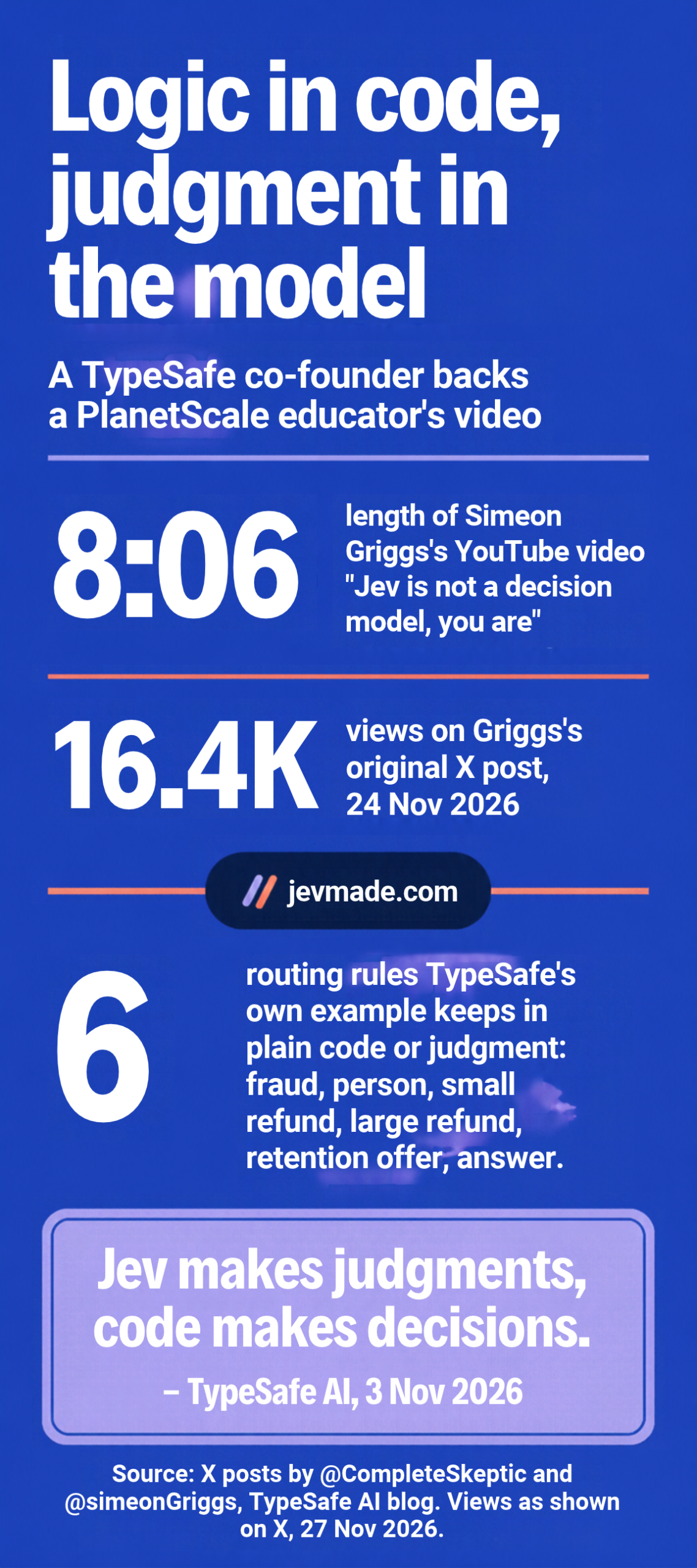
8:06
length of Griggs’s YouTube video, per its player
16.4K
views on Griggs’s 24 November post on X, as shown 27 November
7,268
views on Almeida’s quote-post, as shown 27 November
The video
The only description text JevMade could read is the start shown on X: “Jev is a System One model that kinds looks like a ‘decision model,’…” (the typo is in the original, and the text is cut off). That is consistent with the headline: the video appears to take TypeSafe’s side in the naming argument, that Jev supplies judgments and the developer’s own system supplies the decisions. Beyond that, treat any description of the video’s argument as unverified until you have watched it.
Who is Simeon Griggs? By his own site he is an Educator at PlanetScale, based in Newcastle upon Tyne, who gives talks on content modelling and full-stack development. His GitHub profile lists PlanetScale as his company. Nothing JevMade found says the video is sponsored or commissioned by TypeSafe or PlanetScale, and nothing says it is not.
The idea underneath
The video title echoes TypeSafe’s own essay, “Don’t Call It a Decision Model”, written by Allie Laabs of TypeSafe developer relations. Its argument is that a business decision is rarely one atomic choice. It is wires running through nodes of code and nodes of judgment. Checking whether a refund claim is eligible is arithmetic. Deciding whether a customer wants their money back takes judgment. TypeSafe says Jev belongs only at the second kind of node.
Jev makes judgments, code makes decisions.
TypeSafe AI, “Don’t Call It a Decision Model”, 3 November 2026
The essay’s worked example is a customer-service workflow. The naive design puts the whole decision into one Choice question, with long prose rules in its criteria. TypeSafe calls the resulting cycle of rewording “prompt gymnastics”. Its alternative keeps the routing in code and asks Jev small yes/no judgments.
| Outcome | When it applies (TypeSafe’s example) |
|---|---|
| Fraud team | Customer reports an unauthorised charge |
| Hand to a person | Customer asks for a person or threatens legal action |
| Refund now | Wants money back, claim eligible, $25 or less |
| Refunds team reviews | Wants money back, claim eligible, over $25 |
| Offer to stay | Wants to cancel, subscription active, open to an offer |
| Answer and continue | None of the above |
 Jev News · Company & Strategy
TypeSafe AI Pushes Back on “Decision Model” Label: “Jev Makes Judgments, Code Makes Decisions”
TypeSafe AI DevRel Allie Laabs explains why stuffing business rules into a single Choice prompt creates prompt gymnastics—and why code should still own the final branch.
awesome explainer of how to think like an engineer w/ jev!!! logic should be in code not prompts! (mostly, especially if you want your software to run in the background)
Diogo Almeida, X, 27 November 2026
Note the qualifier in Almeida’s own words: “mostly”. TypeSafe’s essay does not say judgment never belongs in the loop. It says the small questions code cannot answer exactly belong to Jev, and the combination of both is what makes a system’s decisions “reliable, observable”.
Reaction and an independent echo
The reply reads: “half of agent engineering is replacing fragile prompts with boring if statements”. It is a wry summary of the same point, from a user with no stated tie to TypeSafe in the thread.
A less partisan source gives similar guidance. OpenRouter, which offers Jev through its own API and so has a commercial interest, publishes an explainer with a “When to skip Jev” list.
Exact arithmetic, date math, and threshold comparisons aren’t Jev’s job. Compute them first and hand Jev the semantic part.
OpenRouter, “What Is Jev?”, 21 September 2026
The same page says that when the logic is deterministic, “a regex or database lookup beats any model”. That is the engineering instinct Almeida and Griggs are pointing at. It is also consistent with what JevMade’s look at Jev’s probabilities suggests about thresholds: they only help if your own code decides what to do with them.
What this does not show
Does anything here prove the split design beats one big question?
No. TypeSafe’s essay argues from a worked customer-service example and lists clarity of design, observability and extendability as benefits. JevMade has not seen a measurement comparing the two designs on accuracy, cost or latency. The advice may well be sound engineering, but it is a design argument from the vendor, repeated by its co-founder.
Is “decision model” a wrong name?
It depends who you ask. TypeSafe prefers “System One model” and says it has itself used “decision” in education material. Other writers, including OpenRouter and several developers who have written about Jev, use “decision model” freely. Griggs’s title takes TypeSafe’s side of the argument, in a way that is also a joke: the developer is the decision maker.
Why does the co-founder’s role matter here?
OpenRouter’s explainer names Diogo Almeida as one of Jev’s three founders, alongside Erik Gafni and Sasha Sheng. A founder sharing a third-party explainer that supports the company’s own framing is normal marketing, and useful signal about what TypeSafe wants developers to learn. It is not evidence that the explainer is correct.
Terms used
- System One model
- TypeSafe’s name for models such as Jev, which return quick typed judgments for software to use, rather than generated text.
- Decision model
- The name many outside writers use for the same kind of model. TypeSafe argues it overstates what the model does.
- Choice
- A question where Jev picks from options you supply and gives a probability for each.
- Score
- A question where Jev places an answer on a numeric scale you describe.
- Noul
- A yes/no question answered with a probability between 0 and 1.
- Prompt gymnastics
- TypeSafe’s term for repeatedly rewording long instructions to cover each new edge case.
What to watch
- What the video actually demonstrates. It is eight minutes, so you can judge for yourself.
- Whether anyone publishes a head-to-head measurement of decomposed small questions against one large Choice question.
- Whether TypeSafe’s how-to-build guide and patterns pages grow into worked examples that show the observability benefit in practice.
Sources
- Diogo Almeida on X, 27 November 2026
- Simeon Griggs on X, 24 November 2026, follow-up, 24 November and YouTube link, 25 November
- “Jev is not a decision model, you are”, Simeon Griggs, YouTube
- Aaron (@aaron_xong) on X, 27 November 2026
- TypeSafe AI: Don’t Call It a Decision Model, 3 November 2026
- OpenRouter: What Is Jev?, 21 September 2026
- Simeon Griggs: speaker profile and GitHub profile