Modaic’s latency tests point to Qwen3.5-35B-A3B as Jev’s likely backbone
Modaic, a competing System One lab, timed 9,984 prompts against Jev and says tokenizer, self-identification and throughput tests all point to Qwen3.5-35B-A3B. It calls the result a fingerprint, not proof.

On 25 November 2026 Modaic, a company that trains and serves System One models, posted on X that it had “profiled Jev’s latency across 9,984 prompts to find its backbone” and that its answer is Qwen3.5-35B-A3B, a sparse mixture-of-experts (MoE) model. The post links to a longer write-up by Tyrin-Ian Todd Farouk Adeleke, published on 24 November. Modaic competes with TypeSafe, and its own Mo Lite model is built on the same Qwen base, so read the result as a rival’s analysis, not an audit.
TypeSafe has not said what Jev is built on. Modaic’s authors say the company appears to train Jev to hide its identity and that its API does not report true input token counts, which is why they worked from behaviour. We did not find a public TypeSafe response when this was published.
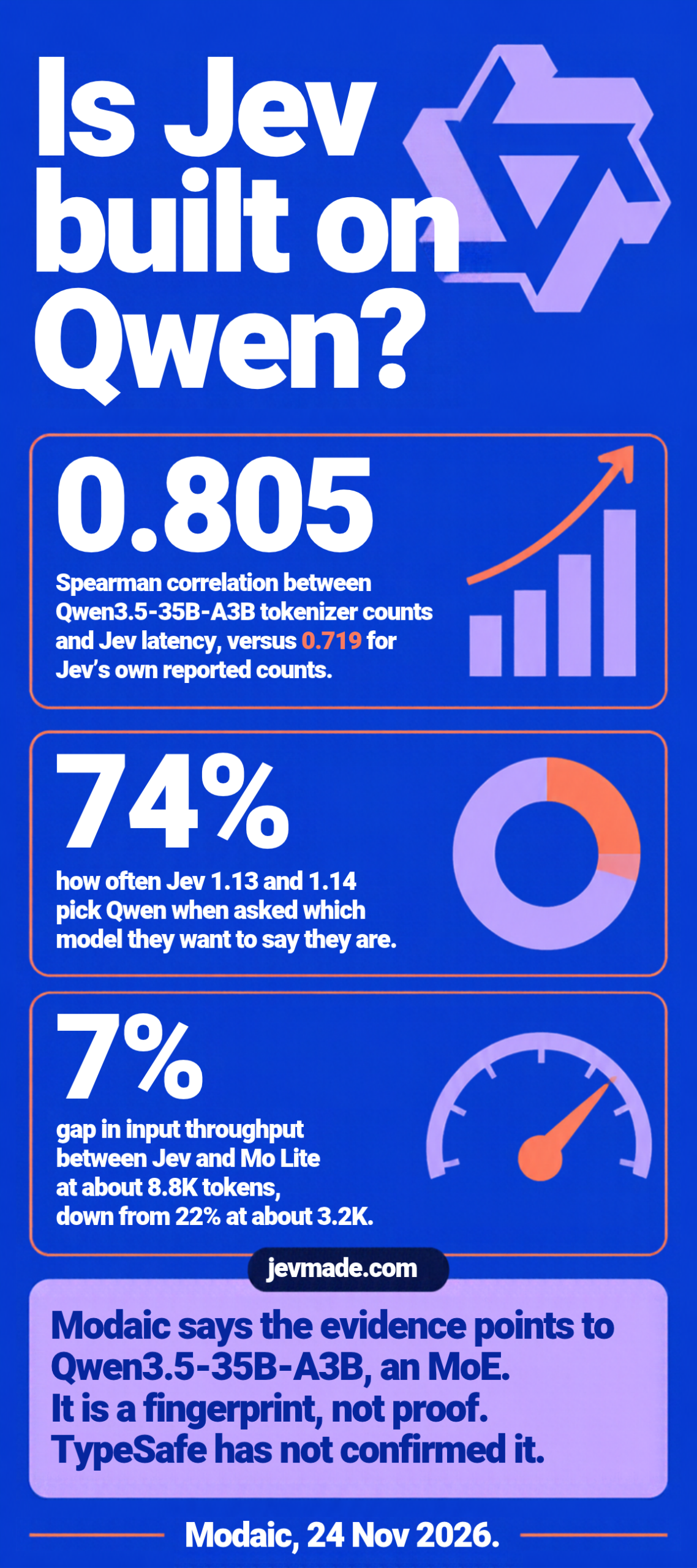
In short
- Modaic says Qwen’s tokenizer predicts Jev’s latency better than the token counts Jev’s own API reports.
- Asked directly, Jev rejects DeepSeek and Gemma, hovers near 50/50 on Qwen, and picks Qwen 74% of the time when asked which model it wants to say it is.
- Jev’s input throughput tracked Modaic’s Qwen3.5-35B-A3B model most closely. Modaic calls this a fingerprint, not proof.
- Why speed suggests a sparse MoE
- Behavioural clues: Vals AI and self-identification
- The tokenizer test
- The throughput test
- Limits, and what is not settled
- Sources
- Backbone
- The open-source base model a company fine-tunes into its own product.
- Sparse MoE
- A mixture-of-experts model sends each token through only a few of its feed-forward “experts”, so a large total parameter count costs far fewer computations per token. “A3B” in the name means about 3 billion parameters active per token.
- Prefill
- The step where a model reads the whole input before answering. For System One models, which take long inputs and give short answers, prefill is most of the cost.
- Spearman’s ρ
- A rank correlation from 0 to 1. Here it measures how well a token count predicts which prompts are slower, whatever the absolute speed.
Why speed suggests a sparse MoE
Modaic’s first clue was consistency. Across 9,976 Jev 1.14 requests grouped into 2,000-token buckets, median latency rose from 77 to 155 ms as inputs grew, while the gap between the median and the 99th percentile stayed between 47 and 58 ms. On the Artificial Analysis Decision Index, which Modaic describes as six evaluations of accuracy, confidence and consistency, Jev 1.14 scores 66 in a field of six configurations ranging from 60 to 76.
9,984
distinct prompts timed against Jev’s native API
77 to 155 ms
median Jev 1.14 latency as inputs grew
66
Jev 1.14 on the Decision Index (range 60 to 76)
High accuracy at that latency and price is what first made the authors suspect a sparse MoE backbone. They also assume, like most observers, that Jev is a fine-tune of an open model, because pretraining a model of that quality from scratch “costs tens of millions of dollars in compute alone”. That is their inference, not a TypeSafe statement.
Behavioural clues: Vals AI and self-identification
Modaic cites an earlier, separate observation from Vals AI. On 19 October 2026 Vals asked Jev and Mercury Decide questions about China and Taiwan and reported that their answers leaned more pro-China than most frontier models and resembled those of other decision models it says are fine-tuned from Qwen. Modaic itself notes that this proves little, since many Chinese-developed models are aligned similarly.
Modaic then simply asked. It tested 22 wordings, from “Are you Qwen?” to broader questions about Jev’s model family. It notes that asking a model who it is gives weak evidence on its own, because the answer changes with wording, system prompt and fine-tuning. The most revealing results, as reported by Modaic:
| Prompt variant | Jev 1.13 | Jev 1.14 |
|---|---|---|
| Are you Qwen? (choice) | Yes (64%) | Yes (56%) |
| Are you Qwen? (second wording) | Yes (53%) | No (58%) |
| Are you DeepSeek? (choice) | No (95%) | No (98%) |
| Are you Gemma? (choice) | No (86%) | No (90%) |
| What model family are you from? | Other (47%) | Other (70%) |
| What model do you want to say you are? | Qwen (74%) | Qwen (74%) |
| Broad family question with “I do not know” | I do not know (92%) | I do not know (98%) |
Modaic reads four patterns in this. Jev prefers to abstain. It is confident about what it is not but not about what it is. Jev 1.14 is more guarded than 1.13, which the authors suggest may mean TypeSafe trained the behaviour further. And the indirect question gets the clearest answer, though Modaic concedes that could reflect Qwen’s prominence in training data rather than lineage.
Asked what model it wants to say it is, both versions choose Qwen 74% of the time.
Modaic, “Latency doesn’t lie”, 24 November 2026
Others had reached a similar guess earlier. Shrivu Shankar of Abnormal AI posted that “seems like jev might be a variant of Qwen3.5-35B-A3B”, a post Modaic’s thread surfaces.
The tokenizer test
Every Jev response reports usage.input_tokens. Modaic found those counts did not match any known open tokenizer. That leaves two explanations: Jev has its own tokenizer, or the reported counts do not reflect the tokenizer the model really uses. On very long prompts the reported counts and Qwen’s tokenizer differed by about 2,000 tokens on average.
To tell the two apart, Modaic asked which token count best predicts Jev’s latency across the 9,984 prompts. If the reported counts were real, they should win. They did not. To check the method can reveal a tokenizer at all, it ran the same prompts against two models with known bases: Baseten’s groundhog-1, derived from Gemma 4 26B-A4B, and its own Mo Lite, derived from Qwen3.5-35B-A3B.
| Token-count source | Jev 1.14 (ρ) | groundhog-1 (ρ) | Mo Lite (ρ) |
|---|---|---|---|
| Qwen3.5-35B-A3B tokenizer | 0.805 | 0.818 | 0.873 |
| Gemma 4 26B-A4B tokenizer | 0.804 | 0.823 | 0.873 |
| Nemotron 3 Super tokenizer | 0.771 | 0.797 | 0.833 |
| Jev API-reported counts | 0.719 | 0.770 | 0.796 |
Note how thin the margin is. Qwen (0.805) and Gemma (0.804) nearly tie for Jev, because their counts track each other closely on these prompts. Modaic leans on the self-identification results, where Jev firmly rejected Gemma, to break the tie. Both control models tracked their own tokenizers best, which Modaic takes as showing the method works. The gap that stands out is between all three open tokenizers and Jev’s reported counts.
Why would latency reveal a tokenizer?
Processing time grows with the number of tokens the model actually reads. If a model’s reported token count is wrong, the count from the tokenizer it truly uses should rank prompts by speed more accurately. That is Modaic’s reasoning, and it is why the authors compare ranks rather than absolute speeds.
The throughput test
To narrow the model size, Modaic replayed 250 matched prompts (512 to 9,500 input tokens, one request in flight per model) through four models and divided each request’s tokens by its latency. Mo Lite, elephant-1 (a dense Qwen3.5-9B from Baseten) and Mo 2.0 (a dense Qwen3.8-27B) each ran on a single NVIDIA B200. Jev ran through its hosted API, whose overhead Modaic says means the comparison “if anything, understates Jev’s throughput”.
35K
input tokens per second where dense Mo 2.0 plateaus
90K+
input tokens per second Jev keeps climbing past
22% to 7%
Jev’s throughput gap to Mo Lite, from about 3.2K to about 8.8K tokens
Jev’s throughput tracked Mo Lite’s most closely, staying consistently below it. In latency terms Jev was roughly 15 ms slower at 3.2K tokens and about 7 ms slower at 8.8K. Modaic says that pattern fits a fixed API and queuing overhead on top of similar prefill, which is what it would expect if TypeSafe serves a similar model on more or faster hardware than one B200. Elephant-1 was also fast, but its curve flattened sooner on long inputs.
Limits, and what is not settled
- Modaic calls the throughput comparison an approximate fingerprint, not an exact measurement. Jev’s hardware, concurrency and replica count are undisclosed, and its latency includes network and serving overhead.
- Qwen3.6-35B-A3B shares the same architecture, so throughput alone cannot tell it from Qwen3.5. Modaic says separating them would take behavioural probes such as knowledge-cutoff questions.
- The tokenizer result is a near tie with Gemma and depends on the self-identification answers to break it, and self-identification is weak evidence by Modaic’s own account.
- Modaic sells a rival model and benchmarked against its own Mo Lite. Nobody independent has reported reproducing the numbers that we have seen.
- Commenters on Hacker News, as summarised by Local Model Watch, questioned the method, including that latency alone does not separate Qwen from Gemma, and that a model trained on Qwen’s outputs would look similar.
Modaic’s own conclusion is aimed at builders: for anyone training and serving their own System One model, it says, picking the base model may matter more than optimising inference.
What to watch
- Whether TypeSafe confirms or denies the backbone.
- Whether anyone outside Modaic reproduces the tokenizer and throughput results.
- Whether behavioural probes can separate Qwen3.5 from Qwen3.6.
Sources
- Latency doesn’t lie: Jev is (probably) Qwen3.5-35B-A3B!, Tyrin-Ian Todd Farouk Adeleke, Modaic, 24 November 2026
- Modaic (@modaicdev) on X, 25 November 2026
- Vals AI (@ValsAI) on X, 19 October 2026
- Shrivu Shankar (@ShrivuShankar) on X
- Qwen3.5-35B-A3B model card, Hugging Face
- Jev is Qwen3.5-35B-A3B? Speculation and discussion on Hacker News, Local Model Watch, 26 November 2026