Judgment Labs Says Jev Matched GPT-6 Luna at Grading Agent Runs for 600x Less Cost
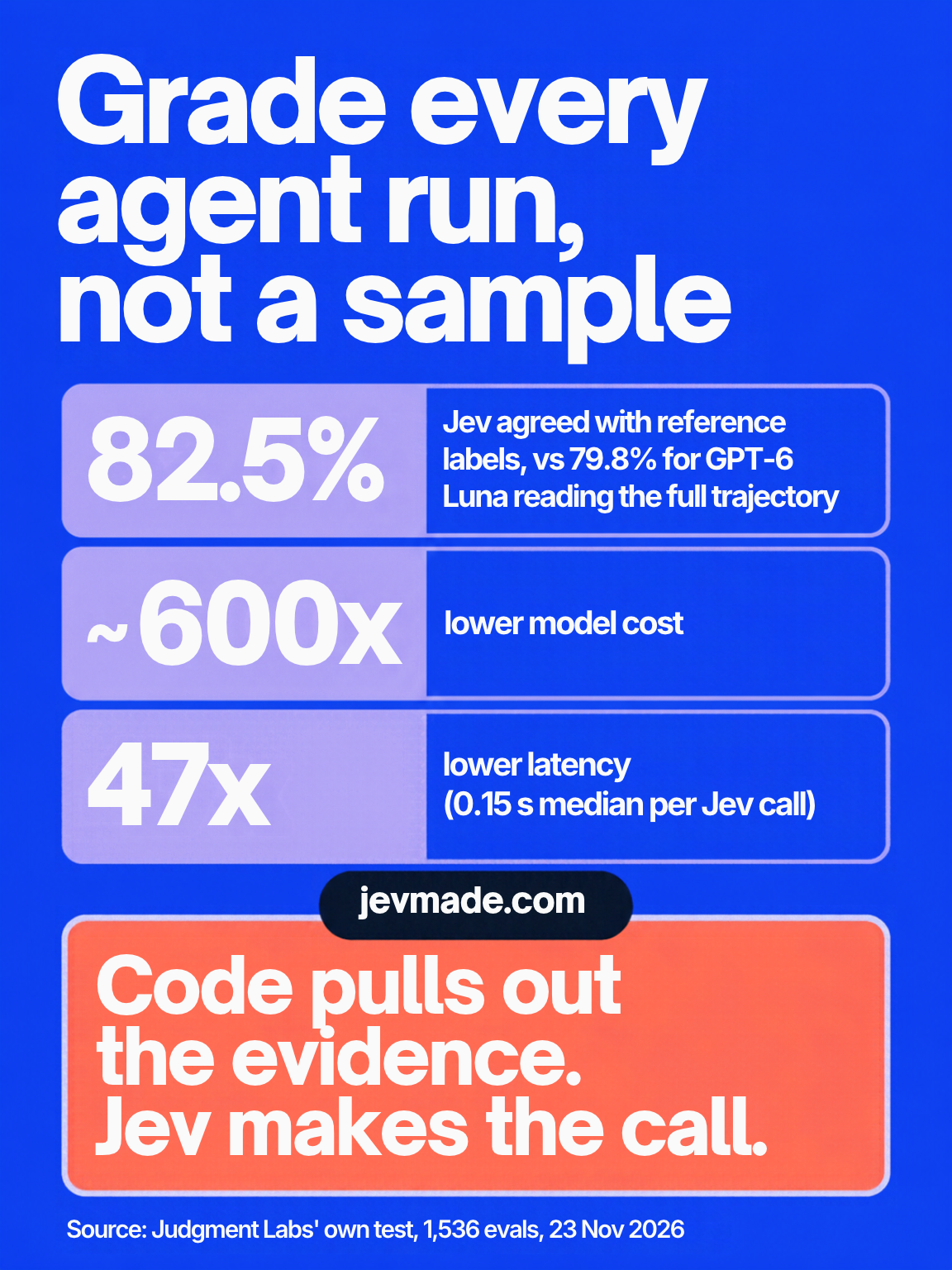
Judgment Labs says that by extracting only the relevant evidence with code, Jev 1.13 agreed with reference labels 82.5% of the time against 79.8% for GPT-6 Luna on full trajectories, at about 600x lower model cost.

On 24 November 2026, TypeSafe AI pointed its followers at a post by Judgment Labs, a company that monitors and evaluates AI agents. Judgment Labs says that when it grades long agent runs, it first uses code to cut each run down to the few hundred tokens that matter, then lets Jev make the call. In its own test, that matched GPT-6 Luna reading the whole run, at about 600 times lower model cost.
These are Judgment Labs’ figures from its own benchmark, reviewed by TypeSafe before publication, and JevMade has not reproduced them.
In short
- Judgment Labs shrinks each agent trajectory with code, so Jev reads under 500 tokens instead of a median of about 117,000.
- On six rubrics and 1,536 evals, Jev 1.13 agreed with reference labels 82.5% of the time, against 79.8% for GPT-6 Luna on the full trajectory.
- Most of the saving comes from the preprocessing, not from Jev alone, and the company says it only works when the evidence is easy to locate.
- What TypeSafe and Judgment Labs said
- How the method works
- The numbers
- Limits and what is not verified
- What to watch
What TypeSafe and Judgment Labs said
TypeSafe’s post asks how many of an agent’s runs anyone actually read last week, then says Judgment Labs answers “all of them”, using Jev to answer each eval question in 0.15 seconds.
The post it quotes is from Judgment Labs itself, which published the long version on its blog on 23 November and as an X article on 24 November.
Most eval questions are narrow. Did the user get frustrated? The answer sits in a few hundred tokens, buried in 100K+. We extract just that evidence with code and let @typesafeai Jev decide, matching GPT-6 Luna on the full trajectory at ~600x lower cost.
Judgment Labs, post on X, 24 November 2026
How the method works
An agent “trajectory” is the full record of a run: every message, tool call and result. Judgment Labs says long-horizon agents now produce trajectories far larger than a small model can read, but that the question being asked is usually narrow. Whether a user sounded frustrated depends on a few user messages, not on every line of the run.
So Judgment’s agent reads the rubric, explores the customer’s trajectories, and, if the conditions below hold, writes code that pulls out just the relevant evidence. Jev then answers the question from that extract. If the script fails, the evidence is too large, or Jev is not confident, the eval falls back to a full agent judge that can read more of the run.
- Addressable
- Code can reliably locate the evidence, for example in the first three user turns.
- Bounded
- The extracted evidence reliably fits under a limit, such as Jev’s context window.
- Sufficient
- The extract contains everything the rubric needs. Judgment Labs calls this the hardest to guarantee.
- Agent-as-a-Judge
- The fallback: an agent that searches the whole trajectory and judges it directly.
The company’s own example is a coding agent where the team wants to know what users ask for: bug fix, new feature, refactor. The preprocessing code keeps only the user’s opening request, which is all that eval needs. Judgment Labs also runs the generated code in Cloudflare Isolates, which it describes as lightweight sandboxes with no network access, and reuses each script’s worker to keep running costs down.
What is a System One model, and why does Jev suit this job?
TypeSafe AI’s term for a model that does not write text. It takes some state and a typed question and returns an answer with calibrated probabilities that code can act on. Judgment Labs lists what that means for grading: it is fast, it is cheap because it produces no output tokens, and it gives a confidence score from 0 to 1 that code can use to decide when to escalate. It also lists the weaker side: no written explanation, a 64K-token default context (262K in a slower long-context mode, which TypeSafe says is less accurate), and less reasoning than an LLM.
The numbers
For a public test, Judgment Labs used SWE-chat, a dataset of real coding-agent sessions from open-source developers. It sampled 256 long trajectories (at least 100 tool calls and three user messages each, no more than three per repository), with a median of about 180 tool calls and 117K tokens and a largest of about 757K. It kept six rubrics, giving 1,536 evals, and used Opus 5.5’s labels as the reference.
82.5%
Jev 1.13 agreement with reference labels, on extracted evidence
~600x
lower model cost than GPT-6 Luna on the full trajectory
47x
lower median latency than GPT-6 Luna on the full trajectory
| Setup | Agreement | Median latency | Model cost |
|---|---|---|---|
| GPT-6 Luna, full trajectory (high reasoning effort) | 79.8% | 6.9 s | Baseline |
| GPT-6 Luna, extracted evidence only | 81.4% | 1.7 s | Under 1% of baseline |
| Jev 1.13, extracted evidence only | 82.5% | 0.15 s | About 600x lower than baseline |
Most of the savings come from preprocessing itself, and Jev cuts cost and latency further still.
Judgment Labs, “Long-Horizon Trajectories, Small Questions”, 23 November 2026
What the table shows: handing GPT-6 Luna the same extracted evidence already lifted agreement to 81.4% at under 1% of its full-trajectory cost. Jev’s contribution is the last step: a further cut in cost and latency, with agreement about a point higher. Judgment Labs also reports the winners varied by rubric: Jev scored highest on explicit constraints, hedging and plans, Luna on the extracted evidence scored highest on command purpose, and Luna on the full trajectory scored highest on frustration.
In production, the company says preprocessing has cut eval cost by up to 80% for customers’ current setups, because some runs still fall back to the full agent judge. It also tested a topic-classification eval on 87 trajectories from a customer’s analytics agent, the longest about 900,000 tokens, and calls that the best case because it had no fallbacks.
Limits and what is not verified
- Vendor test. Judgment Labs ran, scored and published it. TypeSafe reviewed the post. Nobody independent has reproduced the figures that JevMade can find.
- Reference labels came from a model. On SWE-chat, agreement is measured against Opus 5.5’s labels, not human labels. In the smaller customer test, the reference was human-verified.
- Rubrics were chosen. Judgment Labs wrote other rubrics and dropped them, mostly because the extracted evidence fell short. The six kept are the ones where the method works.
- Cost is model cost only. It excludes the work of building and maintaining the preprocessing, and the cost of fallback runs.
- Confident answers from partial evidence. Judgment Labs warns that Jev only sees what it is given and can return a confident answer from an incomplete picture. It recommends checking a sample against a reviewer who reads the whole run before switching it on.
- Adoption claim not checked. The post says Jev is used by 30% of the Fortune 500. That is Judgment Labs’ statement, and JevMade has not verified it.
It also fits a wider pattern. LangChain’s own tests of Jev as a judge in LangSmith, published on 20 and 21 September 2026, reported much lower score variance than the LLM judges it compared, and cautioned that the result was early (LangChain, “Can Jev Be a Better Agent Evaluator?”). Our earlier report on a separate test by Raindrop ranked Jev third on accuracy and first on misses, a reminder that results depend on the task.
 Jev News · Benchmarks & Research
Raindrop's 1,005-Question Test Ranks Jev Third on Accuracy and First on Misses
Raindrop tested 11 decision models on 1,005 questions. GLiDE beat Jev on accuracy, but Jev missed the fewest cases on a 214-question binary subset, the result TypeSafe's CEO highlighted on 21 November.
What to watch
As agents take on more important work, no one will be able to read everything they do.
Judgment Labs, “Long-Horizon Trajectories, Small Questions”, 23 November 2026
- Whether an independent team reproduces the 82.5% against 79.8% result on its own agent data.
- How often real workloads fall back to the full agent judge, since that sets the true saving.
- Whether other eval tools copy the “extract with code, decide with a System One model” pattern. Judgment Labs’ own Eval Optimizer, announced on 19 November 2026, already routes between code, decision models, LLM judges and agent judges.
Sources
- Judgment Labs, “Long-Horizon Trajectories, Small Questions: Evaluating Agents with System One Models”, 23 November 2026
- Judgment Labs on X, article and post, 24 November 2026
- TypeSafe AI on X, 24 November 2026
- Judgment Labs, “Not every eval needs a frontier model” (Eval Optimizer), 19 November 2026
- LangChain, “Can Jev Be a Better Agent Evaluator?”, 20 September 2026