Jev for SEO deep-dive: what Conqueror’s claim shows and what it does not
Daniel Ch says Conqueror now runs Jev for SEO. The same launch format was used for Claude Code and Claude, Conqueror's pages never mention Jev, and Jev cannot write or browse. A close look at what could be true.

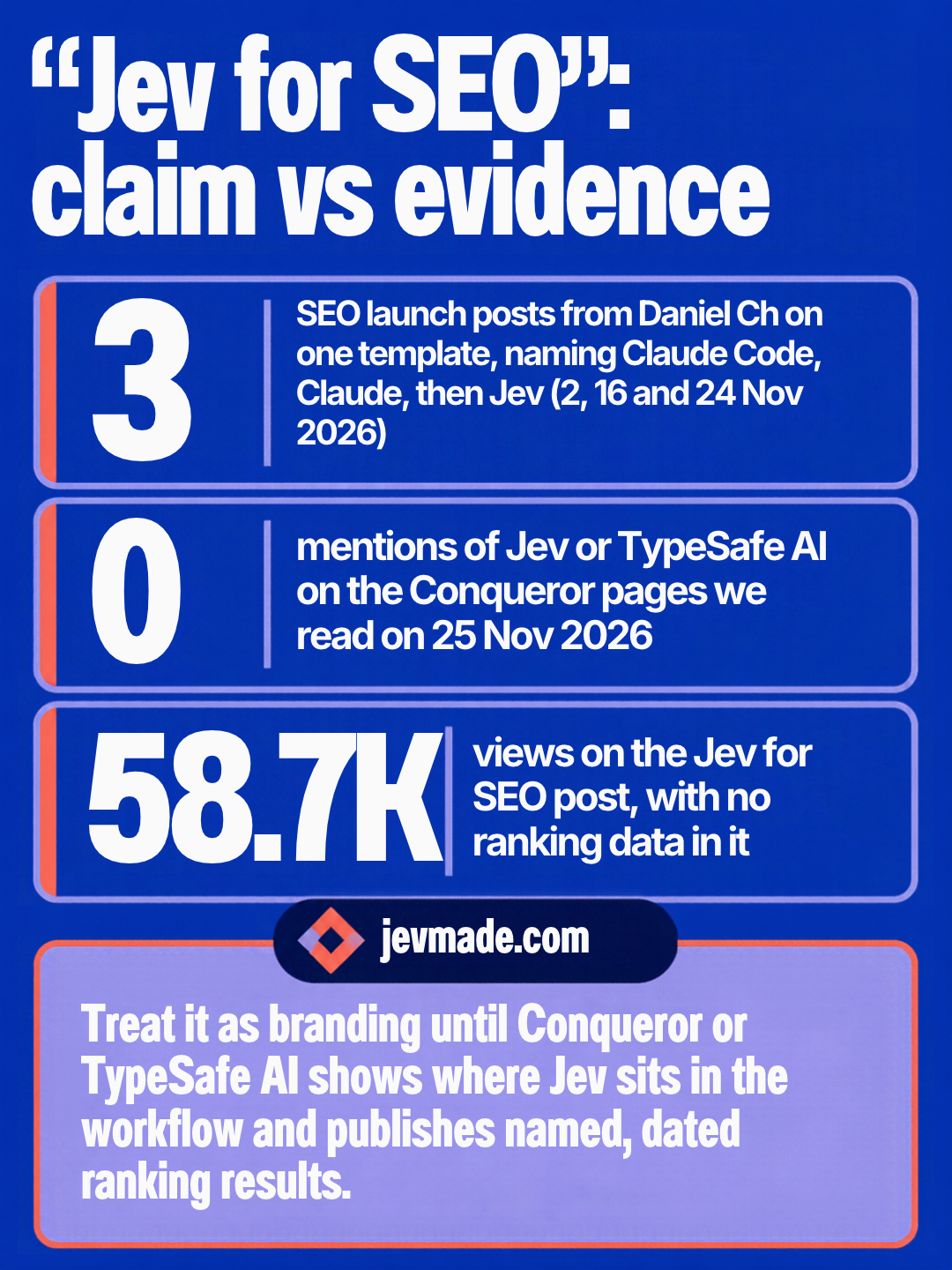
On 24 November 2026, entrepreneur Daniel Ch (@chddaniel) announced “Jev for SEO”. Type in a website address and, he says, his product Conqueror will “deep research competition and rank you #1 for thousands of keywords in seconds”. The post tags TypeSafe AI, the lab behind Jev, and had about 58.7K views a day later.1
Our short report treated it as a vendor claim. This deep-dive goes further: what Conqueror is, how the post echoes two earlier ones, what Jev can and cannot do technically, three ways “Jev for SEO” could be true, what evidence exists, and where decision models really do fit SEO work. Anything attributed to a company is that company’s claim. Where we infer, we say so.
In short
- The post gives no site, keyword list, date range or ranking data. “#1 for thousands of keywords in seconds” is a promotional claim.
- It is the third post on one template, after “Claude Code for SEO” (2 November) and “Claude for SEO” (16 November). Conqueror says it works with any agent through its MCP server. We found no Jev or TypeSafe AI mention on six Conqueror pages or its public skills repository.
- Jev returns typed probabilities, not text. It does not browse or write. It can be a fast, cheap decision step inside an SEO pipeline, which is a real use, but that is not what “deep research” and “rank #1” describe.
- The post
- The third post on one template
- What Conqueror says it is
- What Jev can and cannot do
- Three ways it could be true
- What evidence exists
- How people responded
- Where decision models fit SEO
- Why “#1 in seconds” is the wrong test
- Open questions
The post
Simply enter your website URL, and Conqueror will deep research competition and rank you #1 for thousands of keywords in seconds.
Daniel Ch, X, 24 November 2026
58.7K
views on the post when we read it on 25 November 2026
518
likes, with 36 reposts and about 1K bookmarks
14
replies, of which we could read only a few without logging in
A follow-up post from the same account says “Try it here” and links to conquerorapp.com. Conqueror’s About page says the product is operated by CHGROUP – FZCO, and a founder page on its site names Daniel Ch as its founder.
The third post on one template
The same account made two earlier announcements with the same shape: a product name, “for SEO”, then a one-sentence promise that Conqueror will rank you #1. Only the name changes.
| Date (2026) | Opening line | Promise | Closing line |
|---|---|---|---|
| 2 November | “Today we’re introducing Claude Code for SEO.” | “In one click, Conqueror deploys keyword research agents, writes viral content, and ranks #1 on Google + AI Search for you automatically.” | “This is beyond insanity.” |
| 16 November | “Meet Claude for SEO.” | Same sentence as 2 November | “This is honestly insane.” |
| 24 November | “Introducing Jev @typesafeai for SEO” | “Simply enter your website URL, and Conqueror will deep research competition and rank you #1 for thousands of keywords in seconds.” | “This is honestly insane.” |
2 Nov   "Today we're introducing  Claude Code  for SEO."
16 Nov  "Meet                     Claude       for SEO."
24 Nov  "Introducing              Jev          for SEO"
                                  ^ the only slot that changes
Our reading (inference): this looks like a repeatable promotional format. That does not make the Jev claim false. It does make the post weak evidence that Jev does anything specific inside Conqueror, because the same sentence structure was used for tools that, on Conqueror’s own account, simply drive it through its MCP server.
What Conqueror says it is
Conqueror is a paid SEO and “GEO” (visibility in AI answers) product. We did not run it; this table is what its own pages say, read on 25 November 2026.
| Topic | What Conqueror’s pages say | Page |
|---|---|---|
| What it is | “An SEO platform for WordPress that does the work, not just the reporting.” Home page: “Run your SEO+GEO on autopilot with AI agents.” | About, home |
| Price | Team plan, $39 a month, 7-day trial with a card required. Starter AI usage included, then bring your own AI key and pay the provider. | Pricing, home |
| How agents connect | Through a CLI and an MCP server. Named clients include Claude, ChatGPT, Codex, Cursor, OpenClaw and Hermes; its connect page also lists Grok Bot. | Home, About, MCP |
| Who decides | The agent drafts a rewrite; only the user’s approval publishes it, and applied changes can be rolled back. The home page also says “publish live or roll everything back”. | About, home |
| Operator | CHGROUP – FZCO; Daniel Ch named as founder. | About, founder page |
| Jev or TypeSafe AI | Not mentioned. | All pages above |
This isn’t a setting you can switch off — it’s built into how the product works. The agent writes the rewrite and stores it inside Conqueror. The only thing that can publish to your WordPress site is you, approving a specific change.
Conqueror, About page, conquerorapp.com, read 25 November 2026
Two details matter for the Jev question. First, Conqueror’s page sitemap lists 23 pages for individual AI agents and clients, among them Claude, Codex, Cursor, Gemini, Hermes and OpenClaw, and none for Jev. We read the page names, not every one of those pages. Second, its public skills repository (Shipper-dot-now/conqueror-skills on GitHub) says the skills “do nothing on their own” and that the data comes from the Conqueror MCP server; it does not mention Jev either.
If the agent is external, where does the “AI” in Conqueror live?
On Conqueror’s own description, the thinking is done by whichever agent you connect (Claude, ChatGPT, Codex and so on). Conqueror supplies tools and data through MCP: keyword and ranking data, a site connection, and a way to propose a change. Its pricing page also says AI usage can run on your own provider key. That is why a post titled “Claude for SEO” can be about Conqueror: the name on the post can be the agent that calls it. Whether “Jev for SEO” follows that pattern is the open question in this piece.
What Jev can and cannot do
Jev, released by TypeSafe AI on 15 September 2026, is what the company calls a System One model. A caller sends a “state” (a string or structured data) plus typed questions, and gets back typed answers with probabilities. InfoQ reports that it does not generate text. That single design fact decides what “Jev for SEO” can mean.
- System One model
- TypeSafe AI’s name for a model that makes fast, structured decisions for software and returns typed answers, not prose. Jev is the first.
- State
- The evidence you send with a request: a string or structured data you have already collected.
- Choice
- A question that picks one option from a closed list you define.
- Score
- A question answered on an ordered scale you define.
- Noul
- A question that returns the probability of one yes or no proposition.
- Calibrated
- Answers given with 80% probability are right about 80% of the time, measured across many answers. It does not guarantee that any one answer is correct.
- MCP (Model Context Protocol)
- A standard way for an AI assistant to call an external tool, such as Conqueror’s keyword data.
- SERP
- Search engine results page: the ranked list Google shows for a query.
- GEO
- Generative engine optimisation: trying to get a site cited in AI-written answers.
| What the posts promise | Can Jev do it alone? | Why |
|---|---|---|
| “Deep research competition” | No | Jev evaluates the state it is given. Screpy’s guide lists fetching a URL, writing copy and executing an action as outside Jev’s job. |
| “Writes viral content” (2 and 16 November posts) | No | Jev returns typed answers, not generated text (InfoQ, TechCrunch). |
| “Rank you #1” | No | Rankings are Google’s output, set by many pages competing. No model decides them. |
| Sort thousands of keywords by intent, score pages, pick link targets, gate drafts | Yes | These are closed choices, ordered scores and yes or no questions, the work Jev was built for. |
It is also cheap and quick, on the company’s figures as reported by InfoQ: $0.042 per million input tokens, output free, a 32,000-token context window and end-to-end latency of 70 to 500 milliseconds. Jev is reachable through TypeSafe’s own API and SDKs and, per Vercel’s documentation, through Vercel AI Gateway. Here is what a decision call for an SEO task could look like. It is our illustration in the documented request shape; we did not run it.
POST https://ai-gateway.vercel.sh/typesafe/v1/systemone

{
  "model": "typesafe-ai/jev",
  "state": "Keyword: best invoicing software for freelancers. Page: /blog/invoicing-tools, a comparison of 8 tools, last updated 2025.",
  "questions": {
    "intent": {
      "type": "choice",
      "instructions": "What is the searcher's main intent?",
      "criteria": {
        "informational": "Wants to learn or compare",
        "commercial": "Researching before buying",
        "transactional": "Ready to buy or sign up",
        "insufficient_context": "The state is not enough to decide"
      }
    },
    "stale": {
      "type": "noul",
      "instructions": "Is this page out of date for this keyword?"
    }
  }
}
Everything around that call stays outside Jev: fetching the page, pulling search volume, writing the new copy, publishing, and measuring where the page lands.
Three ways “Jev for SEO” could be true
Putting the post, Conqueror’s pages and Jev’s design together, three readings fit. They are our inferences, not findings, and they are not mutually exclusive.
| Reading | What it would mean | What fits | What we found |
|---|---|---|---|
| A. A decision layer inside Conqueror | Conqueror calls Jev for choices such as keyword intent, which page to rewrite, or whether a draft is ready. | Matches how Jev is designed and how others use it. Glean says its users need not know when Jev is in use. | No documentation, changelog or TypeSafe statement describing it. |
| B. Jev as a selectable “agent” | Jev is offered like Claude or Codex as the thing that drives Conqueror. | The post’s wording (“Jev for SEO”) matches the “Claude for SEO” format. | Jev cannot run a tool-calling, writing agent loop on its own, and Conqueror has no Jev client page. We think this is the least likely reading. |
| C. A name on a promotional template | The post reuses a format; the underlying product is unchanged. | Same structure as the 2 and 16 November posts; Conqueror says it works with any agent. | The wording pattern only. It cannot be confirmed from outside. |
So we want to hide away all the complexity of whether we are using Jev or we are using a full-blown LLM.
Chinmay Goyal, Glean, interviewed by Latent Space, 12 November 2026
That quote is why reading A cannot be ruled out: real products do use Jev invisibly. It is also why an outside reader needs the integrator to say so. Glean has said it publicly; Conqueror has not, on anything we could find.
What evidence exists, and what does not
| Evidence you would expect | Found? | Note |
|---|---|---|
| Named sites with dated before and after rankings | No | The post, its video and Conqueror’s pages give none. The video, per our earlier article’s reading of sampled frames, is a motion-graphics mock-up.2 |
| Conqueror documentation naming Jev | No | Searched six pages, the public skills repository and the page sitemap for “Jev” and “TypeSafe”. |
| A statement from TypeSafe AI about Conqueror | None found | We looked at TypeSafe’s recent posts on X and its documentation index. That is not an exhaustive search. |
| A technical description of where Jev runs | No | Nothing from either company. |
| An independent test of the claim | None found | We found no third-party results as of 25 November 2026. |
| What Conqueror does in general | Yes | Described on its own pages, but not independently tested by us. |
How we checked, and the limits
We fetched Conqueror’s pages over plain HTTP on 25 November 2026 and searched their text for “Jev” and “TypeSafe”. We read X posts without logging in, which hides some replies and rounds some counts. Content a site loads with scripts, or changes it makes after our read, would not show. We did not create a Conqueror account, start the trial, or run any product.
How people responded
The reactions we could read were few. One reply asks the question that sits under reading B.
Put plainly: if Conqueror already works with any agent, what does adding Jev change? Nothing we could find answers that.
One of the tricky things (from a marketing perspective) about being a new kind of programming primitive is that oftentimes the usage of Jev inside systems is not flashy or visible to the user!
Allie the Icon, X, 17 November 2026
TypeSafe AI itself, as far as we saw, has not commented on the Conqueror post. Its most recent posts we read were about a 7 December event with Elise Labs and its swag.
Where decision models fit SEO work
None of this means Jev has no place in SEO. SEO is full of small, repeated choices, and others have written down how Jev suits them. Screpy co-founder Mustafa Aydemir lists nine workflows in a guide published on 22 September 2026, each with a boundary around what Jev decides.
| Workflow | The Jev decision | Kept outside Jev |
|---|---|---|
| Search intent | Choice among a fixed taxonomy, with an “insufficient context” route | Collecting SERP data, defining the taxonomy |
| Internal links | Choice of the best eligible target page, or no link | Crawling, canonical checks, anchor writing |
| SEO brief check | One yes or no question per brief requirement | Source checks, editorial approval |
| Topic overlap | Distinct, partial overlap or same-intent duplicate | Merge or redirect decision |
| Issue prioritisation | Scores for bounded judgments such as likely search impact | Counts, traffic data, the final formula |
| Meta description relevance | Relevance scores and an overall verdict | Fetching, length rules, rewriting |
| Brand mentions in AI answers | Clear mention, competitor only, ambiguous, none | Capturing answers, alias lists |
| Backlink prospects | Editorial fit or insufficient evidence | Fetching, link policy, outreach |
| AI search citations | Does the cited source support the claim | Fetching sources, human review |
SEO educator Julian Goldie makes a similar case in a video from 19 September 2026 and a written playbook five days later. His thesis is that agents already write drafts, so the bottleneck is deciding which page links where, which keyword needs its own page and what to prune. He is promoting his own community and tools, so read his numbers as his.
8 cents
to sort 1,000 research queries into 24 categories, as relayed by Julian Goldie from a developer he names3
21 cents
for a 586-page internal link map, according to Goldie’s write-up
$0.42
for 10,000 decisions of about 1,000 tokens each at $0.042 per million input tokens (our arithmetic)
Those costs explain why “thousands of keywords” is a believable scale for the classifying part of an SEO job. They say nothing about whether any page reaches position one. Sorting 5,000 keywords by intent is a decision task. Winning the top result for them is not.
JevMade already lists two Jev-based SEO tools that stay on the decision side of that line.
 Written guide
Checking website search engine readiness with Jev SEO
This guide explains a software tool that checks if a website is easy for search engines to read. It shows how to run basic checks for free and limit spending on optional AI features.
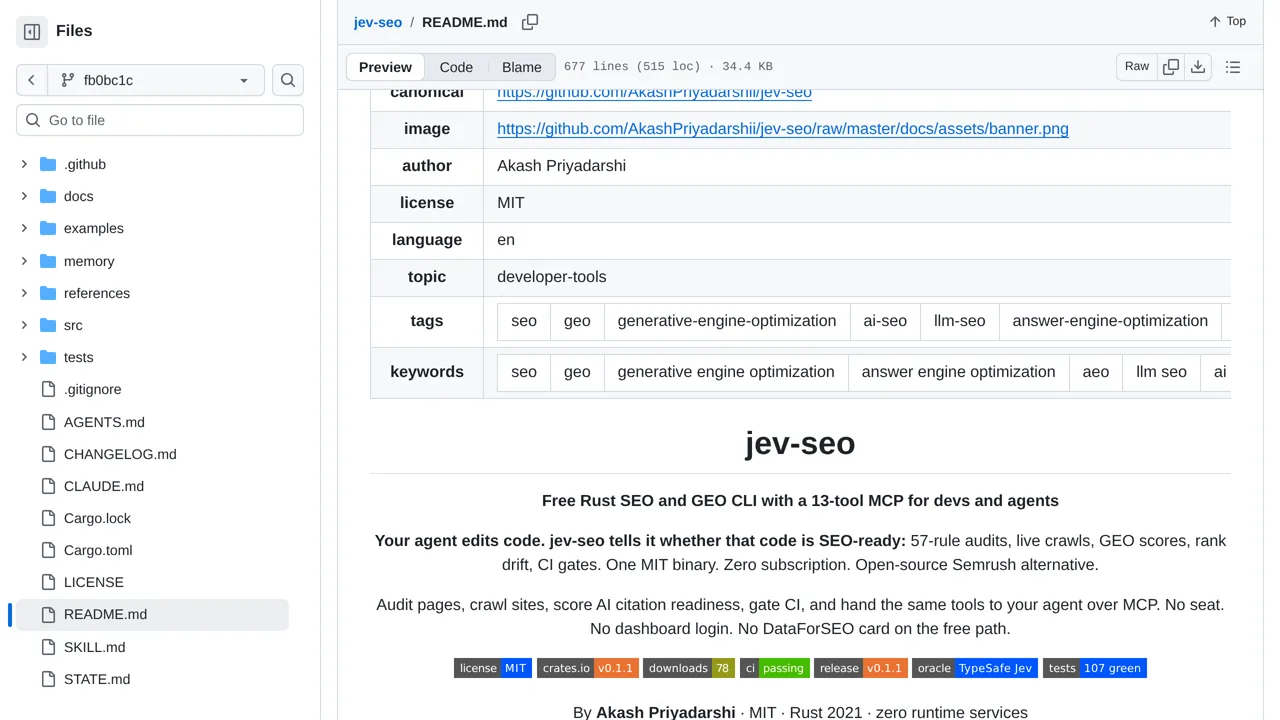 Experiment
jev-seo
Gives coding agents a Rust CLI and MCP server for deterministic SEO checks, live crawls, and optional Jev judgements.
Why “#1 in seconds” is the wrong test
Search position is an outcome. Google and the competing pages set it, over days or weeks, after a page is crawled and indexed. A tool can speed up the work that precedes ranking; it cannot make the ranking happen in seconds. Our earlier report, from sampled frames of the demo, described a mock-up with “Writing 538 new articles” and “Updating 34 old posts” while every keyword showed “#1”. Volume framing like that also runs into a rule Google has published.
Scaled content abuse is when many pages are generated for the primary purpose of manipulating search rankings and not helping users.
Google Search Central, spam policies, read 25 November 2026
The same policy says this applies “no matter how it’s created”, and lists using generative AI to produce many pages without adding value as an example. We are not saying Conqueror does that. Its About page describes a human approval step for every change, which is the right place to apply this test. We are saying a promise measured in thousands of keywords and seconds invites it.
A fairer test (our suggestion)
- Name the site and 20 to 50 target keywords, and record current positions from Search Console first.
- Make every change through the approval step, and keep the before and after text.
- Leave comparable pages untouched as a control.
- Measure after weeks, not seconds, and publish the data with dates.
- If a Jev setting exists, repeat with it off, so its contribution can be separated.
Open questions
Is Jev called when a user runs Conqueror?
Nothing public says so. A plain yes or no from Conqueror would settle readings A, B and C quickly.
Which decisions would Jev make?
Keyword intent, page selection, draft scoring or something else. Each has a different failure mode and a different way to test it.
Is TypeSafe AI involved?
The post tags TypeSafe AI, and anyone can use Jev through its public API. A tag is not a partnership, and we found no statement either way.
What does “#1” measure?
Which keywords, in which country, on which date, for how long, on which site? The post defines none of these.
How do “publish live” and “nothing goes live without your approval” fit together?
Both phrases appear on Conqueror’s own pages. They are probably compatible, with “publish live” meaning after approval, but the wording is worth confirming.
What to watch
- A write-up from Conqueror or TypeSafe AI saying where, if anywhere, Jev runs.
- Named sites with dated before and after ranking data.
- A Jev page or setting appearing on conquerorapp.com.
- Whether the next post on the template names yet another model.
 Jev News · Ecosystem & Tools
Ch Daniel announces "Jev for SEO" in Conqueror, claims #1 rankings in seconds
Ch Daniel says Conqueror now offers Jev-based SEO that ranks a site for thousands of keywords in seconds. The claim is unverified, and Conqueror's own pages do not mention Jev.
 Jev News · Benchmarks & Research
Can you trust Jev’s probabilities? What two months of tests found
TypeSafe promises that higher confidence means higher accuracy. Preprints from Carnegie Mellon and others, and benchmarks from Arize and Liquid AI, test that promise and do not agree.
Sources
- Daniel Ch (@chddaniel), “Introducing Jev @typesafeai for SEO”, X, 24 November 2026
- Daniel Ch, “Meet Claude for SEO”, X, 16 November 2026; “Today we’re introducing Claude Code for SEO”, X, 2 November 2026
- Valentin Florez, reply, X, 24 November 2026; serpyn, reply, X, November 2026; Allie the Icon, X, 17 November 2026
- Conqueror: home, About, pricing, MCP, AI agents, founder page, page sitemap, all read 25 November 2026; conqueror-skills on GitHub
- TypeSafe AI documentation, System One; Vercel, TypeSafe API with AI Gateway
- InfoQ, “TypeSafe AI Releases Jev”, 1 October 2026; TechCrunch, 18 September 2026; Latent Space, “The Jev Revolution”, 12 November 2026
- Screpy, “Jev SEO: How to Use TypeSafe AI’s Jev in SEO Workflows”, Mustafa Aydemir, 22 September 2026
- Julian Goldie SEO, “Jev AI: How to Rank #1 with Jev AI SEO”, YouTube, 19 September 2026; AI Profit Boardroom, “Jev For SEO And GEO”, 24 September 2026
- Google Search Central, spam policies
- JevMade: our short report on the post
- Counts are as read on 25 November 2026, about a day after posting. X rounds large numbers and they change. When their pages were captured, the 2 November post showed 56.4K views and the 16 November post 25.8K, so compare the three with care. ↩︎
- The frames come from our earlier article. We did not re-watch the video for this piece. ↩︎
- Julian Goldie names the developer as Hassan and gives about a quarter of a second per query. We could not trace the original. ↩︎