Can you trust Jev’s probabilities? What two months of tests found
TypeSafe promises that higher confidence means higher accuracy. Preprints from Carnegie Mellon and others, and benchmarks from Arize and Liquid AI, test that promise and do not agree.

When Jev says it is 90% sure, how often is it right? That question decides whether software can act on its answer without a person checking it, and it is the promise TypeSafe AI makes for its model: “Calibrated: higher confidence means higher accuracy.”
In the two months since launch, university labs, benchmark makers and independent developers have tested that promise. Their answers do not agree. This article sets out what each test measured, what it found, and what it means for anyone setting a threshold.
In short
- A Carnegie Mellon preprint finds that accepting Jev’s confident verdicts and escalating the rest beats GPT-6 alone at 41% of its fee.
- Other preprints find its probabilities do not always add up and lose their promise outside English. A benchmark finds one hosted model, which it does not name, underconfident.
- Every study that tuned a threshold on its own data did better than the default.
What TypeSafe promises
Jev’s launch post says “all answers are accompanied with calibrated probabilities and confidence scores.” The company’s documentation explains that the confidence value is worked out from the probabilities: “It is 1 when all the probability is on one outcome and 0 when the probability is spread evenly.”
The same page warns against a single cut-off. “A confidence threshold is not one number,” it says. “Different actions within the same system should use different thresholds depending on the consequences of getting it wrong.” It suggests starting with ranges: at high confidence, “act automatically”; at medium confidence, “proceed with caution”.
The launch post is also plain about one claim that is often misread. Its charts put Jev’s hallucination rate at 0%, and a note under them explains: “Our number is not empirical. Schema matching is guaranteed, thus we can confidently add 0% into the plots.”1 A model that can only pick from your options cannot invent a new one. It can still pick the wrong one.
- Probability
- The share the model puts on each answer. For a yes or no question, the two add up to one.
- Calibrated
- Answers given with 80% probability are right about 80% of the time.
- Confidence
- TypeSafe’s single number for how concentrated the probabilities are: 1 when all of it is on one answer, 0 when it is spread evenly.
- Threshold
- The probability above which your code acts on its own and below which it asks a person.
- Calibration error
- The gap between the probabilities a model states and how often it is right. Lower is better.
The Carnegie Mellon cascade
The most detailed test so far is “JEV-as-a-Judge: Accept When Confident, Escalate When Unsure”, a preprint by Yubo Li, Yidi Miao, Ramayya Krishnan and Rema Padman of Carnegie Mellon University, first posted on arXiv on 22 September. It uses Jev as a judge that grades other models’ answers, and compares it with sixteen other judges.
Its abstract says Jev “comes within three points of GPT-6 wherever a verdict can be read off the text, at 0.36% of its fee and a 0.15-second median latency, and falls behind where the verdict must be derived, as in math, code, and logic.” Jev’s confidence, the authors write, “marks this boundary”.
Accepting confident verdicts and escalating the rest is 0.9 points more accurate than GPT-6 on 1,610 held-out pairs at 41% of its fee.
Li, Miao, Krishnan and Padman, Carnegie Mellon University, arXiv:2609.26550
The cascade has limits the authors name: “Confidence routing weakens on style-adversarial pairs and reference-free prose.” They end with a recipe for checking thresholds on your own data, which is the advice almost every study below repeats.
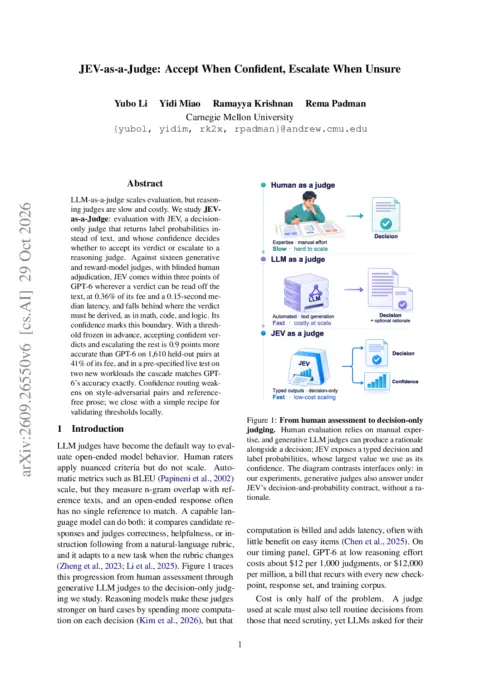 JEV-as-a-Judge: Accept When Confident, Escalate When Unsure (Li, Miao, Krishnan and Padman, arXiv:2609.26550, CC BY 4.0)
PDF 53 pages 2 MB arxiv.org
DownloadKrishnan is the W. W. Cooper and Ruth F. Cooper Professor of Management Science and Information Systems at Carnegie Mellon’s Heinz College, and its dean emeritus: his faculty profile says he served three terms as dean, from 2009 to 2025.

Do the numbers add up?
A calibrated model should also be coherent: the chance that a label is X and the chance that it is not X should sum to one. A preprint posted on 27 September, “Beyond Calibration: Do a Typed-Decision Model’s Probabilities Obey the Probability Axioms?”, asked Jev both questions about the same items.
On 480 such pairs, Jev’s two answers “miss summing to one by 0.064 on average (95% CI 0.055 to 0.072)”. An open model, Qwen3.8-27B, missed by 0.293 when its probabilities were read from its first token, and by 0.122 when it was asked to state them. Jev did better, but the authors still conclude that “Jev is not coherent either”: its three single-label probabilities “sum to 1.14 on average”.
0.064
Jev’s average miss when “X” and “not X” should sum to one
1.14
what three labels that should total 1 add up to on average
8 of 51
locales where a 95% promise calibrated in English held
TypedBench, a benchmark posted on 8 October “for typed decision models like Jev”, tested one hosted model against open ones. It found the hosted model “follows the stated policy but is wording-sensitive and systematically underconfident; under asymmetric costs, using its probabilities can be worse than taking its top answer.” The abstract does not name the hosted model.
A promise about groups, not single answers
“Confidence Is Not a Promise: A Reference Audit of Typed Decision Models”, posted on 26 October, makes a sharper point. A calibrated probability is a statement about many decisions together. A system that promises a level of accuracy on the cases it handles alone keeps that promise only if the threshold is checked against a lower bound, on data like its real traffic.
Across 190 exchangeable evaluations,
  a threshold chosen by point estimate   breaks the promise in 147;
  Learn then Test                        keeps it in all of them.
Calibrated in English, Jev keeps a promise of 95% in 8 of 51 locales.
Those lines are from the paper’s abstract, set out as a table. Learn then Test is a statistical method for choosing a threshold with a guarantee. The abstract also says that “ordinary typing noise breaks a promise calibrated on clean text.”
Tuning the cut-off
Hamel Husain’s evaluation guide, published on 20 October, starts from the same place. Decision APIs turn a score into a yes or no with “a default decision threshold of 0.50”, he writes, and people use it “without checking whether it works well for their task”. A model could give every failure a score of 0.40 and every pass 0.10: it separates them perfectly, yet at 0.50 it flags nothing.
JevMade’s notes on his guide:
 Written guide
Tune the cut-off before you judge a decision model
Hamel Husain and Antaripa Saha use six decision models to check an apartment-leasing AI for mistakes, and show how to set, compare and trust their scores.
In practice, tuning means labelling a few hundred real cases, then picking the lowest threshold whose accuracy on those cases stays above what you need. The sketch below is ours, not TypeSafe’s code, and it uses a point estimate: the “Confidence Is Not a Promise” paper above explains why a lower bound is safer.
# labelled: list of (probability, was_correct) from your own traffic
def lowest_safe_threshold(labelled, target=0.95, minimum_cases=50):
    for threshold in [t / 100 for t in range(50, 100)]:
        kept = [ok for p, ok in labelled if p >= threshold]
        if len(kept) >= minimum_cases and sum(kept) / len(kept) >= target:
            return threshold
    return None  # no threshold is safe: send everything to a person
What the benchmarks say
Arize compared eight decision models on 7 October, scoring each on spotting hallucinations in the RAGTruth set, on its own evaluator suites, on routing and on calibration.
| Model | Hallucination (RAGTruth) | Evaluators | Routing | Calibration error | Latency (p50) | Cost per 1,000 |
|---|---|---|---|---|---|---|
| Jev 1.13 | 85.5% | 91.1% | 49/52 | 0.023 | 0.08 s | $0.045 |
| Clef 27B | 85.2% | 91.5% | 50/52 | 0.062 | 0.50 s | $0.223 |
| Liquid d1 | 84.8% | 87.6% | 48/52 | 0.051 | 0.20 s | $0.034 |
| OpenAI Decisions | 81.5% | 90.0% | 48/52 | 0.042 | 0.16 s | $0.090 |
| Jeeves 9B | 80.3% | 87.1% | 48/52 | 0.043 | 16.8 s | $0 (local) |
Arize reports Jev’s 85.5% against OpenAI’s 81.5% but calls accuracy a draw, because “the confidence intervals touch by a tenth of a point”. Jev’s calibration error was the lowest in the table. Arize also asked each question both ways round (“is every claim supported?” and “does it contain an unsupported claim?”). “Only Jev, Clef 27B and OpenAI held their pose.”
Rivals measure differently. Liquid AI’s d1.2 announcement on 16 November gives calibration errors across 13 benchmarks and 22,505 questions: 0.8 points for its own d1.2-ultra, 1.2 for d1.2, 2.7 for Jev 1.14, 3.7 for Perplexity’s Decider v1.3 and 7.2 for GPT-6 Luna on OpenAI’s Decisions API. That is a vendor scoring itself first.
When an attacker writes the options
Calibration says nothing about an adversary. “One Word Opens the Gate”, posted on 8 October, tested typed decision models used as guardrails for AI agents. It tested open-weight models, not Jev. Renaming the permissive option, “with its definition and the judged text untouched”, raised the rate at which the gate let things through to between 93% and 100% on four of them.
Escalating the least confident decisions does not help either: a decision an attack has reversed is no less confident than the one it replaced.
“One Word Opens the Gate”, arXiv:2610.12292
The same paper found that turning each policy field into a typed value removed one attack, but then “a deterministic rule over those values reaches 100% accuracy on all six policies”. Sometimes the answer is ordinary code.2
Is “underconfident” a problem?
Less than overconfidence, but yes. If a model says 70% when it is right 90% of the time, a threshold set at 85% sends work to people that the model would have got right. You pay for reviews you did not need, which is why TypedBench says using such probabilities “can be worse than taking its top answer” when mistakes cost different amounts.
What to do with it
- Label a sample of your own traffic before trusting any threshold, including TypeSafe’s suggested ranges.
- Use a different threshold for each action, set by what a mistake costs.
- Check again for each language, each new wording of a question and each model version.
- Do not let untrusted text name the options a guardrail chooses between.
Sources
- TypeSafe AI: Introducing System One Models and Jev; TypeSafe docs: Confidence
- arXiv:2609.26550, JEV-as-a-Judge; Heinz College: Ramayya Krishnan
- arXiv:2609.33209, Beyond Calibration; arXiv:2610.11392, TypedBench
- arXiv:2610.36311, Confidence Is Not a Promise; arXiv:2610.12292, One Word Opens the Gate
- Arize: Decision model benchmark; Hamel Husain: How To Use Decision Models for Evals; Liquid AI: d1.2
- TypeSafe AI, launch post, 15 September 2026, in its notes on the comparison charts. The same notes say the language-model figures come from OpenRouter and that “there almost certainly is bias here”. ↩︎
- The abstract adds that these models “can reduce how many cases reach a reviewer”. Its six policies are the authors’ own test set. ↩︎