Education Tests Jev: a Marking Trial Falls Short as a King’s College Model Targets Assessment
Examplary found Jev agreed with teachers 62% of the time against 81.5% for its own model. King's College London researchers released a marking-focused decision model, and a UK schools checker rates Jev amber for staff and red for pupils.

Marking is a natural fit on paper for a model that returns a typed score and a probability instead of prose: pick a rubric level, check a marking point, flag the uncertain cases for a teacher. Three public sources from the past two months show how that idea holds up in education. One is a failed production trial, one is a research model built specifically for assessment, and one is a data-protection rating aimed at UK schools.
In short
- Examplary’s own test: Jev matched teacher scores exactly 62.0% of the time, against 81.5% for the model it already uses. It was about ten times faster, and the team did not adopt it.
- King’s College London researchers report an open 4B model, EDU-Jev, that beats five commercial decision APIs on their education benchmarks, with caveats the authors list themselves.
- AI Prefect, an independent UK schools checker, rates Jev amber for staff use and red for pupil use, based on the supplier’s published terms.
- A marking trial that did not make the cut
- EDU-Jev: a model trained for assessment
- Open projects that keep the teacher in charge
- What UK schools are told about data
- Sources
A marking trial that did not make the cut
On 29 September 2026, Thomas Schoffelen published results from testing Jev on the evaluation set behind Examplary, a test-building tool that grades student answers with AI. The set holds 14,659 student answers that were scored by the product’s existing models and then reviewed by a teacher. The author compared each candidate with the teacher’s scores using exact agreement and quadratic weighted kappa (QWK), a measure that penalises big disagreements more than small ones, where 1 is perfect and 0 is chance.
62.0%
Jev exact agreement with teachers
81.5%
existing Examplary model
0.65 vs 0.83
QWK, Jev against baseline
3,000 → 300 ms
grading time, as the author reports it
| Model | Exact agreement | QWK |
|---|---|---|
| Examplary baseline (current model) | 81.5% | 0.83 |
| Jev | 62.0% | 0.65 |
| Jev without multiple choices | 61.7% | 0.65 |
| laya-finetuned-v1 (open, fine-tuned) | 37.4% | 0.19 |
| laya-typed-decisions (open) | 38.1% | 0.10 |
| laya-multilingual (open) | 49.7% | 0.01 |
| laya-multilingual without multiple choices | 52.6% | 0.01 |
The author lists why the speed and price advantage did not outweigh the accuracy gap for this product. Open the list to see each blocker.
The four obstacles the author names
- Region: no way to choose where Jev runs, which matters because Examplary can be fully hosted in the EU.
- Modality: Jev accepts only text, while the product increasingly handles images, documents, audio and video.
- Context: grading is grounded in teachers’ uploaded source material, so complex questions often cross Jev’s 32,000-token input limit.
- No reasoning: Jev returns a decision and a probability, so teachers cannot see why a grade was given and the same call cannot write feedback.
For this use case, those advantages don’t currently outweigh the disadvantages. It is interesting for other use cases, though, like flagging safeguarding issues that teachers should be notified about.
Thomas Schoffelen, “Can Jev AI improve grading and marking accuracy?”, 29 September 2026
This is one team’s test on its own data, written up on a personal blog, and JevMade has not reproduced it. It is useful because it is a negative result from a team that wanted the speed: the model was fast and cheap, and still lost on accuracy and constraints.
EDU-Jev: a model trained for assessment
On 29 October 2026, Jiazheng Li and Yulan He of King’s College London posted a preprint on EDU-Jev, a family of open “System One” decision models at 0.8B, 2B and 4B parameters. They take an assessment context and a question with fixed options, then return a probability for each option in one pass. The models are built on Qwen3.5 bases and trained on about 1.5 billion tokens of typed decisions for tasks such as rubric scoring, checking marking points, verifying solution steps and diagnosing errors. The authors evaluated hosted Jev through its version 1.14 API alongside four other commercial decision APIs.
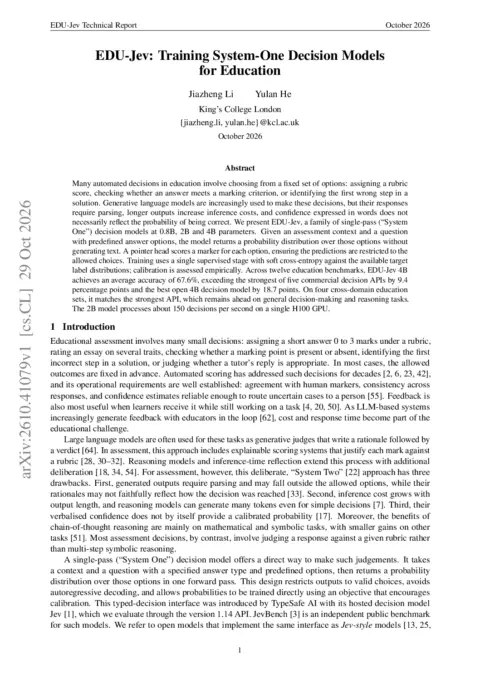 EDU-Jev: Training System-One Decision Models for Education (arXiv:2610.41079)
PDF 16 pages 293 KB arxiv.org
| Model | Education average (12 sets) | General decisions average |
|---|---|---|
| EDU-Jev 4B | 67.6% | 84.3% |
| EDU-Jev 2B | 63.2% | 78.1% |
| EDU-Jev 0.8B | 62.8% | 70.6% |
| pplx-decider v1.2 (API) | 58.2% | 90.5% |
| Drex Max (API) | 57.9% | 91.0% |
| Cloudflare Clef (API) | 54.4% | 87.5% |
| Jev 1.14 (API) | 51.0% | 88.9% |
| OpenJev-4B (open) | 48.9% | 85.6% |
| Microsoft Decision-1 (API) | 49.2% | 89.1% |
The 4B model leads the best API on the education average by 9.4 points (67.6 against 58.2). The lead is concentrated in task families the model was trained on. On the four cross-domain education sets, it scores 55.2% against 55.4% for the best API, a difference the authors call not statistically significant. The hosted APIs, including Jev, stay ahead on general decisions and most reasoning tasks. The authors also report that the 2B model processes about 150 decisions per second on a single H100 GPU.
It is not intended for high-stakes decisions about individual students without human oversight.
Li and He, EDU-Jev preprint, intended-use statement
The authors’ own limitations section matters as much as the headline. They say the comparison is not fully independent, since their data includes typed-decision training data and synthetic labels from third-party decision models. The models are research-only, trained mostly on English and Chinese, text only, not evaluated with teachers in the loop, and not audited for bias across student populations, languages or writing styles. The preprint’s calibration error is lower than the hosted APIs on in-domain sets but rises on unseen datasets.
Open projects that keep the teacher in charge
Community code shows the pattern both sources point to: Jev scores or checks, and a person confirms. The independent case library at typesafe-jev.com describes an open grader that checks written exam answers against instructor-approved rubric items, sends low-confidence items to a second model, produces no recommendation when the two disagree, and leaves the final score to a human grader. It notes that the authors report a synthetic evaluation and that the site used no student data. Separately, the awesome-typesafe-jev list includes a sidecar that grades a student’s cloud attack-path writeup against an answer key using three yes/no questions and a depth score.
What UK schools are told about data
AI Prefect, an independent research project that rates AI tools for UK schools from suppliers’ published documents, last checked Jev on 3 November 2026. It is explicit that its rating is not legal advice and does not replace a school’s own data protection impact assessment.
| Question | AI Prefect’s recorded answer |
|---|---|
| Staff use | Amber, use with caution |
| Pupil use | Red, not recommended for school data |
| Trains on inputs | No, per the supplier’s help page |
| Where data is processed | United States, per the supplier’s help page |
| Data processing agreement | Not stated |
| Processor or controller | Not stated |
| Minimum age | Not stated |
The reasons for red are that the supplier says the product is not for pupils. The reasons for amber include that no school data processing agreement was found and that safeguards for non-UK processing are not stated. This matches the Examplary author’s note that region control was a blocker for an EU-hosted product.
Sources
- Can Jev AI improve grading and marking accuracy?, Thomas Schoffelen, 29 September 2026
- EDU-Jev: Training System-One Decision Models for Education, Jiazheng Li and Yulan He, King’s College London, 29 October 2026
- Jev (TypeSafe AI) on AI Prefect, last checked 3 November 2026
- Jev case library, typesafe-jev.com (independent)
- awesome-typesafe-jev, community list on GitHub