Independent Tests of Jev’s Cost Claims Find a Huge Edge Over Flagship Models and a Narrow One Over Cheap Ones
Vals AI, two Leiden University political scientists and a data scientist each tested Jev. Its price claim held against flagship models, shrank against budget ones, and calibration and accuracy varied by task.

TypeSafe AI’s launch post says Jev is “193.6x faster, 444.6x cheaper” than frontier language models. The same post calls that “on the higher end of real world gains” and admits that its own team built the workflows behind it. In the weeks since, three groups with no stake in the answer have run their own numbers.
Vals AI, an evaluation company, tested Jev against eleven other systems on claims drawn from US company filings. Two political scientists at Leiden University replicated seven published studies. A data scientist writing for Towards Data Science rebuilt Jev’s probability interface with scikit-learn and compared the two. Their results agree on more than the headlines suggest, and the places where they differ are the useful part.
In short
- Against flagship models, Vals measured Jev at about 1/498th of GPT-6 Astra’s cost on one task, close to TypeSafe’s own 444.6x figure.
- Against budget models the edge shrinks: about three times cheaper than GPT-6 Luna in the Vals test, and no cheaper than Luna at batch prices in the Leiden test.
- Accuracy and calibration depended on the task. Jev tied the leaders on claim verification and finished last on a legal-reasoning slice.
- The claim being tested
- Vals AI: 400 claims and 396 legal questions
- A rival on the same test
- Leiden: seven political science replications
- Scikit-learn against Jev on BANKING77
- What the three tests say together
- Test it on your own work
- Claim verification
- Reading a source passage and a claim, then answering whether the passage supports the claim, contradicts it, or says too little to tell.
- Calibration error (ECE)
- The gap between the confidence a model states and how often it is right. Lower is better; 0 means perfectly calibrated.
- Class-balanced accuracy
- Accuracy averaged over each possible answer, so a model cannot score well by always giving the most common answer.
- Error budget
- The share of automated decisions you can afford to get wrong. A threshold is set so that confident answers stay within it and the rest go to a person or a stronger model.
- Batch pricing
- A discounted rate some providers offer when requests can wait, rather than being answered straight away.
The claim being tested
The 193.6x and 444.6x figures come from TypeSafe’s “workflow evals”, a set of multi-step tasks the company ran against the average of GPT-6 Astra and Claude Fable 5.1. TypeSafe’s launch post, dated 15 September 2026, spells out the limits itself.
The content of these workflows was not deliberately chosen nor constructed to make our model look good, and is not in our training distribution. However, they were made by individuals on our model capabilities team, so some bias could exist.
TypeSafe AI, “Introducing System One Models & Jev”, 15 September 2026
The post also says Jev is priced at $0.042 per million input tokens with free output, and that its response time is “70ms-500ms”. It adds that the company “can’t prove” the pricing is not subsidised. Those are the numbers each test below checks, using different tasks.
Vals AI: 400 claims and 396 legal questions
On 6 October 2026, Connor Frank of Vals AI published “An Independent Evaluation of TypeSafe’s Jev”. Vals normally scores written answers, so it built two tests that a typed model can take. The first has 400 claim-verification items made from the latest 10-K filings of 48 large US companies, 80 items in each of five categories. A Gemini model wrote the paraphrases and contradictions, but the correct answers come from the construction rule, and Vals says a person audited every item. The second is a preregistered slice of LegalBench: 12 subtasks with 33 questions each.
97.5%
Jev’s accuracy on 400 claim-verification items, tied with GPT-6 Astra, GPT-6.1 Sol and GPT-6 Luna
1/498
Jev’s cost compared with GPT-6 Astra on that task, as Vals measured it
12 of 12
Jev’s rank from the bottom on the LegalBench slice, on raw and class-balanced accuracy
For bounded verification over a document, Jev sits within noise of every system we tested.
Vals AI, 6 October 2026
Price: it depends who you compare with
Vals confirms the headline against a flagship: it measures 1/498th of Astra’s cost against TypeSafe’s 444.6x. It then adds a line that matters for budget decisions: “Even cheap LLMs can often match Jev’s performance but are still several times more costly.” GPT-6 Luna scored 0.975 on claim verification at $0.08 per 1,000 cases, which Vals calls Jev’s score “at about three times its price”.1
| System | Cost per 1,000 claims, label plus probability |
|---|---|
| Jev 1.13.0 | $0.02 |
| GPT-6 Luna | $0.10 |
| DeepSeek V4.1 Flash | $0.55 |
| Claude Haiku 4.5 | $0.95 |
| GPT-5.6 Terra | $2.42 |
| GPT-5.4 mini | $2.71 |
| GPT-6.1 Sol | $3.52 |
| GPT-5.6 Sol | $3.72 |
| Claude Sonnet 5.5 | $4.95 |
| Gemini 4 Argon | $6.46 |
Speed: flat as questions pile up
Vals asked each system for 1 to 64 judgments about one long document. Jev’s latency rose only from 0.10 seconds to 0.12 seconds. GPT-6 Astra took 38 seconds and Gemini 4 Argon 65 seconds at 64 judgments. At 32 judgments Jev’s median was 194x lower than Astra’s and 241x lower than Gemini 4 Argon’s; on single judgments under load it was 47x lower than Astra’s. Vals notes that TypeSafe’s own latency figure covers a multi-step workflow, so the two numbers are not the same test, and that it measured from one machine on a residential connection.
Legal reasoning: where it fell behind
On the LegalBench slice, GPT-5.6 Terra led with class-balanced accuracy of 0.932. Jev came last at 0.730, a hair behind Claude Haiku 4.5 at 0.732, and every other system’s lead on raw accuracy was statistically reliable. Jev struggled most on two contract-entailment subtasks. On contract_nli_permissible_copy it answered “Yes” to all 33 items, where the gold answers split 16 yes and 17 no. Every LLM scored 0.91 to 1.00 on these subtasks. Vals cautions that each subtask has only 33 items and that LegalBench is public and “probably sits in the LLMs’ training data”.2
Calibration did not travel between tasks either. Jev’s calibration error was 0.011 on claim verification, the lowest of the twelve, and 0.108 on LegalBench, the highest. Vals says some of that rise is mechanical, because errors grow as accuracy falls, but “a calibration measured on one task did not hold on the other.”
The error-budget test
Vals then asked how much work each system could automate within a 1% error budget. It set a confidence threshold on 30% of the claims and applied it to the other 70%. Six of the twelve systems went over budget on the held-out items. Jev automated 95% of them at 1.6% error.
| Router | Share automated | Realised error |
|---|---|---|
| Claude Sonnet 5.5 | 100% | 0.4% |
| Gemini 4 Argon | 100% | 0.8% |
| Claude Opus 5.5 | 99% | 0.4% |
| GPT-6.1 Sol | 99% | 1.9% |
| GPT-6 Astra | 99% | 1.5% |
| GPT-6 Luna | 97% | 1.9% |
| GPT-5.6 Sol | 97% | 1.6% |
| DeepSeek V4.1 Flash | 96% | 0.8% |
| Jev 1.13.0 | 95% | 1.6% |
| GPT-5.6 Terra | 94% | 1.2% |
| GPT-5.4 mini | 84% | 0.9% |
| Claude Haiku 4.5 | 22% | 0.0% |
The lesson Vals draws is about method, not about Jev: “Step 4 is easy to skip”, it writes of reading the realised error on fresh data, “and it showed six of our twelve systems exceeding the budget they were tuned for.” In hindsight, sweeping the threshold over all 400 items would have let Jev automate 91% within budget, against 100% for Opus 5.5, Sonnet 5.5 and Gemini 4 Argon. Vals also says Jev’s confidence score “tracks its probability distribution almost exactly and adds no additional signal”.
Why does a 95% automation rate at 1.6% error count as a miss?
Because the threshold was chosen to hit 1% on the tuning claims and then failed to hold on new ones. That is the ordinary cost of picking a threshold from a small sample. Six systems did it, including several frontier models, so it says more about threshold tuning than about Jev. JevMade’s earlier piece on whether Jev’s probabilities can be trusted covers other studies that found the same thing.
A rival on the same test
Two days later Vals ran Inception’s Mercury Decide through the identical benchmarks. Mercury Decide works the same way as Jev: a state and a list of allowed answers go in, and one probability per option comes back in a single call. Inception prices it at $0.021 per million input tokens, half of Jev’s rate.
| Measure | Jev 1.13.0 | Mercury Decide |
|---|---|---|
| Claim verification accuracy | 0.975 | 0.978 |
| Cost per 1,000 claims | $0.025 | $0.006 |
| LegalBench accuracy | 0.740 | 0.869 |
| LegalBench class-balanced accuracy | 0.730 | 0.821 |
| Latency, one judgment / 64 judgments | about 0.1 s / about 0.1 s | 0.16 s / 0.40 s |
| Cost of one 64-question call | $0.00016 | $0.0022 |
| Automated at a 1% budget | 95% at 1.6% error | 94% at 0.8% error |
Mercury Decide is cheaper per claim and much better on the contract-entailment subtasks, where it scored 0.970 on both against Jev’s 0.485 and 0.576.3 Jev wins on speed at scale and on the cost of many questions about one document, because Mercury Decide bills more input tokens as the question count grows, from about 1,700 at one judgment to about 106,000 at 64. Vals’s summary: “If you ask many questions about the same document in one call, Jev’s latency and cost scale better.”
Leiden: seven political science replications

Steven Denney and Matthew DiGiuseppe, both at Leiden University, posted “JEV versus LLMs: Accuracy, Cost and Calibration on Seven Political Science Replications” to arXiv on 5 October 2026, a 71-page paper. They took seven published studies in which language models had been used to annotate tweets, code conflict events or scale political text, re-ran each with Jev, and compared it with the original models and with two current ones: OpenAI’s GPT-6 Luna and the open-weight Qwen3.8-27B.
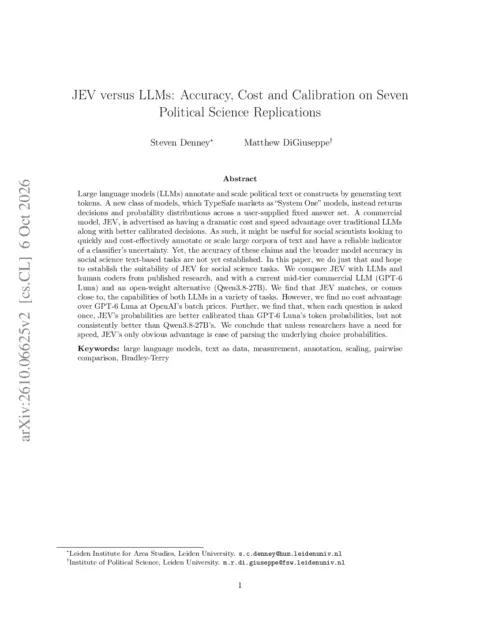 JEV versus LLMs: Accuracy, Cost and Calibration on Seven Political Science Replications (Denney and DiGiuseppe, arXiv:2610.06625)
PDF 71 pages 724 KB arxiv.org
DownloadWe conclude that unless researchers have a need for speed, JEV’s only obvious advantage is ease of parsing the underlying choice probabilities.
Denney and DiGiuseppe, arXiv:2610.06625, abstract, 5 October 2026
The abstract says Jev “matches, or comes close to, the capabilities of both LLMs in a variety of tasks”, but that the authors “find no cost advantage over GPT-6 Luna at OpenAI’s batch prices”. The cost and speed table in the paper shows why.
| Replicated study | Jev, $ per 1,000 | Luna batch | Luna standard | Qwen3.8-27B | Jev, s per decision | Luna, s per decision |
|---|---|---|---|---|---|---|
| Gilardi et al. (2023) | 0.017 | 0.017 | 0.034 | 0.085 | 0.09 | 0.77 |
| Ornstein et al. (2025) | 0.024 | 0.012 | 0.025 | 0.128 | 0.26 | 0.75 |
| Brandt et al. (2026) | 0.027 | 0.018 | 0.035 | 0.139 | 0.27 | 1.04 |
| Weidmann et al. (2026) | 0.020 | 0.012 | 0.024 | 0.058 | 0.26 | 0.75 |
| Di Leo et al. (2025) | 0.018 | 0.008 | 0.016 | 0.042 | 0.25 | 0.78 |
| DiGiuseppe and Flynn (2026) | 0.012 | 0.012 | 0.024 | 0.058 | 0.13 | 0.78 |
| Le Mens and Gallego (2025) | 0.014 | 0.009 | 0.019 | 0.058 | 0.13 | 0.87 |
$7.17
what 510,681 GPT-6 Luna batch requests cost the authors in one appendix comparison
156
decisions per second for Jev on the fastest application, against 18 for Luna
74%
of Luna’s probabilities sat below 0.01 or above 0.99 in one replication, against 18% for Jev
Accuracy was mixed, and the paper is careful about it. On the 2021 content-moderation tweets, GPT-6 Luna reached 91.1% accuracy against Jev’s 89.0%, with the paired interval excluding zero. On conflict event types Jev reached accuracy of 0.715 and macro F1 of 0.555 against Luna’s 0.709 and 0.544, which puts Luna level on F1. The fine-tuned conflict models ConfliBERT and ConflLlama stayed ahead, but the authors note that researchers starting a new task will rarely have the labelled data those models were trained on.
On calibration, the paper reports that when each question is asked once, Jev’s probabilities are better calibrated than Luna’s token probabilities, “but not consistently better than Qwen3.8-27B’s”. The authors also say TypeSafe “provides no technical account from which we can verify” how Jev’s parallel evaluation works, and that the API offers no determinism guarantee: it takes no temperature or seed.
Scikit-learn against Jev on BANKING77
The third test is the smallest and the most hands-on. Ankur Tomar, writing for Towards Data Science on 10 November 2026, asked whether Jev’s calibration is special or just what a simple, properly tuned classifier gives you. He trained naive Bayes and logistic-regression models on BANKING77, a public set of 10,003 training and 3,080 test banking queries across 77 intents, then ran the same tests against the real Jev API. The whole Jev run was 6,540 calls and cost $0.80. His code and raw responses are published under the MIT licence.
| Task and model | Accuracy | Calibration error (ECE) |
|---|---|---|
| 7 intents, logistic regression plus temperature | 0.975 | 0.022 |
| 7 intents, Jev Choice questions | 0.975 | 0.014 |
| 77 intents, logistic regression plus temperature | 0.888 | 0.031 |
| 77 intents, Jev with three examples per intent | 0.859 | 0.065 |
| 77 intents, Jev with terse criteria | 0.801 | 0.083 |
On the seven-intent slice the two were indistinguishable: the paired difference was 0.008 with an interval of −0.004 to 0.020. On the full 77 intents the open model was better calibrated, 0.031 against 0.065, although Jev used no training data and at most three examples per intent while the open model learned from 10,003 labelled queries. Jev’s yes-or-no (Noul) answers were underconfident on true cases: mean probability of yes was 0.84, and only 56% cleared 0.9.
What is the “none-of-the-above” trap?
If a typed model must choose from a fixed list and the true answer is not on it, it picks something anyway, and may do so confidently. Tomar tested queries outside the schema: with no “none of these” option, 29% were auto-acted on by his temperature-scaled model and 26% by Jev at a 0.90 threshold. His fix is cheap: give the schema a way out. He did not test an explicit “none of these” option on Jev, so how much it helps there is untested.
His conclusion is modest. Jev’s contribution, he writes, is “the contract: typed questions in, checkable probabilities out, and abstention as a branch your code can take”. He lists his own limits: one dataset, small Jev samples, operating points picked on the test set, and the chance that Jev saw BANKING77 in training, which would make its accuracy numbers optimistic.
What the three tests say together
Put side by side, the findings are less contradictory than they look. The table is JevMade’s summary of what each source reports.
| Question | Vals AI | Leiden | Tomar | Consistent? |
|---|---|---|---|---|
| Is it cheap against flagships? | Yes, about 1/498th of Astra | Not tested against flagships | $0.80 for 6,540 calls | Yes |
| Is it cheap against budget models? | About 3x cheaper than Luna | No edge over Luna batch, about 2x over Luna standard in most tasks | Not tested | Roughly, once batch pricing is counted |
| Is it fast? | 0.1 s regardless of questions per document | 0.09 to 0.27 s against 0.75 to 1.04 s for Luna | Not measured | Yes |
| Is it accurate? | Ties the leaders on claims; last on legal slice | Matches or comes close to LLMs; Luna ahead on some tasks | 0.975 on 7 intents; 0.801 to 0.859 on 77 | Task-dependent in all three |
| Is it well calibrated? | 0.011 on claims; 0.108 on legal slice | Better than Luna; not consistently better than Qwen | 0.014 on 7 intents; 0.065 on 77 | Task-dependent in all three |
One inference, ours and not the studies’: the price edge shrinks as the comparison model gets cheaper. Against a flagship it is a factor of hundreds, against the cheapest mainstream tier a factor of two to four, and at batch prices it can vanish. The one thing none of the tests found a cheap rival for is latency that stays flat as you add questions about the same input, though Vals’s Mercury Decide result shows that is not unique to Jev either.
An earlier review of the first wave of research reached a similar view. “Typed Decision Models: An Early Evidence Audit and Evaluation Checklist”, by Lijuan Tang and Yuemeng Zheng and posted on 26 September 2026, covered 28 papers posted in the first week.
In this early literature, the typed readout itself has not shown an independent accuracy advantage over comparable label-probability readouts. Jev’s clearest gains are in latency and cost, while accuracy gaps remain on harder tasks.
Tang and Zheng, arXiv:2609.32160, abstract, 26 September 2026
JevMade’s recent coverage of production use points the same way: the companies reporting savings are mostly replacing a language-model call on a narrow, high-volume task.
 Jev News · Enterprise & Production
Jack & Jill, MotherDuck and Sardine Publish Results From Putting Jev Into Production
Three companies have published numbers from replacing or beating LLM calls with Jev: 88% lower screening cost at Jack & Jill, 50 cents against $37 for 100,000 rows at MotherDuck, and 93% fraud-ring recall at Sardine.
 Jev News · Benchmarks & Research
Can you trust Jev’s probabilities? What two months of tests found
TypeSafe promises that higher confidence means higher accuracy. Preprints from Carnegie Mellon and others, and benchmarks from Arize and Liquid AI, test that promise and do not agree.

Test it on your own work
Test it on your own work
Every study ends with the same advice, and Vals states it as a recipe: collect 200 to 400 real cases with known answers, audit them by hand, ask each candidate for a label and a probability while pricing them separately, set a confidence threshold on 30% of the cases, and read the realised error on the other 70%. The sketch below is ours, not Vals’s or TypeSafe’s code.
import random

def check_threshold(cases, error_budget=0.01, seed=7):
    """cases: list of (probability, was_correct) from your own audited data."""
    random.Random(seed).shuffle(cases)
    cut = int(len(cases) * 0.3)
    tune, hold = cases[:cut], cases[cut:]

    # pick the lowest threshold that meets the budget on the 30%
    chosen = None
    for t in [x / 100 for x in range(50, 100)]:
        kept = [ok for p, ok in tune if p >= t]
        if kept and 1 - sum(kept) / len(kept) <= error_budget:
            chosen = t
            break
    if chosen is None:
        return None  # nothing meets the budget: send everything to a person

    # the step that is easy to skip: read the error on the other 70%
    kept = [ok for p, ok in hold if p >= chosen]
    coverage = len(kept) / len(hold)
    error = 1 - sum(kept) / len(kept) if kept else None
    return chosen, coverage, error
What to watch
- Price per task, not per token: compare Jev with the cheapest model that passes your own test, at the pricing tier you would really use, batch or standard.
- Domain fit: claim checking over a document held up in the Vals test, while legal entailment did not, so test the exact question type you plan to automate.
- Held-out error: read the realised error on data the threshold was not tuned on.
- A way out in the schema: add a “none of these” or “unclear” option so out-of-schema inputs can be routed to a person.
- Rivals on the same tests: Vals already ran Mercury Decide through its Jev benchmarks, and it is the cheaper of the two on single claims.
Sources
- Vals AI, An Independent Evaluation of TypeSafe’s Jev, 6 October 2026; An Evaluation of Inception’s Mercury Decide, 8 October 2026
- arXiv:2610.06625, JEV versus LLMs (Denney and DiGiuseppe), 5 October 2026
- Towards Data Science, Scikit-Learn Matched or Beat Jev’s Calibration on BANKING77 (Ankur Tomar), 10 November 2026; code and data
- arXiv:2609.32160, Typed Decision Models: An Early Evidence Audit and Evaluation Checklist (Tang and Zheng), 26 September 2026
- TypeSafe AI, Introducing System One Models and Jev, 15 September 2026
- Vals gives $0.02 per 1,000 cases in its write-up and about $0.025 in its posts on X. Both figures appear in the sources, and the write-up’s price includes the probability output. ↩︎
- Vals says its LegalBench slice is small, drawn from 1,808 available questions, and not representative of the full benchmark. Jev gave the same answer on all five repeats of 25 items. ↩︎
- Vals’s post on X summarises the LegalBench result as 82.1% for Mercury Decide against 73.0% for Jev. Those are the class-balanced figures (0.821 and 0.730); the write-up gives raw accuracy of 0.869 against 0.740. ↩︎